This essay examines regenerative artistic research in costume design, focusing on pedagogical practices rooted in queer theory, material reuse, and embodied experimentation. It highlights how dismantling and reconstructing garments can foster critical awareness of identity, ethics, and social context. Through radical design methods, students are encouraged to challenge norms, embrace unpredictability, and rethink relationships between bodies and materials. Ultimately, the work argues that (costume) design can be a transformative and political act.
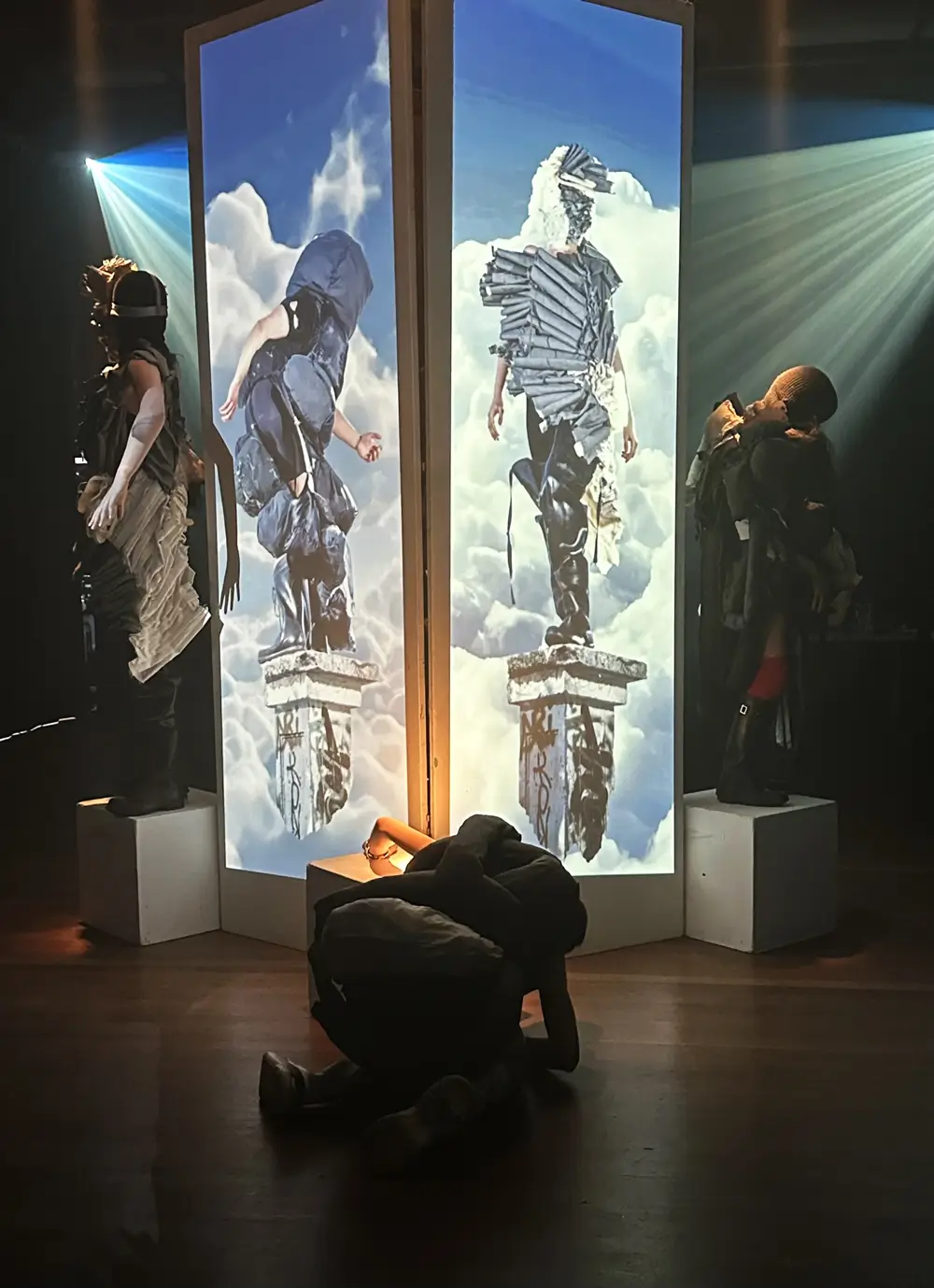
Costume design, often understood as a representational practice – one that visually articulates character, narrative, and aesthetic cohesion – for me, encompasses more than mere ornamentation: it pulses as a form of artistic research – a way of thinking with the body, with materials, and with the messy intricacies of socio-political structures. Over fifteen years of teaching at the Academy of Theatre and Dance (ATD) in Amsterdam, my practice has evolved into what I term regenerative artistic research: an embodied, improvisational method rooted in queer pedagogy, radical material reuse, and the urgent creation of spaces for other(ed) bodies. My approach is inherently personal – as a queer and gender-fluid costume designer raised in theatre – and arises from a refusal to view bodies as fixed, knowable entities. Instead, I ask: What can bodies become inside costumes? What do costumes provoke in bodies? How might design intervene in, and reimagine, the ethical and political circumstances in which bodies appear?
My methodology centres on what I call staging coincidence – a practice that embraces the unexpected and the intuitive. Rather than starting with fixed concepts or predetermined aesthetic objectives, I craft environments where unplanned connections, material surprises, and embodied discoveries can happen. This philosophy underpins one of my core first-year scenography courses, Hoofd Zoekt Hand (Head Seeks Hand). Students are sent out to purchase a second-hand grey suit – not as a blank canvas for an idea, but as a situation to explore. Through the slow process of dismantling and reconstructing it into a wearable item that diverges as much as possible from the human silhouette, they give in to missteps, accidents, and the resistance of materials, learning that artistic research thrives on chance rather than control. The suit, a symbol of Western patriarchy, heteronormativity, and bureaucratic power, is taken apart to reveal its hidden architecture: pad stitching, interlinings, a forgotten handkerchief, and nearly 140 individual pieces that make up a suit (Prins 2018). This hands-on engagement reflects Cornel Bierens’s view that artistic insight emerges from the interplay of head and hand (Bierens 2014). Ultimately, students understand that a garment’s value does not lie in its market price but in the embodied time, labour, and histories embedded in its material.
To contextualise this work, I read aloud an excerpt from Anne Boyer’s Garments Against Women, which foregrounds sewing as an act linked to gendered labour and structural inequality. Boyer reminds us that each garment contains “hours of women’s and children’s lives,” an observation that redefines craft as political history (Boyer 2016). Students come to see sewing as a practice intertwined with ethics, class, gender, and care. This understanding resonates with Marie-Renée Bourget Harvey’s reflection, cited by Tanja Beer, on matter “circulating” through several lives and uses – a foundational concept within ecoscenographic design (Beer 2021, 42).
Beer’s ecoscenography provides an essential framework for archiving and articulating these pedagogical methods. During a 2025 research internship, Nana Yasukawa helped organise the Hoofd Zoekt Hand and Radical Thinking course materials using Beer’s regenerative cycle of Co-creation, Celebration, and Contribution (Yasukawa 2025). In the course, co-creation emerges through collective unpicking; celebration occurs in group critiques, photoshoots, and public presentations; and contribution unfolds as costumes circulate into new communities, contexts, and interpretations.
Public encounters act as crucibles for transformation. When students wear their hybrid creations through subways or tourist sites, they become living laboratories of embodied difference. One student, whose costume had no discernible head, shoulders, or arms, appeared as a spectre to passersby – overheard but never acknowledged – highlighting how unfamiliar bodies disrupt social scripts of recognition. Another, crafting during the isolating quiet of the COVID-19 lockdown, layered transparent plastic over images of an empty Dam Square, conjuring the spectral, distanced textures of pandemic life. Such moments demonstrate that costume design extends beyond theatre; it acts as a catalyst for social inquiry, poetic disruption, and embodied world-making.
The hybrid, grotesque, and amplified forms students create align with Francesca Granata’s analysis of the “grotesque body” in contemporary fashion, which she situates within Bakhtin’s theorization of the open, ever-becoming body (Granata 2011). Such forms resist normative ideals of whiteness, thinness, ability, and gender stability. They invite experimentation with new movement vocabularies and challenge students’ assumptions about bodies – what they should look like and how they should move.
Movement is central to this pedagogical methodology. In collaboration with Maria Ines Vilasmil of ATD’s Embodied Knowledge group, we co-developed a workshop that uses padded and hybrid costumes to access what Vilasmil calls the body’s “movement archive.” Wearing costumed forms that alter weight, balance, volume, and silhouette, students discover movement possibilities otherwise inaccessible to them. Costume becomes an interlocutor rather than an accessory – an active agent shaping thought, motion, and perception.
Regeneration, in my practice, also describes how costumes travel across projects, disciplines, and political contexts. The mountain costumes I constructed from second-hand tents and raincoats for The NeverEnding Story (2016) later appeared in a performance about refugee experience, in a Glamcult photoshoot supporting Palestinian solidarity, and in environmental research meetings examining dying mountains. Each iteration transformed their meaning, showing how design participates in multiple communities of struggle and care. This approach echoes the ethos of non-commercial carnival traditions from my hometown Bergen op Zoom, where “dweil” costumes made from household scraps constitute a joyous, anti-elitist, ungendered form of performance. Such methods resonate with Jack Halberstam’s theorisation of queer failure, which reframes improvisation and nonconformity as generative political resistance (Halberstam 2011).
In her attendee reflection on my CARPA9 lecture, Hiroko Oshima noted that the session’s tone reminded her of Natalie Rogers’s principles for empathetic, psychologically safe creative environments, where exploration and uncertainty can unfold without judgment (Oshima 2025; Rogers 1993). Although this interpretation is hers rather than my own, it underscores how crucial emotional safety is when students navigate sensitive territory around identity, representation, and embodiment. My classrooms prioritise such conditions: students must have space to fail, reconsider, and revise without fear. This is particularly vital when navigating sensitive terrain around race, gender, disability, and identity in design contexts. Through embodied experimentation, students encounter – and sometimes exceed – the boundaries of social normativity. What emerges is not merely technical skill but critical, intersectional awareness.
These pedagogical commitments align with recent institutional efforts at ATD to integrate regenerative artistic research within the Scenography curriculum. A four-step structure for an artistic design process underpins the Scenography programme throughout the bachelor’s course: engaging with a fascination, conducting artistic research, conceptualising insights, and realising a design. This pedagogical framework, already present in “Hoofd Zoekt Hand,” is expanded in the Radical Thinking course, where students are encouraged to examine and articulate their own socio-political embodiment as a foundation for artistic research. While “Hoofd Zoekt Hand” begins with material unmaking and coincidence, Radical Thinking shifts the focus inward, prompting students to locate their design impulses within their lived experiences, identities, and positionalities. Both courses – though differing in method, pace, and starting point – frame design as a form of analysis rather than product, and as a process rather than an outcome.
In closing my CARPA9 lecture, I cited Anne Boyer’s resignation from The New York Times, an act that underscores the intimate entanglement of aesthetics and ethics. Rosie Elnile succinctly articulates this interdependence: “Design is a political act” (Elnile 2020). In a climate-changed world marked by structural inequality and overproduction, costume design cannot remain apolitical. Regenerative artistic research thus becomes both a pedagogical method and a form of activism: a way of imagining – and practising – more inclusive, sustainable, and compassionate futures for our bodies, our materials, and our shared world.
References
Beer, Tanja. 2021. Ecoscenography: An Introduction to Ecological Design for Performance. Cham: Palgrave Macmillan.
Bierens, Cornel. 2014. “Hoofd zoekt Hand.” De Groene Amsterdammer 14 April 2010. www.groene.nl/artikel/hoofd-zoekt-hand.
Boyer, Anne. 2016. Garments Against Women. Boise: Ahsahta Press.
Elnile, Rosie. 2020. “Design is a political act – let’s use it to reshape the future”. The Stage Magazine. www.thestage.co.uk/opinion/design-is-a-political-act–lets-use-it-to-reshape-the-future.
Granata, Francesca. 2011. “The Grotesque Body in Contemporary Fashion.” Fashion Theory 15(2): 139–166.
Halberstam, Jack. 2011. The Queer Art of Failure. Durham: Duke University Press.
Harvey, Marie-Renée Bourget. 2022. Quoted in Tanja Beer, keynote lecture, Future of Performance Design. Nicosia.
Oshima, Hiroko. 2025. Reflection on CARPA9 presentation.
Prins, Maartje. 2018. Reflection sheet. Hoofd Zoekt Hand course archive.
Rogers, Natalie. 1993. The Creative Connection: Expressive Arts as Healing. Palo Alto: Science & Behavior Books. Quoted in Hiroko Oshima’s reflection.
Yasukawa, Nana. 2025. Internship report.
Contributor
Carly Everaert
Carly Everaert is an award-winning costume scenographer. Recent projects include The Drop (D’Haus), Safe & Sorry (TDJW), and Girlswn’tbeGirls. In 2022, Carly received the Prosceniumprijs for their entire oeuvre. Carly is a teacher-researcher in the Scenography department of the Academy of Theatre and Dance in Amsterdam, where they conduct practice-based research into costume, space, and socio-political embodiment. They chair the design jury of the Nederlands Theaterfestival.