“Danser le corps-paysage” (Dancing an embodied landscape) is a movement workshop for all audiences that focuses on situated improvisation. It’s an invitation to allow movement to happen in response to our relationship with the place and with the beings we encounter, a dance with our sensory landscape. The workshop offers a creative pedagogy that activates embodied forms of ecological storytelling.
——
In recent years, my artistic practice and academic research has been focused on the relationships between moving bodies, sensory landscapes, intergenerational connections with the land, and the dances that can emerge from these relationships. The combination of these interests with my love for pedagogy has led me to develop movement workshops adapted from this practice, and I was delighted to be invited to CARPA9 to facilitate one of these workshops. This text shares a brief overview of the theoretical meshwork at the root of the workshops, and records of experience from CARPA9.
Let’s gather round, find a comfortable spot for yourself. Welcome. I’m grateful to the land for welcoming us and our practice. I’m grateful to the committee for this invitation. I’m grateful for your presence in this indoor basketball court, after this fascinating and intense first day of conferences. Welcome.
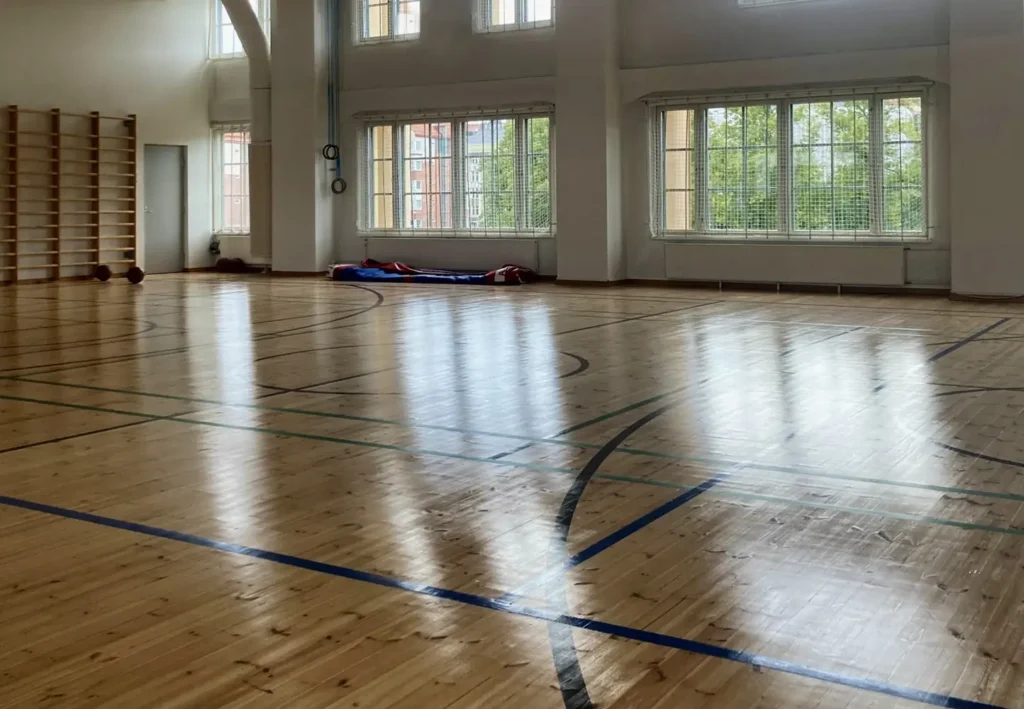
Around us, there are wall bars and piles of blue mats organised along the walls. The hardwood floors, glistening with varnish and adorned with coloured lines and curves, reflect the light that’s pouring inside from the large windows all around the room. I’ve put away the balls and opened the mesh curtains before the workshop, and we can gaze freely upon the rooftops of Helsinki.
What’s your relationship with this kind of place? What’s your relationship with this specific place? Let ideas, memories and thoughts come to you, and let them go. What can you change in your relationship with this place? Let’s find out.
Ecosensitive tracking and the crisis of attention
The current ecological crisis is often described as a crisis of attention (Citton 2014), a crisis of the readability of the world (Zhong Mengual & Morizot 2018). Learning how to read, sense and relate to our environment and the beings around us, learning how to amplify and deepen our relationship with the world, are all vital and political issues at the core of my approach.
In his books Sur la piste animale and Manières d’être vivant (Morizot 2018; 2022), Baptiste Morizot describes an approach he calls pistage écosensible (ecosensitive tracking), that enables him to reach a deep connection with his sensory landscape and create new ways of being and knowing. In my practice, I work towards amplifying my multisensory attention to be able to perceive various physical, sonic, or emotional traces (Ingold 2007) or sensory affects (Stewart 2007; 2013) embedded in the land. My relationship with these traces and affects creates movement, and I become a tracker, a hunter, whose goal is not to hunt down and kill but to re-presence and to re-embody. In her inspiring book Brading Sweetgrass (Wall Kimmerer 2013) botanist and author Robin Wall Kimmerer, member of the Potawatomi nation, weaves together western scientific knowledge, indigenous wisdom, and the teachings of plants in her work which offers an empowering example of ecological storytelling based on relationality, reciprocity, and kinship. Following this approach of radical relationality, the workshop Dancing an embodied landscape is an adaptation, an embodiment of these principles. Amplifying and deepening our senses and relational capacities through movement allows us to access what I describe as a state of embodied landscape, a specific way of being that can emerge during periods of situated dance improvisation in connection with the land (Ducros 2025). This state of body, and the movements that stem from it, are the foundations of the workshop and resonate with ecosomatic approaches (Clavel et al. 2019; Bienaise et al. 2025) that place the relationships between the body and its environment at the core of the experience.
Site-specific practices stemming from land-art and in-situ artistic movements from the second half of the 20th century allow us to tap into an infinity of experiences that connect us to our environment. The works of Don Asker, Victoria Hunter and Melanie Kloetzel have been a great source of inspiration in my research (Asker 2019; Kloetzel & Pavlik 2013; Kloetzel 2023; Hunter 2015). In the context of the workshop, the term landscape is understood as a form of sensory relationship with the land. If a visual landscape refers to the visual relationship, we can also work with sonic landscapes, olfactory landscapes, affective landscape, etc. Dancing an embodied landscape also invites me to work with the land and with a space, rather than on the land, or in a space. It is a situated practice, where the land becomes partner and teacher, guiding us towards new ways of knowing, inspired by indigenous traditions of knowledge-making (Wall Kimmerer 2013; Wall Kimmerer 2003; Betasamosake Simpson 2014; Naoufal 2020).
Let’s tune in to our sensory landscape. Are you seating, standing, lying down? What parts of your body are in contact with the floor? What’s your relationship with gravity? Notice your feet. Gently sway from side to side, then find your centre. Notice your breath, don’t change anything at first, just notice the small dance in your spine, each time you take a breath. Now breathe generously, share your air with the space and the beings around you. Notice the sensation of clothes on your skin, the temperature of the air, perhaps a draft. Notice the sounds around you, those that are close, and those that are far. Notice the shapes, colours, textures, lines, all around you. Those that have names, and those that don’t.
Let’s become extremely curious. Find your curiosity dial and turn it up to 11. Notice traces of activity, traces of presence, traces of movement in the space. Follow your curiosity and explore possible relationships with the space. Amplify the movement in the space. Be moved by past movement like an invisible river flowing around you. Disappear in the space without making yourself small. Notice the changes, inside and out.
Sharing practice as knowledge
Since 2022, I’ve been part of a research group led by UQAM professor Johanna Bienaise: “Pratiques écosomatiques en danse et performance au Québec”. Soon it became obvious that our participation to conferences and round tables would only make sense if the events allowed for hybrid, embodied presentations, braiding together theory and practice, a position we have recently defended in an article (Bienaise & Ducros 2025). We strongly believe in welcoming ecosomatic practices in academic conferences and events, not as a byproduct, not as an afterthought, not as entertainment or leisure, but as a fully realised medium to share embodied knowledge. This practice-led approach, which might have seemed obvious in the context of CARPA9, still needs to be justified in other situations.
The workshop Dancing an embodied landscape offers a caring and playful approach. No dance experience is necessary: participants were invited to move with curiosity. In the indoor basketball court, there were no cue cards, no slideshow presentations. There were no chairs, no folded legs, no screens, no notebooks, only bodies. Bodies relating in space and time, human bodies, living bodies, the former living bodies of trees in the form of hardwood floors, bodies of water seen through the window, bodies of texts still swirling in our minds, and many others. There were few words, and they were all chosen according to their potential of invitation.
The hour flies by quickly. We gather for a last moment of stillness before parting. Outdoors, the light has changed. Indoors, the entire space feels different. The air is thick with movement, like heavy cream that has been whipped, delicious and light. We now know all the lines on the floor, all the curves in the wood grain. Our relationship with the space has changed, our bodies have changed, we all have changed. Sitting in a circle, we look at each other, soft eyes, deep breaths, lingering smiles. There are invisible, embodied notes and bullet points, non-verbal somatic traces of what was discovered and experienced. The quiet conversation that concludes the workshop holds as much meaning in its silences as in the few words that are shared. It takes time to articulate a deeply somatic experience, to let events and sensations infuse and be digested before they can be transposed into language. That’s for another time.
I am immensely grateful for the flexibility of the organising committee of CARPA9 who made it possible for a second workshop at the very end of the conference, and for the presence of all the participants who showed up after three rich, stimulating, inspirational days. It is always a renewed pleasure to facilitate this practice of attention, ecosensitive tracking, radical relationality, moving with the space and being moved by the space (Bigé 2023), and to share tools that can change our relationship with the space and with ourselves. By moving through existing patterns towards new ones, we nurture new stories, new embodied ways of living and knowing.
References
Asker, Don. 2019. “Dancing the Landscape.” In Dance and the Quality of Life, edited by Karen Bond. Social Indicators Research Series. Springer International Publishing.
Betasamosake Simpson, Leanne. 2014. “Land as Pedagogy: Nishnaabeg Intelligence and Rebellious Transformation.” Decolonization: Indigeneity, Education & Society 3(3).
Bienaise, Johanna, and Germain Ducros. 2025. “Des Traces Qui Nous Habitent : Réflexions Autour d’un Atelier Écosomatique.” Percées 14.
Bienaise, Johanna, Germain Ducros, Camille Renarhd, Mélissa Raymond, Alice Blanchet-Gavouyère, Mathi LP. 2025. “Devenir Avec l’environnement : Pratiques Attentionnelles de Mise En Relation En Danse et Performance Au Québec.” Percées 13.
Bigé, Emma. 2023. Mouvementements: Écopolitiques de La Danse. La Découverte.
Citton, Yves. 2014. Pour Une Écologie de l’attention. Seuil.
Clavel, Joanne, Isabelle Ginot, and Marie Bardet. 2019. Écosomatiques : penser l’écologie depuis le geste. Éditions Deuxième époque.
Ducros, Germain. 2025. “Pistage Écosensible et Danse Située : Jalons d’une Approche et Récit de Pratique.” Australian Journal of French Studies 62(3–4): 264–274. doi.org/doi:10.3828/ajfs.2025.22.
Hunter, Victoria. 2015. Moving Sites: Investigating Site-Specific Dance Performance. Routledge.
Ingold, Tim. 2007. Lines: A Brief History. Routledge.
Kloetzel, Melanie. 2023. “Danse in Situ et Éthique Environnementale : Des Champs Relationnels à l’ère de l’Anthropocène.” Recherches En Danse, ahead of print. doi.org/10.4000/danse.5634.
Kloetzel, Melanie, and Carolyn Pavlik. 2013. Site Dance: Choreographers and the Lure of Alternative Spaces. University Press of Florida.
Morizot, Baptiste. 2018. Sur la piste animale. Babel ; 1758. Actes sud.
Morizot, Baptiste. 2022. Manières d’être vivant: enquêtes sur la vie à travers nous. Babel. Actes sud.
Naoufal, Nayla. 2020. “Le paysage comme pédagogie : Danser Sápmi / Landscape as Pedagogy: Dancing Sápmi.” esse arts + opinions 98: 60–67.
Stewart, Kathleen. 2007. Ordinary Affects. Duke University Press.
Stewart, Kathleen. 2013. “Regionality.” Geographical Review 103(2): 275–84.
Wall Kimmerer, Robin. 2003. Gathering Moss: A Natural and Cultural History of Mosses. Oregon State University Press.
Wall Kimmerer, Robin. 2013. Braiding Sweetgrass: Indigenous Wisdom, Scientific Knowledge and the Teachings of Plants. Milkweed editions.
Zhong Mengual, Estelle, and Baptiste Morizot. 2018. “L’illisibilité Du Paysage.” Nouvelle Revue d’esthétique 22(2). doi.org/10.3917/nre.022.0087.
Contributor
Germain Ducros
Germain Ducros is a dance artist, researcher and PhD candidate based in Montreal, Quebec. He is interested in the possible relationships between sensory landscape, sensitive body and the territory it inhabits. After ten years teaching languages in France, he moved to Quebec to begin a PhD in Art Studies and Practices. Initiated in 2021, his doctoral research-creation at Université du Québec à Montréal revolves around the concept of corps-territoire. Germain Ducros is also a facilitator of movement workshops, multifaceted performer, and occasional lecturer.