Introduction
This presentation is a visual case study of the design process for the University of Toronto’s Centre for Drama, Theatre and Performance Studies (CDTPS) production of The Trials by Dawn King (2022). Referencing The Theatre Green Book; Issue 01, Educational Edition (Happold & Renew Culture 2021), this production successfully integrated sustainable design practices into an academic drama program with limited financial and human resources. This practical experiment also examines the requirements for achieving sustainable performance in a smaller, traditional theatre setting, touching on how the findings can be applied to professional practice in Canada. I contributed to the production as a set and costume designer and as a design professor; thus, my presentation also addresses the teaching methods used to support this low-carbon-emission production.
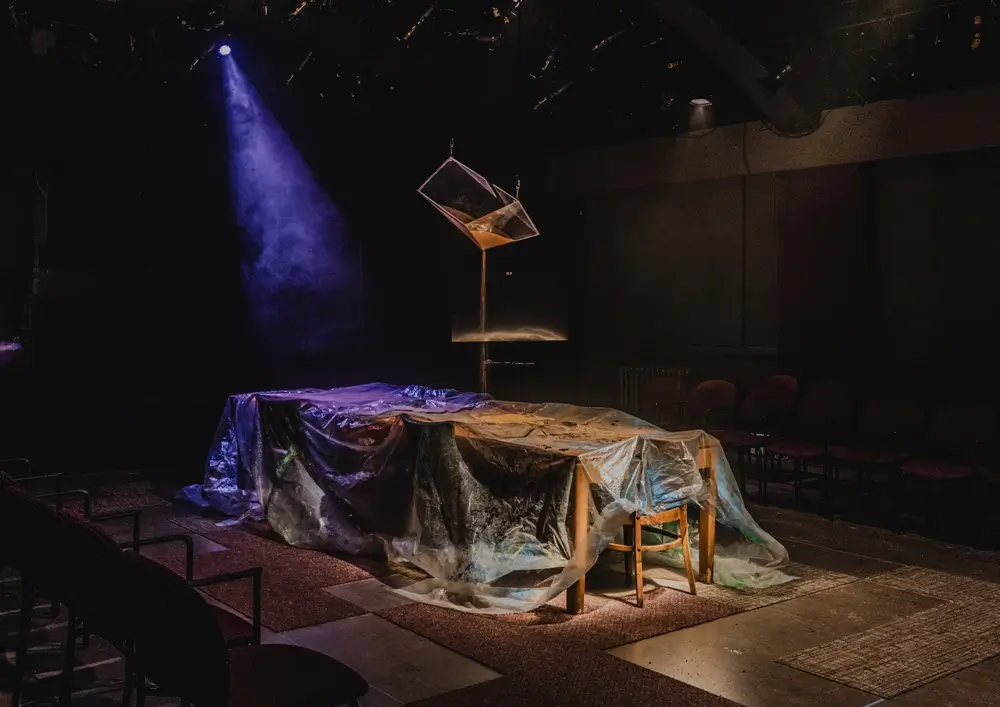
Initiation of the ecologically sustainable design process
From my perspective as both an academic and a freelance scenographer, I have observed a discrepancy between students’ ecological awareness, international efforts in performance sustainability, and the day-to-day practices of Canadian theatre companies still not attuned to these contemporary currents. The environmentally friendly approach that my cohort and I brought to The Trials stemmed from this observation, along with my personal research interests and efforts to foster ecological consciousness among Canadian design students and emerging theatre artists, providing them with tools to catalyze change. This production also represented my first hands-on attempt to create ecologically viable design in a traditional theatre space. With its practical approach, this project examined what it takes to achieve sustainable performance in a theatre and how, in the long run, the findings and experiences from this practical exercise could be implemented in work within the Canadian and global theatre industry.
Beyond these professional and academic goals, the play itself called for such an approach. The Trials (King 2022) isa dystopian story about ecological responsibility and eco-justice. Set in the near future, during an unfolding global catastrophe, the play concerns a group of people who go on trial for their roles in the climate crisis, judged after their actions are retroactively declared “crime”. The play follows a jury of teenagers as they struggle to cope with the environmental chaos created by their elders. With such a narrative at its core, thescript spurred the play’s director and the rest of the creative team to adopt an ecologically sustainable approach.
Production resources
For this undertaking to be fully understood, it is vital to address the resources and the structure of the University of Toronto drama program and the Mainstage production. The presentation explains this setup in the introductory section.
Dawn King’s play The Trials, directed by Andrew Kushner, was produced in the academic year 2023–2024 as a Mainstage performance at the Centre for Drama, Theatre and Performance Studies (CDTPS) at the University of Toronto. The production opened in March 2024 and was performed in front of an audience eight times. The Mainstage production assembles 20–35 students per year, gathered from three courses: the cast is drawn from a fourth-year acting course (DRM403: Mainstage Performance), taught by the show’s director; students in a technical theatre course (DRM455: Production II), instructed by the department’s technical director, provides show’s technical support and running crew; while the set and costume design aspect of the performance are partially developed and executed by participants in the third-year design course (DRM354: Design II), under my supervision and mentorship. Students taking the design course are directly involved in the design aspects of the production as set and costume design assistants, researchers and builders. Typically, the show’s director is an experienced professional and a sessional instructor, while the lighting and sound designers are emerging artists who have limited contact with the student body.
The Mainstage performances take place in a small proscenium theatre that can be partially modified for different stage configurations. For The Trials, the proscenium and trust (horseshoe) configurations have been combined, allowing for 80 audience members. The play featured 14 characters played by ten actors. Overall, the costume and set budget for this performance was $3,000 CAD (approximately $1,000 US or 950 Euros per discipline). Besides a small carpentry shop and significant costume and set storage, CDTPS does not have sewing, painting, or dying facilities. Most design activities are performed in a classroom-like space or in the theatre. In essence, many CDTPS productions rely heavily on existing storage and already meet certain ecological standards in set and costume design. However, The Trials production deviated from the standard design process within the department due to its conscientious commitment to implementing and teaching eco-sustainability, as well as an attempt to track and quantify results.
References
The design process and teaching plan for this production were primarily developed by referencing The Theatre Green Book; Issue 01, Educational Edition (Happold & Renew Culture 2021). The publication served as an illustrative step-by-step guide through the process. The design team followed the essential principles outlined by this source: creating more with less, recycling and reusing, shopping with awareness, reducing travel and transportation, eschewing harmful chemicals, and ensuring that everything is used again. Formulating clear design goals and an action plan further defined the course structure, objectives, and methodology for both the design process and the course. The students were also asked to familiarize themselves with Tanja Beer’s (2021) coined term “ecoscenography” and to understand the concept of applying ecological thinking scholastically across the design disciplines.
Design beginnings and approach
While committing to sustainable design practice and creating an action plan to fulfill this goal, the creative process began in the most conventional way – with reading and analyzing the play and understanding the director’s vision. Understanding space objectives, time, place, and characters still played a crucial role in the design process. In this case, the play called for two distinct areas (the jury room and the defendant’s area), and the director was interested in merging indoor and outdoor spaces, as well as reality and abstraction. While respecting these parameters, aiming for a sustainable design process demanded a much higher level of design flexibility and establishing an understanding among all creatives that the design would be driven by sustainability principles, rather than solely by artistic vision. For example, the set colours were not pre-determined; instead, the director and I discussed our inspirations, desired materials, and moods. In the process, our desires were adjusted to accommodate availability, cost, and sustainability factors. Unlike the typical design process, design conception was finalized after sourcing the material and other design elements. Working in this manner allowed for these acquired scenic elements to influence and dictate the final design. This approach to conceptualizing sets or costumes in this production is one of the most significant differences between the conventional design process and sustainable design practices. Additionally, incorporating ecological considerations also requires a higher level of flexibility in the director’s approach, which is atypical in professional settings.
Design process
Next, the presentation explains the eco-conscious design process on The Trials, broken down into three phases:
1. Organization:
- Setting sustainability as the production objective
- Researching sustainable design methods
- Creating an action plan
- Creating an outline/preliminary concept of the sustainable design
- Researching the availability of materials, potential scenery, and costumes
- Collaboration: Extensive planning process with the team and communication throughout
2. Implementation of Ecologically Viable Design:
- Continuous research of sustainable design methods and experimentation
- Flexibility in design throughout the execution
- Creation of a local network: sourcing used materials, scenery, and costumes from local theatres, theatre schools, and other organizations
- Partner with organizations committed to sustainability
- Use found objects and materials as part of the design
- Extensive borrowing and renting
- Recycling, reusing, and upcycling existing clothing and scenery (Most of the scenery and costume alterations were temporary, due to the rental/borrowing factor)
- Reversible costume alterations and breakdown
- Second-hand shopping; limited use of virgin materials
- Minimum delivery and transportation
- Limited use of toxic chemicals (some dyes); researching and experimenting with eco-friendly dyes, paints, and alternatives to aerosols
3. Post-Production:
- Securing the afterlife and running returns of all design elements used in performance
- Measuring outcomes
- Sharing gained knowledge within our department, the university, and beyond
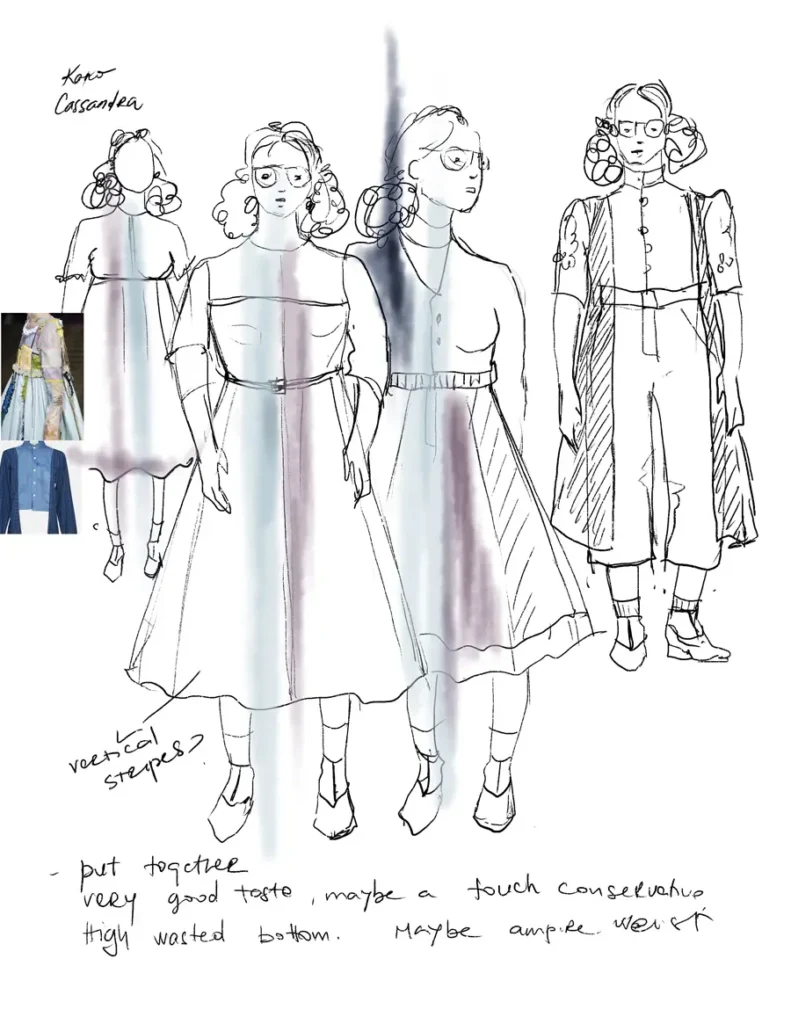
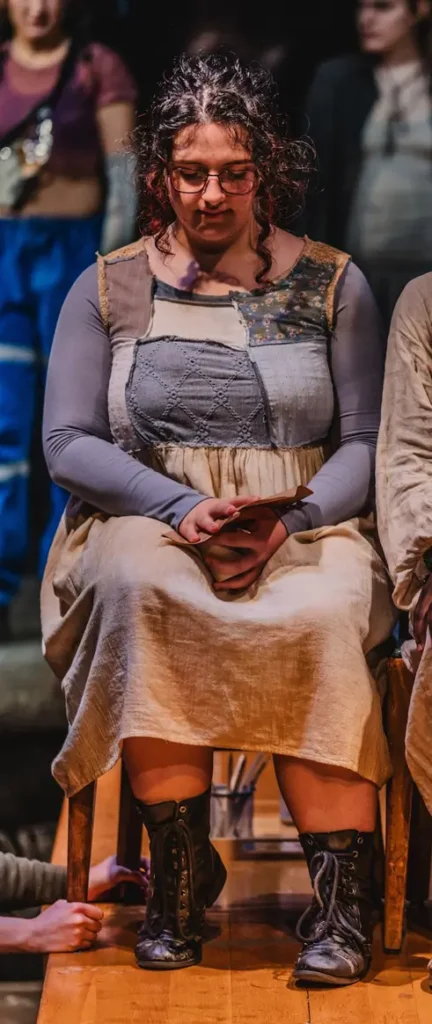
Summarizing set and costume sustainability level
Based on theTheatre Green Book’s guidelines on measuring sustainability standards (Happold & Renew Culture 2021, 28), The Trials achieved an intermediate level of production sustainability:
The Trials production (Intermediate Sustainability Level)
- 85–90% of all materials come from reused or recycled sources
- 100% of them go on to have future lives through storage or re-use
- 10% of materials are harmful or unsustainable (synthetic dyes)
- Minimum use of transportation: three online purchases in total
Teaching methods and course structure
The presentation continues with a breakdown of the teaching approach specific to The Trials production:
The DRM354: Design II course is based on student-centred, collaborative learning methods, outlined with a few course parameters and production goals. My role is to teach specific practical skills and facilitate individual learning, collaborate with and mentor students throughout the process, and give them a taste of what it is like to be involved in a professional theatre production. This is a three-month-long Winter Term course that supports Mainstage production throughout its implementation and running phases. Initial meetings with the director, production planning, and design are typically finalized before the beginning of the course.
In Winter Term 2024, the course enrolled five students. Each student served as a Set and Costume Assistant Designer for The Trials, and one of them also worked as a Prop Master. These students worked on the production during class time (approximately 48 hours) and were obliged to contribute an additional 25–30 hours outside of class. This Mainstage Production was their major project within the course and accounted for 45% of the mark. Student assessments are based on participation, teamwork, critical thinking, research, communication, and execution.
Given that design flexibility was a necessity of the sustainable approach, The Trials production allowed for significant student input and intervention throughout the design execution phase. Unlike leading design students through the traditional design process, collaborating with them on this production gave them more agency and freedom to interpret the design, while remaining in close communication with me. To start the process, I provided the students with rough sketches of costumes and an unfinished set model, allowing for design changes and asking for their assistance in finalizing designs. I also relied on students’ visible interest in eco-sustainability, which led to refined research on sustainable techniques and materials, and on their ability to self-initiate an action based on their personal research. The ecology-related research was more practical and thus a deviation from the typical practice in this course, where most of the research component was conducted by me before the design process. In this case, the students were research leaders, conducting experiments and continuing the research process throughout the production period, with my supervision.
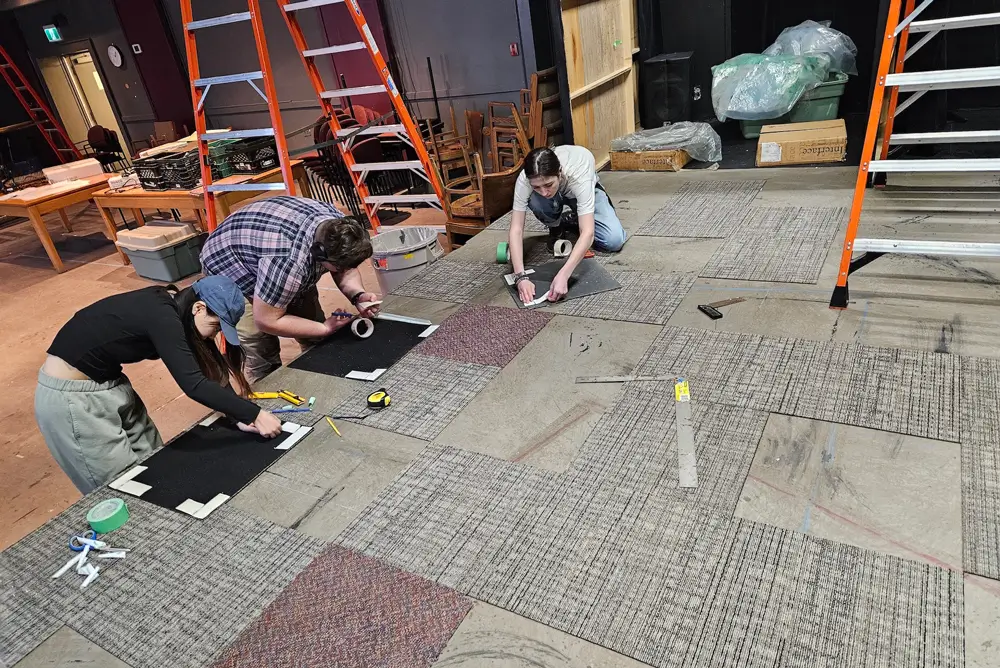
Student activity
Set and Props:
- Scenic painting
- Installation of set pieces: sustainably sourced plexiglass and carpet tiles
- Creating a cardboard prototype of an abstract set element (“send clock”), and an ecological replacement for sand
- Research on eco-friendly, impermanent approaches to frosting plexiglass
- Research on aerosol replacements
- Sourcing sustainable materials for props, researching techniques of prop-making and eventually, prop execution (for example, collapsible lunchboxes)
- Creation of running props (food/“power bars”)
Costume:
- Learning to sew, stitch, and use a sewing machine and serger before working on actual costumes. (Most of the students did not have any previous experience before this class.)
- Each student worked on two full costumes, based on my sketches, from sourcing materials to creating the final garment. This included work on costume alterations, patchwork, stitching, costume dying and painting, leading fittings, artistic breakdown of garments etc.
- Extensive research on natural dyes. (Our experiments yielded partial successes.)
Findings
This presentation concludes with a summary of observations regarding the process and potential for working sustainably in a professional setting:
Students as initiators of the change
I discovered the value of addressing sustainability throughout the course and teaching the topic through a theatre lens. There is a significant interest in eco-practices among the student body. Students (and future theatre practitioners) are more inclined to incorporate an ecologically viable design process into their theatre practice and to adapt to it than most creatives and staff in larger theatre institutions.
Working outside of a traditional hierarchical system
A lean creative and production team, where I, as a designer and faculty member, had significant power to initiate an ecological design approach, is highly deserving of the process’s success. Arguably, achieving this level of sustainability would be significantly harder in traditional theatre hierarchies and within much larger production teams.
Planning and support
A low-carbon footprint design process requires longer, more careful planning and the full support of the entire creative and production team. Without the director Andrew Kushner’s support and adaptability, working sustainably would have been entirely impossible. As the flexibility and adjustability of the design and its responsiveness to sourced materials and objects are among the main factors in the success of a sustainable process, the director and the production team need to agree on a certain level of uncertainty, change, and improvisation in their planning and in the overall design and direction process.
Increase in human labour in eco-sustainable processes
From the initial planning stages to a slower, manual production process and limited shopping, to securing the afterlife of all scenography elements, eco-sustainable theatre production in a traditional theatre setting is a longer, far more labour-intensive process – and therefore more expensive – in all aspects of production. In The Trials production, a significant amount of this labour was performed by students as part of their education. In a typical Canadian professional setting, particularly in larger houses and/or commercial theatres, the entire theatre setup would become unsustainable for ecological viability. Together with the other production roles, the viability and value of the designer’s work would have to be reassessed. This is, in my opinion, the most significant discrepancy between this controlled process in an educational environment and working in a professional setting. Having worked in professional theatres across Canada, I would argue that the design approach I employed on The Trails production would be suitable and feasible for some smaller-scale productions with budgetary constraints and relatively small creative teams that lack traditional theatre hierarchies.
Conclusion
Based on this first-hand design and teaching experience, designing sets and costumes for a traditional theatre space within a university is achievable. In essence, it requires dedication to the goal, an intensive planning process, lean production and creative teams, and somewhat modified educational methods. By contrast, this labour-intensive process also showed that introducing sustainability to professional theatres requires a significant transformation regarding how we think about and produce performances, from the theatre company’s structure and traditional hierarchies to budgeting models and work-life balance. Knowing what it takes, the question remains: how to start a conversation about sustainability within the well-oiled machines of major Canadian (English-speaking) theatres?
While this presentation does not provide an answer to this question, it does address some potential options and allow for discussion. It is still our responsibility as a community to address the environmental crisis through our work and to apply the best ecological practices whenever possible – and small steps are better than stillness. Designing The Trials production while collaborating with students brought me a step closer to the solution, or at least made me more hopeful and gave me ideas.
First, after this design experience in a smaller, proscenium theatre, I concluded that it is potentially less challenging to start eco-sustainable conversations within smaller to mid-sized independent companies, given their less rigid labour structures, smaller production teams, and commonly smaller productions.
Second, taking small steps and achieving some level of sustainability is better than making no effort at all. In the larger theatres, moving down the hierarchical scale and approaching your director or shop managers to accommodate some of your ecological routines may be feasible, even if that means just fewer shopping trips. It may be a good starting point, since talking to producers and production managers of these venues about the environmental impact of our work is complex and intimidating, even for the most established designers.
The third and most encouraging conclusion from The Trials project is that the upcoming generation of theatre artists appears motivated to start these difficult conversations and drive theatre’s environmental evolution. It proved to me that all of us who have contact with these theatre students and emerging artists are obligated to mentor or formally educate them about the ecological impacts of our profession, introduce them to some possibilities, and provide them with the tools to start this dialogue.
Bibliography
Beer, T. 2021. Ecoscenography: An Introduction to Ecological Design for Performance (1st ed.). Singapore: Palgrave Macmillan.
Happold, B, and Renew Culture Ltd. 2021. The Theatre Green Book, Issue 1, Educational Edition. theatregreenbook.com.
Happold, B and Renew Culture Ltd. 2024. The Theatre Green Book Version 2 [online] theatregreenbook.com.
King, D. 2022. The Trials. 1st ed. London: Nick Hern Books.
Note: The Theatre Green Book, Issue 1, Educational Edition is no longer available.
Contributor
Snežana Pešić
Snežana Pešić is an award-winning scenographer, multidisciplinary artist and educator. Based in Toronto, she is an assistant professor of performance design at the University of Toronto’s Centre for Drama, Theatre and Performance Studies. Pešić presented her work across Canada and internationally.