A year after my article “Putting the Theatre Green Book in Practice: sustainability, pedagogy and the Theatre Green Book” (Downton 2024) was published, I was delighted to have the chance to speak about the research at CARPA9. Not only did it offer me the opportunity to reflect and carefully consider the impact that this paper has had on both my work as an educator and practitioner but it also prompted thoughts regarding the context in which the paper had been written and the period leading up to it. Preparing for CARPA9 urged me to look closely at significant experiences and threshold concepts that had led me to the point of conducting the research and also to its impact and legacy. This is an overview of the symposium presentation.
Background: Another man’s treasure?
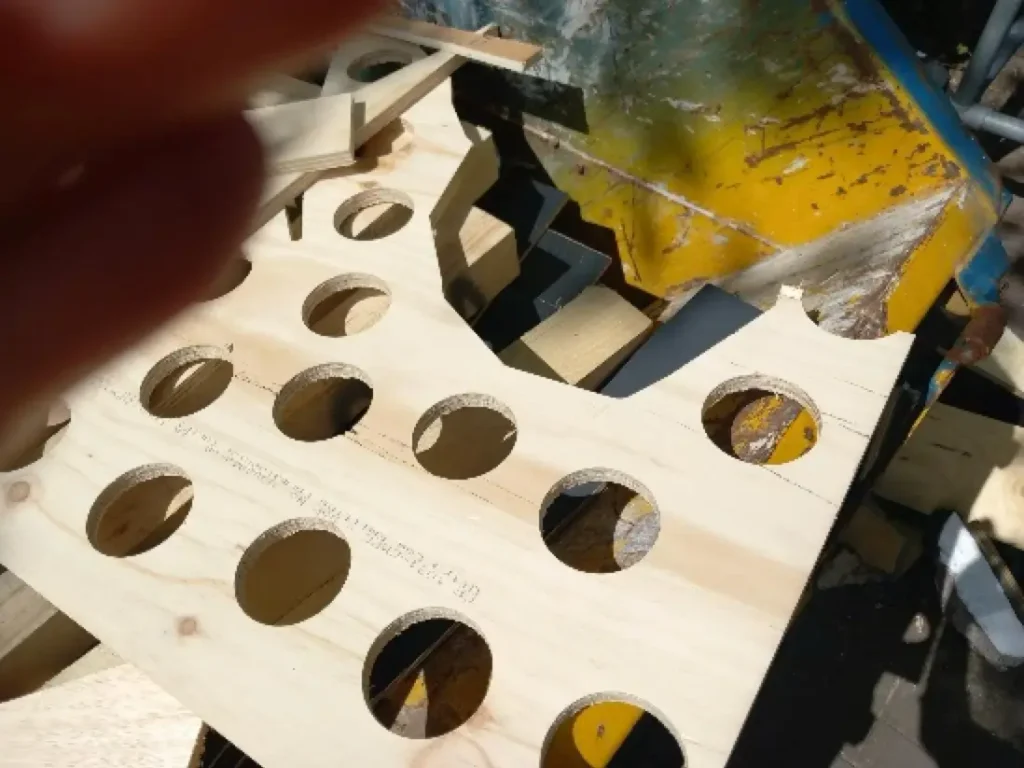
Having worked in commercial set building companies for many years as a scenic painter I witnessed the disposal of barely used virgin materials that were being considered “waste”. Whilst new advanced methods such as CNC (Computer Numerical Control) cutting reduced the time needed to cut holes in a ply for example, poor planning and a “throw away” culture led to an increase of “waste” compared to more traditional hand tool methods. Seeing precious materials being skipped and wasteful practices being normalised urged me to consider alternatives and question current practice.
In addition to my professional practice I have always maintained strong links and active participation in the education of theatre practice in acknowledgement of the symbiotic nature of industry and education. While working in the apprenticeship sector I was lucky enough to assess and observe many technical theatre apprentices in the workplace, and what I saw was interesting. The apprenticeship framework for the Technical Theatre course in 2014 included a knowledge criteria that was based on environmental sustainability; that was the first time I had seen that as a learning outcome in a theatre production course. These young apprentices were questioning their employers about their sustainability credentials and policies, and essentially prompting them to address sustainability in their theatres. That was when I realised that the new generation of theatre makers were going to be the agents of change: they were going to change the industry from the bottom up.
Fast forward 5 years and when I took my current role as Theatre Production Lecturer at the Guildford School of Acting, my focus was getting sustainable practice into curricula and productions. After getting involved with a few initiatives and setting up a Theatre Educators Sustainability group, we became aware of the Theatre Green Book (TGB) in its early stages. The education group got an early look and offered to trial it within their institutions. Finally we had a robust and comprehensive guide to sustainable productions to share with our colleagues and students and it was a turning point for sustainability in theatre education.
I am sure that you are familiar with the TGB but for those of you that aren’t it was written collectively by industry for industry and is a comprehensive framework of how to produce theatre more sustainably , and provides different levels for productions to aim for; Basic, Intermediate and Advanced. In order to achieve Basic 50% of your materials must have had a previous life and 65% go on to have another life. For Intermediate it is 60% and 70% and Advanced it is 75% and 80%. There are various tools to support this such as the Production Calculator[1] and the Materials Hierarchy[2].
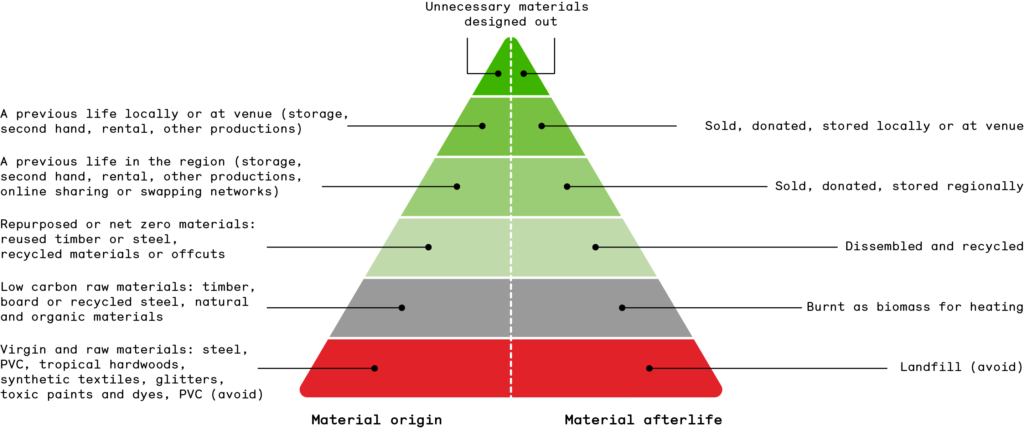
Essentially it is about eco-efficiency but there are lots of other brilliant ideas about how to embed sustainable practice throughout the production, from suggested contract wording for creatives to the inclusion of the “Green Card” meeting to discuss the design from a sustainability perspective. Within a year the Education group had become the TGB Education Group and it is now the TGB Education Committee that I continue to convene.
At this stage we had about 25 educators in the group from the UK and a few international members from Australia and Hong Kong. What became clear from these meetings was that the same challenges were being highlighted again and again, the people coming to these meetings were motivated and engaged with the sustainability in production movement, but this didn’t always reflect the broader view within the institution and a deeper dive was needed to find out what could be done to support educators.
Investigation: Educating with the Theatre Green Book
The research itself centred around 4 semi- structured interviews that were conducted with theatre production educators that taught on a undergraduate technical theatre course in the UK. They had to have attended a TGB Education meeting, have working knowledge of the framework, and be from an industry background. They were questioned regarding their application of the TGB into their respective institutions both from an academic and productions perspective.
The interviews were anonymous so interviewees were able to comfortably disclose anything that may be relevant, but in order to document what educators were saying in the PUBLIC domain it was decided to include the transcripts for three TGB Education meetings too. Obviously any comments included were anonymous for the purposes of the paper, but they were comments made publicly at the time in front of the TGB education group.
They were grouped into meaning units and a series of themes came through across the interviews and transcripts, some of which I will now briefly discuss.
Working collaboratively
“I don’t think there is a lot of joined up thinking yet across the college.”
Meeting 2 2023 (Downton 2024, 432.)
This theme included visibility, working groups and committees and the notion of silo working. The practice of universities having “Core Pillars” or “Strategic Pillars” that included sustainability was mentioned many times, but this wasn’t necessarily filtering down to the productions. Sometime these meetings were positive for visibility, but sometimes they essentially created a “tick box” culture that distracted from the reality of what was happening on productions.
Storage
“Someone would have to be there with a truck ready to go at the exact moment, you got to be there at 2.00 on Tuesday otherwise it won’t work.”
Interview C 2023 (Downton 2024, 433.)
Challenges regarding storage were mentioned many times but some local solutions had been found. For example a college had arranged some extra storage with the local council that could then redistribute set items to local schools etc. This was just one person doing this in their own time however and extra time being allocated to arrange these sort of things was also discussed. It became clear that in order to fully implement circularity and address lack of storage through passing on items, time would need to be allocated to staff and students.
Time
“The hours we do are sometimes 70 hours a week, for 3 or 4 weeks at a time, the idea of redesigning or implementing a new strategy at the moment is very, very difficult.”
Interview C 2023 (Downton 2024, 434.)
Time is always a precious commodity in drama schools, for example at Guildford School of Acting (GSA) we produce between 20–25 shows a year in order to facilitate the many performing courses that need set, lighting and sound. The TGB is very clear about the need to allocate time in the production process to discuss and research methods and materials, but the educators in this study were not seeing this happen.
Creatives and creative phase
We started off this year with fantastic intentions, and introduced lots of things from the Theatre Green Book, we wanted to bring in the concept of the Green Card. The thing that got squeezed out was the new process of the Green Card meeting.
Meeting 2 2023 (Downton 2024, 436.)
One educator said that the Green Card Meeting was the first thing to go when they were short of time. Interestingly in my own experience it is actually more likely to save time in the long-run, due to early confirmation of processes and being clear regarding the parameters from a sustainability perspective.
Senior Leadership
Senior management really embraced it, and it changed everything – they offered us carbon literacy training, and it changed the way I thought, which is a powerful thing. Some students did it (carbon literacy training) as well as staff and that started the change with management on board.
Meeting 3 2023 (Downton 2024, 436.)
We had some really positive comments about how the senior leadership can implement change and there were some interesting conversations about carbon literacy training and how this motivates and empowers staff to engage with sustainability initiatives. The TGB requires staff to be carbon literacy trained to achieve intermediate standard and this is even more important in theatrical education environments as it cascades down to the students.
Transition phase
“I am hell-bent on getting sustainability into our revalidation and that is the crucial political key that it is, to turn to the production staff and go ‘but we have to engage with this because it is a student learning outcome’. That is leverage.”
Interview B 2023 (Downton 2024, 436.)
This theme included changing jobs, changes in leadership and revalidation. There was a real feeling that there were opportunities for development during periods of change as well as limitations regarding staff work load. Revalidation periods as many of you know, offer the opportunity to change learning outcomes and wording in a syllabus, but these windows may only be open every five years or so.
Student influence
“We have a design course, and I must say that its student designers who are far more open to designing sustainably than visiting professionals.”
Meeting 3 2023 (Downton 2024, 436.)
The desire and drive of students to implement change came up again and again. The two interviewees that primarily used student designers due to having in-house design courses felt that student designers were happy to work with the TGB method; however, the other interviewees that largely worked with external designers generally found it more challenging. It also shows the time-lag between a student being introduced to this concept and the potential professional application of these skills when they join the future workforce.
Recommendations from the research
It is so important to engage and empower staff. Theatre educators are so used to being experts in their field and there is a feeling of overwhelm when this whole new system is introduced and they are expected to deliver and understand it. The online Theatre Green Book webinars are free and I can highly recommend them, and there are also links for contextualised Carbon Literacy training for staff and students.
Instigate collaborative thinking
Do this by seeing what other people are doing across your institution. What are the student society, estates or other faculties doing? Through the Institute for Sustainability at Surrey where I am a Fellow we have discovered and connected with a range of interesting and motivated individuals and initiatives in the local area and formed positive and productive networks.
Include sustainability in learning outcomes
This is certainly a political key. Having sat on revalidation panels this year I can wholeheartedly say this is happening and will be firmly in place for many institutions by next academic year. There is a time lag but we will get there. Embedding in your academic delivery is the easy bit, applying in a practical sense is the hard bit. Changing the way an institution has run for years is incredibly hard. It may take a revalidation to help guide the process.
Actions and legacy work
The Theatre Green Book Education Conference 2024.
The TGB are already leading and running many free professional training webinars which are a fantastic resource for teachers and staff alike. However to really get into the detail for educators we put together an online conference specifically for educators that included content such as international case studies, an employers panel, and a pedagogy focussing on learning outcomes. We also broadened the conversation to include how the TGB might be taught in Secondary (High) school and I think you will agree that the earlier we start embedding this into creative industries teaching the better. All of the seminars were recorded and are available on the TGB website, so please do access them and share them with colleagues and associates.
Advanced on a GSA season
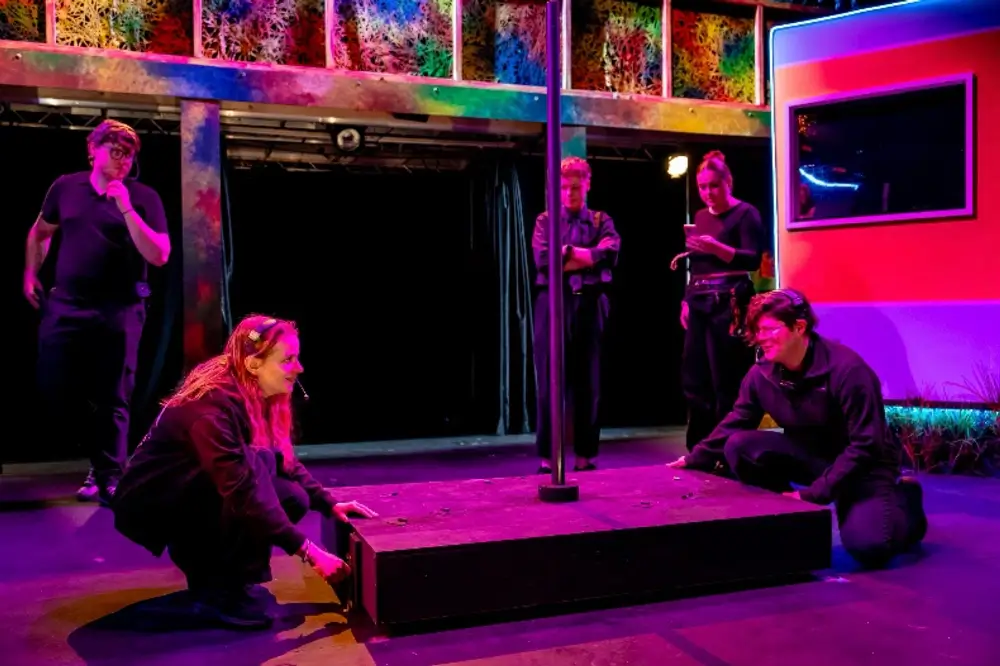
By implementing some of these recommendations and using the research as a springboard for change, GSA achieved “Advanced” TGB standard on two shows last year. This was largely due to the Designer Jennifer Taillefer implementing the TGB at every stage of the design and production process, the directors being on-board and flexible and the students being able to apply their TGB knowledge and skills by completing the production calculators throughout. New methods were instigated by Taillefer such as “styling” the costumes by simply pulling out suitable garments from GSA’s extensive wardrobe department, and trusting the knowledgeable team to make style decisions based on Taillefers detailed design drawings and mood boards. Taillefer also engaged in a “stock familiarisation” visit in order to utilise GSA’s extensive scenic stock and furniture store. Even in a busy conservatoire environment with high commercial expectations; it would seem that “everything we need is already here” (Beer et al. 2024, 476); something that Tanja Beer has been trying to tell the theatre world for a decade.
Modular scenery sessions
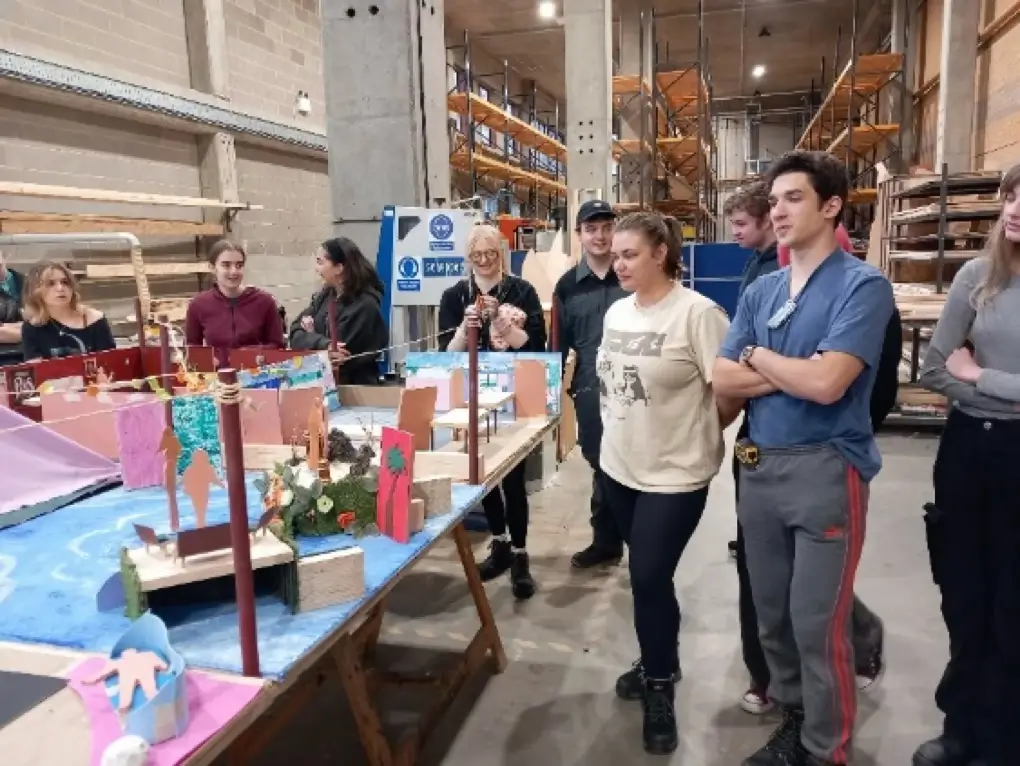
To further support collaborative thinking in theatre education courses we are planning to share some open access session plans for the TGB website such as a session that we ran at GSA. By exploring design methodologies and practical problem solving using 1:10 models and exploring the numerous iterations that are possible with a finite amount of scenic elements; Production Arts students (stage managers, lighting and sound technicians and design realisation trainees) were encouraged to see that parameters don’t mean a curtailment of creativity. The TGB is very clear that “everyone has a part to play” in the sustainability journey and it is essential that all future theatre makers are engaged and responsible for producing theatre in an ethical and sustainable way.
Notes
1 Theatre Green Book. nd. “Theatre Green Book Sustainable Productions toolkit” Production Calculator, Theatre Green Book V2. Productions Calculator | Theatre Green Book accessed 23/10/25.
2 Theatre Green Book. nd. “Theatre Green Book Sustainable Productions toolkit” [online] theatregreenbook.com/sustainableproductions-toolkit accessed 23/10/25.
Theatre Green Book. nd. Materials Hierarchy. “Detailed Guidance” [online] TGB_v2_Productions accessed 26/10/25.
References
Tanja Beer, Tessa Rixon, Ian Garrett, and Angela Goh. 2024. “Embedding ecoscenography into performance design pedagogy: three practice based approaches.” Theatre, Dance and Performance Training 15(3), 472–494. doi.org/10.1080/19443927.2024.2345609.
Happold, Buro, and Renew Culture Ltd. 2024. The Theatre Green Book Version 2 [online] theatregreenbook.com accessed 23/10/25.
Downton, Katy. 2024. “Putting the Theatre Green Book into practice: sustainability, pedagogy and the conservatoire.” Theatre, Dance and Performance Training 15(3): 429–444. doi.org/10.1080/19443927.2024.2380840.
Theatre Green Book. nd. “Theatre Green Book Sustainable Productions toolkit” [online] theatregreenbook.com/sustainableproductions-toolkit/. Accessed 23/10/25.
Contributor
Katy Downton
Katy Downton is a Senior Lecturer in Theatre Production at the Guilford School of Acting specialising in sustainable working practices. She convenes the Theatre Green Book Education Panel and sits on the steering committee for the Theatre Green Book Sustainable Productions. She is a Fellow of the Institute for Sustainability at the University of Surrey, and co-leads their Sustainability, Creativity & Communication Programme.