…On the table, on the screen, passing round, from hand to hand, touching materials and paper, fragments of my ongoing research….
Costuming the Collapse (CtC) is a post-qualitative and posthuman investigation into the degradation of the natural environment through performance costume, and it delves into the intricate relationship between performance art and environmental degradation within the climate collapse, highlighting the urgent need for sustainable practices in the realm of costume. This research aims to explore the (dis)connection individuals experience with the natural world through tangible, practical outcomes that reflect ecologically considerate costuming inquiries. By employing post humanist perspectives, my enquiry emphasises the responses to the climate collapse from both human and more-than-human viewpoints, fostering a deeper understanding of our interconnectedness with the environment.
Robin Wall Kimmerer in the book Braiding Sweetgrass (2013, 117), whilst introducing students to digging for roots in the soil around a white spruce tree, explains.
“Digging spruce roots takes you someplace else. The map in the ground asks you over and over, Which root to take? Which is the scenic route, which is the dead end? The roots may spread out like a map, but a map only helps if you know where you want to go. Some roots branch. Some break. …Which route to take? Isn’t that always the question?”
(Wall Kimmerer 2013, 117.)
Throughout the presentation, I showcased three key pieces of my PhD work so far, each offering a unique perspective on costume, creativity, and collaboration.
The roots of inquiry
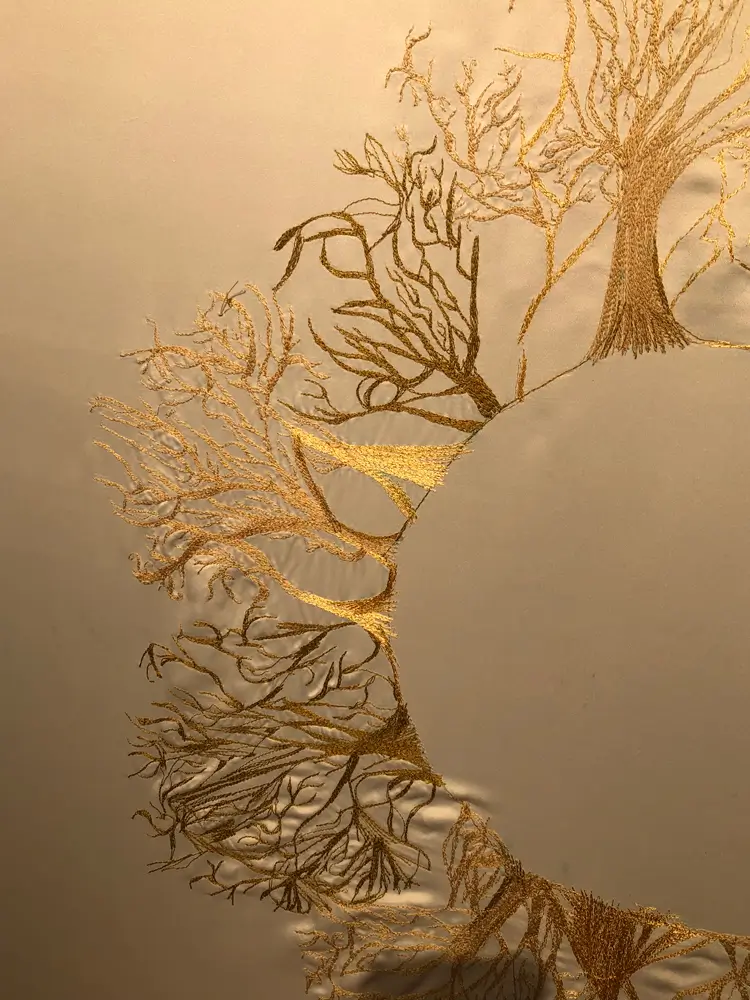
(RE)Root, features free-motion machine embroidery and measured approximately 1.5 metres square. This work, inspired by the visual representation of mycelial networks, functions as both a map and a diagram that illustrates the complex interconnections characterising my creative process. Like the spruce roots discussed by Robin Wall Kimmerer, the piece symbolises the mycelium spreading through soil, representing connections and points of juncture that allow deeper meanings to emerge from these nodes within my research. Approaching research with a mindset of interconnectedness and respect for the various options, like the roots of the white spruce in a forest, where each choice is part of a larger, more complex web. My research isn’t linear with a start, middle and end; coming from a non-academic background and using my work as a costume practitioner as my way in, to finding roots (or routes) that seem instinctual and natural where more traditional research approaches and methodology focused routes do not.
Postqualitative inquiry leans on the poststructuralist perspectives that challenge traditional qualitative research paradigms, disrupts normalised binaries that separate ontology and epistemology as theory is worked to force multiple understandings. It is through Elizabeth St. Pierre, Tracy Young et al. and Karin Murris that the dense and sometimes impenetrable theory that comes with the concepts and paradigms around postqualitative Inquiry have now become so entangled in my making.
Tracy Young, Sarah Crinall, and Karen Malone in their paper Disruptions of Post-Qualitative Education Research: Tensions and Openings; written to support students and supervisors, and to encourage researchers using PQI to “take theoretical and methodological risks, use inventive methods or processes, and adopt emerging concepts as ways to think/sense/flow with the inquiry.” (2021, 313). It is this risk taking and flow that has inspired me so much in my own practice.
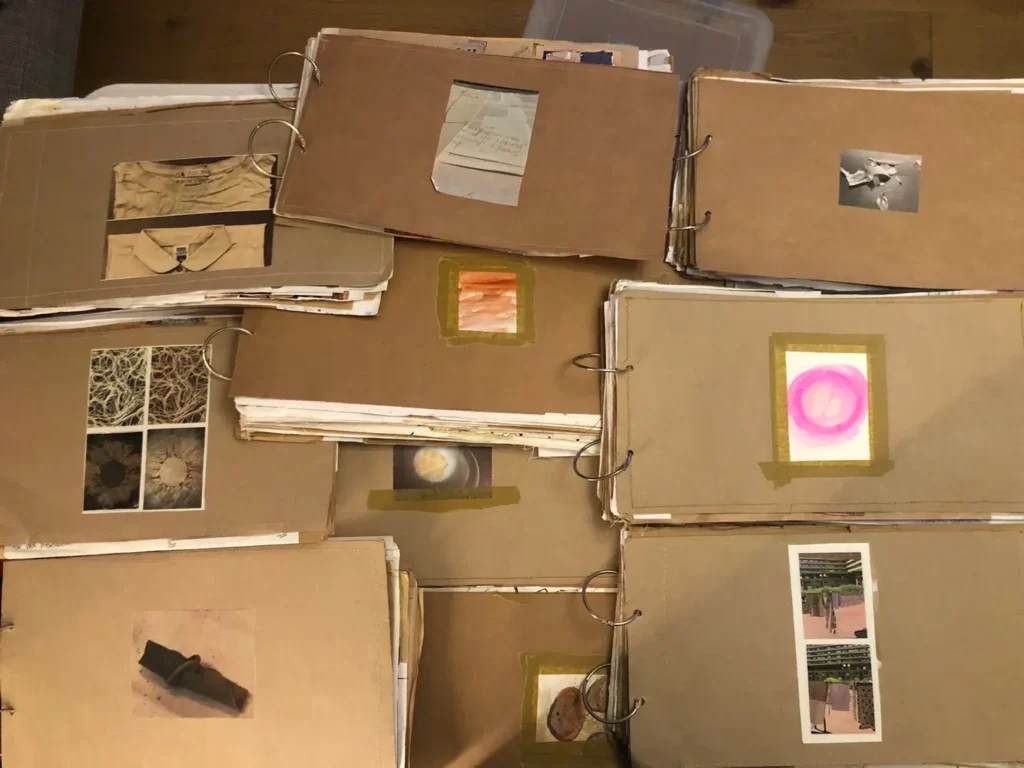
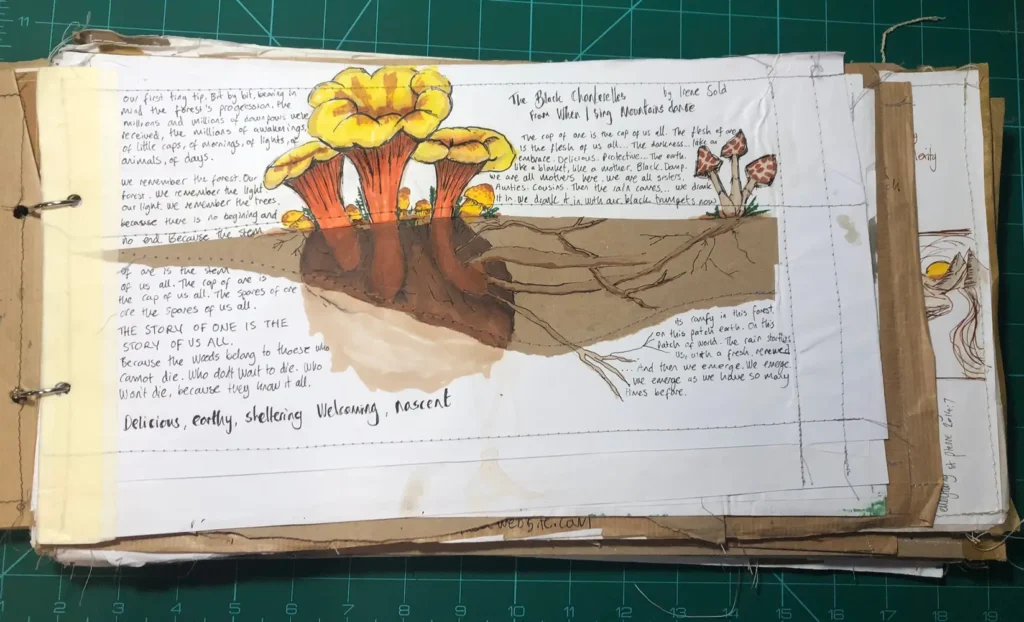
My PhD is multifaceted, and I document my journey through Stitchbooks, which are constructed from paper, the fundamental material for a costume maker. The Stitchbooks encompass patterns and designs from shows at Guildhall, students remade patterns (with the permission of the students) and represent a constantly evolving collaboration between myself and the materials of my craft, serving as a medium for experimentation and contemplation. Like the stitchbooks my investigation is constantly evolving through the materials.
The material
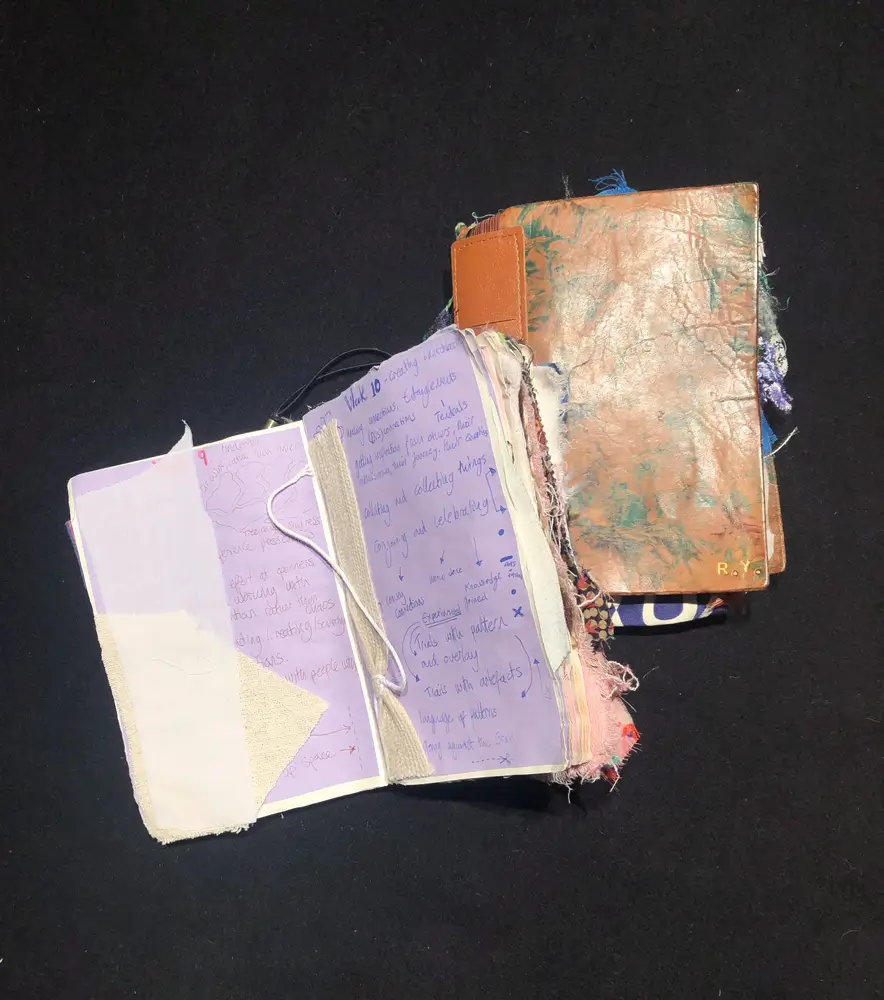
Another aspect of my work presented were two smaller paper notebooks with fabric samples attached to each page. These are what I’m calling my 365-week notebooks or (RE)Material and these contain one fabric sample for each week of the process of my PHD which I worked out would be 365 weeks. Alongside each fabric sample is a journal entry for that week, documenting, sketching and developing ideas as they grow. These are a tapestry of experiences, emotions and connections journaling my process.
These notebooks were originally inspired by textile tokens and billet books from the London Foundling Museum. The billet books, contain scraps of fabric given as tokens by parents (mostly mothers) to the London Foundling Hospital between 1740 and 1770, symbolising the hope for reunion with their children.
Taken from the book Threads of Feeling by John Styles he explains;
The fabric samples from the London Foundling Hospital offer a glimpse into the lives of those who were part of this institution. They provide a tangible connection to the past, allowing us to appreciate the delicate nature of the fabric, the depth of colour and detail in the patterns, and the marks of haste and urgency. These fabric samples are not just pieces of cloth; they are threads that weave together stories of love, loss, and hope.
In addition to the billet books, I am influenced by costume professionals, supervisors, designers, and my costume students, all of whom utilise paper notebooks to collect and combine ideas, images, sketches, and diagrams. In these abundant notes and samples they represent the potential energy of costumes, some made, some in progress, and some never realised.
The more-than-human
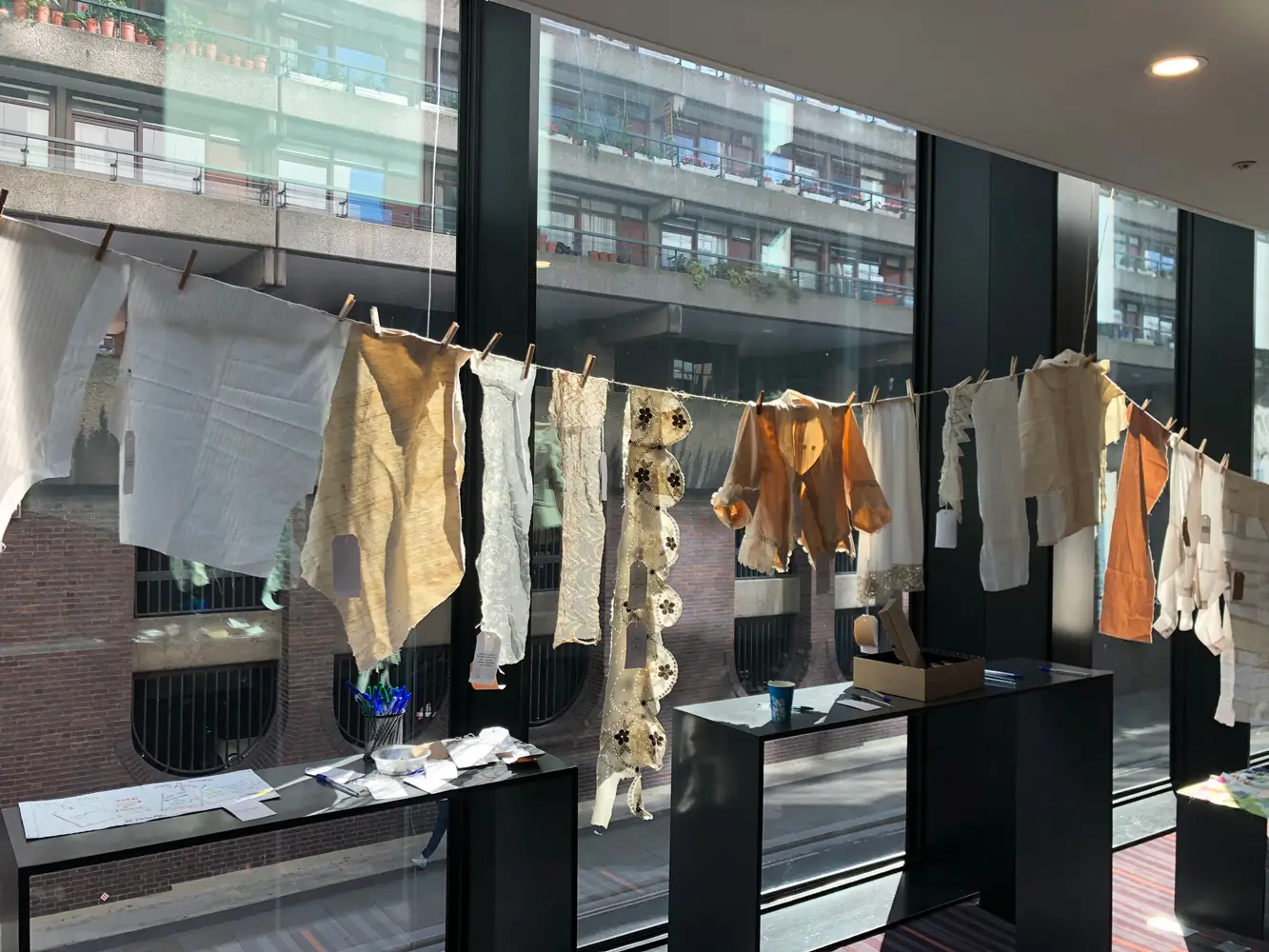
Finally, I presented a piece titled “The Line of Stories” A washing line that represents a tapestry of stories, highlighting the tactile qualities of the materials and costumes. The items displayed, include shirts that have been unpicked, antique lace, costumes and costumes at the end of their life, as well as my embroidery map from earlier. Originally, the piece was planned for human interaction. However, as is often the case, nature has taken its own course.
Now, this installation embraces the concept of co-collaboration with non-human elements. The wind gently moves the fabric, while various creatures engage with the installation, fostering a dynamic dialogue between the materials and their surroundings, the sunlight, the shadows and so much more.
Through this piece, human participants were invited to “not just peer but interfere” (Hacking 1983, 6), reflect and play with the materials, garments, and the natural world surrounding it. By immersing themselves in the delicate dance, and discovering the unseen, the beauty of the ephemeral, and the profound impact of the wind and air on our shared human and more-than-human interactions. The materials used, carefully selected for their texture, weight, and drape, respond to the movement of air, creating a dynamic visual dialogue.
This piece serves as a reminder of the interconnectedness of all living things and the significant role of the environment in shaping our creative expressions. It encourages us to reflect on how our practices are influenced by the world around us and how we, in turn, impact that world.
This piece was most recently installed as part of the trans virtual centre of excellence symposium at Guildhall in July that encouraged people to approach it as a line of stories as a way of connecting to the material with given prompts, ideas and questions. For this symposium the material washing line was installed inside with the light beaming through (On one of the hottest days of the year in the UK) and created wonderful shadow, depth and darkness on the materials.
The presentation was concluded with a video of the installation set up in the Fens in Cambridgeshire, UK, illustrating the interactions with trees and insects, the sunlight dancing across the fabric, and the sounds of the surrounding environment. The pulling of the unfinished edges on the grass and trees surrounding.
References
Hacking, Ian. 1983. Representing and Intervening: Introductory Topics in the Philosophy of Natural Science. Cambridge: Cambridge University Press.
Murris, K., ed. 2021. A Glossary for Doing Postqualitative, New Materialist and Critical Posthumanist Research Across Disciplines. London: Routledge. ISBN 9780367484699.
Murris, K., ed. 2021. Navigating the Postqualitative, New Materialist and Critical Posthumanist Terrain Across Disciplines: An Introductory Guide. 1st ed. Abingdon: Routledge.
St. Pierre, E. A. 2021. “Why Post Qualitative Inquiry?” Qualitative Inquiry 27(2): 163–166. SAGE Publications.
Styles, John. 2010. Threads of Feeling: The London Foundling Hospital’s Textile Tokens, 1740–1770. The Foundling Museum.
Young, Tracy, Sarah Crinall, and Karen Malone. 2021. “Disruptions of Post-Qualitative Education Research: Tensions and Openings.” Sage Journals 28(3-4). doi.org/10.1177/10778004211038255.
Wall Kimmerer, Robin. 2013. Braiding Sweetgrass: Indigenous Wisdom, Scientific Knowledge, and the Teachings of Plants. Minneapolis: Milkweed Editions.
Contributor
Rachel Young
Rachel Young is a PHD Candidate at the Guildhall School of Music and Drama in London. Rachel is also Head of Costume at Guildhall and runs a three-year BA (Hons) degree programme in Production Arts specialising in Costume. Rachel is a costume professional, predominantly in Costume Making. Rachel.young(at)gsmd.ac.uk PHD Instagram page @CTCthePHD.