Drawing on Doreen Massey’s insight that landscapes “cannot be disciplined” (2006), this workshop explored collective storytelling by engaging with surroundings as active participants rather than passive backdrops. Merging spatial and writing practices through participants’ embodied experience, the workshop embraced an anti-methodological approach that invited the unexpected to emerge through material and sensory attunement to what the site and its inhabitants were already telling us. Facilitated by a performance score and documented in booklets specifically crafted for the workshop, participants moved through three phases that progressively expanded collaborative clusters. The process culminated in a collectively produced text of four paragraphs – a heterogeneous textural assemblage integrating verbal and nonverbal documentation alongside the site’s visible and invisible features as collaborative voices. Through this posthuman framework – merging our research on practice-based posthuman phenomenology of place (Elena Peytchinska) and synthetic fiction (Thomas Ballhausen) – the workshop enacted the site itself as an active coauthor, decentering human authorial control.
Situating our practice within language-based artistic research
Situated within the field of language-based artistic research, our practice engages writing as a material and performative method of inquiry that extends into spatial and posthuman domains. We approach text not as a vehicle for meaning but as a dynamic, material practice that generates knowledge through the conditions of its production. Within this framework, our practice unfolds along four key characteristics that reimagine writing beyond literary convention and foreground language as an active, mediating force within artistic inquiry – a position also shaped by broader histories of media and cultural production.
First, we consider writing to be an embodied and performative event. Rather than approaching text as an outcome, we understand it as a trace of actions embedded in temporal conditions. Writing implicates the body through rhythm, resistance, and the physical engagement of inscription, producing knowledge in the moment of its articulation.
Second, we approach writing as a spatial practice. A text is not simply placed on a material or medial surface; it generates spatial relations through the medium that carries it. The page, the screen, or any other surface becomes an active field of orientation where meaning is shaped through the entanglement of placement, position, proximity, distance, and rhythm. One recurrent method in our collaboration is writing by transposition[1]: the act of relocating an existing text into a new medial or environmental context. Through such shifts – across media, formats, and settings – meaning is unsettled and reconstituted, revealing how medial and material configurations participate in the text’s becoming.
Third, we understand text as an assemblage of material entanglements. Language manifests as inscription, texture, interference, or glitch, and the technological conditions of its appearance co-produce its meaning. What might appear as malfunction or error becomes an active agent in the work’s articulation. In this expanded sense, text encompasses not only linguistic forms but also diagrammatic, visual, and sonic traces – marks that record gestures of thought through material means. This perspective is further informed by ecocritical approaches that examine the correspondences between what Laurence Buell calls the “word-world” and the “actual world,” or more precisely, “the matching or non-matching of wordscape and worldscape that takes quite varied forms” (Buell 2005, 39). Material ecocriticism challenges this differentiation by considering the articulation of matter not only in a text but as a text (Iovino & Oppermann 2014, 2). Thus, “mattertext” describes the text-body embedded in world-matter (Ağin 2018).
Finally, our practice involves the design of operators – entities that act within the work much like literary characters, endowed with perceptual or cognitive capacities distinct from our own. Drawing on the philosophical tradition of thinking through conceptual personae (Deleuze and Guattari), and particularly on Michel Serres’s figures and Donna Haraway’s figurations, we consider fiction a method of knowledge production. These operators allow us to explore domains that exceed the human scale, acting as speculative instruments for navigating what lies beyond the immediate reach of perception and understanding.
Extending this approach toward other-than-human epistemologies requires acknowledging the limits of our anthropomorphic perception. How can nonhuman entities participate in multispecies collectives without being subsumed under human-morphic categories of meaning-making? Can a landscape possess a “voice” that we do not define as such through our anthropocentric apparatus of sensing the world? In this context, the notion of strategic anthropomorphism, as used in ecocriticism, offers a critical framework for approaching nonhumans on their own terms while recognizing the productive constraints of human cognition and the potential for collaboration that emerges within them – a collaboration grounded in the value of difference rather than similarity or reciprocity (Peytchinska 2026, forthcoming; Peytchinska 2025).
Research frameworks: Posthuman phenomenology of place and synthetic fiction
In the context of this workshop and its underlying research trajectory, we draw on the frameworks of practice-based posthuman phenomenology of place and synthetic fiction to extend the four characteristics outlined above into spatial and narrative practice. Both approaches share an interest in engaging with nonhuman agencies as active participants in processes of knowing and meaning-making. Within the workshop, these frameworks intersected to articulate a mode of collective storytelling that operates through attunement, material responsiveness, and co-authorship with the site itself.
Notes on practice-based posthuman phenomenology of place
Unlike classical phenomenology, which privileges human consciousness as the locus of spatial perception, a posthuman phenomenological approach to place begins elsewhere. Emerging from posthumanist thought – which challenges the human as the sole locus of perception and agency – this approach reconceives subjectivity as distributed across human and nonhuman assemblages. It expands perception beyond the human sensorium, which in turn reshapes the understanding of space as a relational and material practice co-constituted with nonhuman agencies. In this view, landscapes are not objects to be observed but processes we participate in – shared temporalities of matter, texture, and movement; they are durations rather than surfaces, dynamic ecologies that tell stories together with more-than-human coauthors. This reorientation draws on several theoretical frameworks that inform our understanding of spatial experience as an embodied, material, and more-than-human practice. Central among them are Doreen Massey’s conception of landscape and place as events, Astrida Neimanis’s and Stacy Alaimo’s feminist materialisms of corporeal interrelation, Michel Serres’s figure of randonnée as an anti-method of embodied knowledge production, and Salomé Voegelin’s sonic experience of space. Together, these perspectives open complementary ways of rethinking how place, perception, and agency intertwine – grounding our workshop’s emphasis on attunement, movement, and collective authorship.
Doreen Massey’s work offers a key foundation for rethinking spatial experience as processual and dynamic. In Landscape as a Provocation (2006), building on her earlier formulations of place and space as relational and always under construction (A Global Sense of Place, 1991; For Space, 2005), she redefines landscape as a spatial formation in movement – an event rather than a surface. Drawing on Barbara Bender’s claim that “landscapes refuse to be disciplined” (Massey 2006, 34), Massey shows how landscapes unsettle disciplinary and conceptual divides between nature and culture, materiality and meaning. As hybrid assemblages of forces, inscriptions, and histories, they are constantly emergent terrains where multiple narratives and material processes co-occur – a “provisionally intertwined simultaneity of ongoing, unfinished stories” (Massey 2006, 46). This notion of the undisciplined landscape directly informs our workshop’s approach to collective storytelling as an event coauthored by site and participants.
Extending Massey’s conception of spatial relations into corporeal experience, Astrida Neimanis and Stacy Alaimo articulate a feminist materialist understanding of human and more-than-human entanglement. Neimanis proposes that we are not merely in relation to watery environments but are bodies of water – porous, fluid, and co-constituted through movement, exchange, and flow, part of what she calls a “more-than-human hydrocommons” (Neimanis 2017, 2). Alaimo’s framework of trans-corporeality similarly emphasizes the intermeshing of human corporeality with more-than-human nature, describing a “contact zone” where the substances of the human and the environment continually traverse one another (Alaimo 2008, 297–298). This framework opens an epistemological and ethical space that accounts for the often unpredictable, even unwanted, actions that emerge through such crossings – whether between bodies, environments, or technologies (Alaimo 2010, 3). In our workshop, this understanding of corporeal permeability and shared materiality resonates with participants’ practices of attunement and co-creation, where writing, sensing, and movement unfolded as relational acts within a living environment.
The anti-methodological orientation of the workshop’s approach finds its philosophical roots in Michel Serres’s concept of randonnée, which emerges as both a theoretical orientation and a methodological figure of embodied knowledge production. First introduced in Hermès V: Le passage du nord-ouest (1980) as a metaphor for navigating between the exact and the human sciences, randonnée later evolves in The Five Senses (1985) into an embodied mode of spatial engagement and knowledge production. The term derives from the Old French courir à randon, a hunting phrase describing the erratic flight of prey, and shares its etymological root with the English random. This trace of linguistic turbulence already signals a mode of motion that is unpredictable, wandering, and shaped by chance. For Serres, randonnée designates not the negation of method but its radical multiplication: a movement that exceeds procedural logic and reorients knowledge toward improvisation, encounter, and responsiveness. As Christopher Watkin observes, echoing Harari and Bell, Serres’s randonnée is an anti-method “not because it denies all method […], but because it […] multiplies the Cartesian methodical straight line to the extent that it becomes functionally indiscernible from aleatory movement” (Watkin 2020, 97; Harari & Bell 1982, xxxvi). Randonnée therefore stands for an epistemology practiced through the body in motion – an approach that engages with the world not from above but from within, accepting its “sumptuous disorder” and working with its materials, resistances, and surprises (Watkin 2020, 96). Alongside randonnée, Serres introduces in The Five Senses two further figures of spatial experience: paysage and visite (Serres 1983, 259–340). The former is not a static vista but a field of singularities, topological and experiential; the latter resists the detached gaze of the observer, offering instead a mode of encounter that is intimate, situated, and contingent.
Salomé Voegelin’s writing on listening expands these spatial and embodied considerations into the sonic field. In Sonic Possible Worlds (2021), she proposes that sound reveals the landscape as a temporal and relational event rather than a fixed image, granting “access to the mobility of its own production” (Voegelin 2021, 34). Listening thus becomes a mode of spatial knowing – an encounter that is immersive, contingent, and co-constituted between listener and environment. This sonic attentiveness echoes the phenomenological and material frameworks outlined above, transforming perception into participation.
Brought into dialogue, these frameworks reorient spatial practice toward inquiry rather than mastery. They ask: What happens when theory walks, listens, and writes with its surroundings? How does knowledge take shape through detour, permeability, and resonance? Where does authorship reside when the landscape itself becomes a meaning-making body?
Synthetic fiction
Thomas Ballhausen’s framework of synthetic fiction focuses on the examination of human–machine collaborations in the creation of new artistic works, as well as in the development, reconstruction, and completion of fragmented cultural artefacts. Building on preliminary work between Mozarteum University Salzburg and Research Studios Austria[2], it discusses the further development of a distributed, process-oriented, and iterative production method. This approach deviates from the limitation of AI in co-creative processes: the notion of an enslaved agent conceived purely as a tool is replaced by a reflexive examination of agency. The development of the synthetic fiction framework discussed here is characterized by the active inclusion of generative AI in the process as an actor. This shift – made necessary by technological, philosophical, and pedagogical developments – allows for a more precise description and implementation of iterative production methods in the development of tailor-made digital objects. The underlying process draws on aspects of the Scrum methodology, in which refinement of the desired result is achieved not only through a non-linear workflow but also through the structured exchange of tasks and responsibilities among participants during the predefined steps of the respective process. Synthetic fiction entails not only the need for comprehensive contextual and cultural knowledge in the work process but also the consideration of technological and ethical implications. The described practice calls for future skills that extend beyond pure application competencies and encompass hermeneutic, epistemological, archival, and ethical dimensions.
In this workshop, the iterative, non-linear methodology of synthetic fiction – with its emphasis on task-swapping and distributed responsibilities – finds expression in the workshop’s three-phase process, where individual attunement, pair collaboration, and group composition create space for unexpected narrative emergences. The workshop’s documentation methods – combining words, non-words, material traces, and sonic notations – mirror synthetic fiction’s integration of diverse media forms, while the final collective assembly of micro-stories reflects the framework’s commitment to processual rather than product-oriented creation. In this sense, this extension of synthetic fiction becomes a strategy of posthuman phenomenology of narration, foregrounding the language work through which spaces and their inhabitants co-author meaning beyond human-centered discourse.
Workshop methodology: Site-specific writing and performance scores
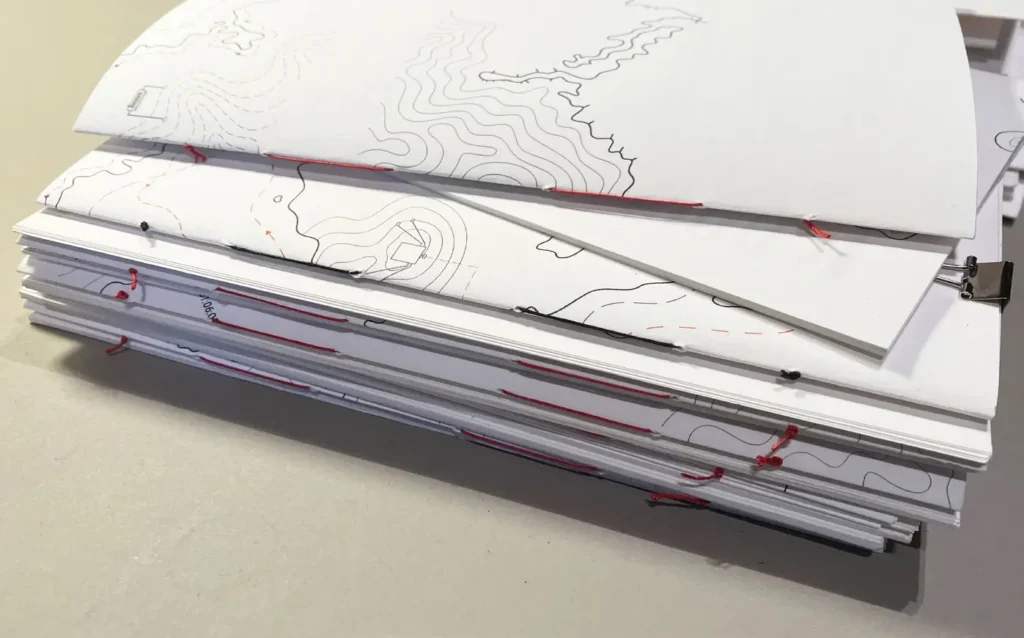
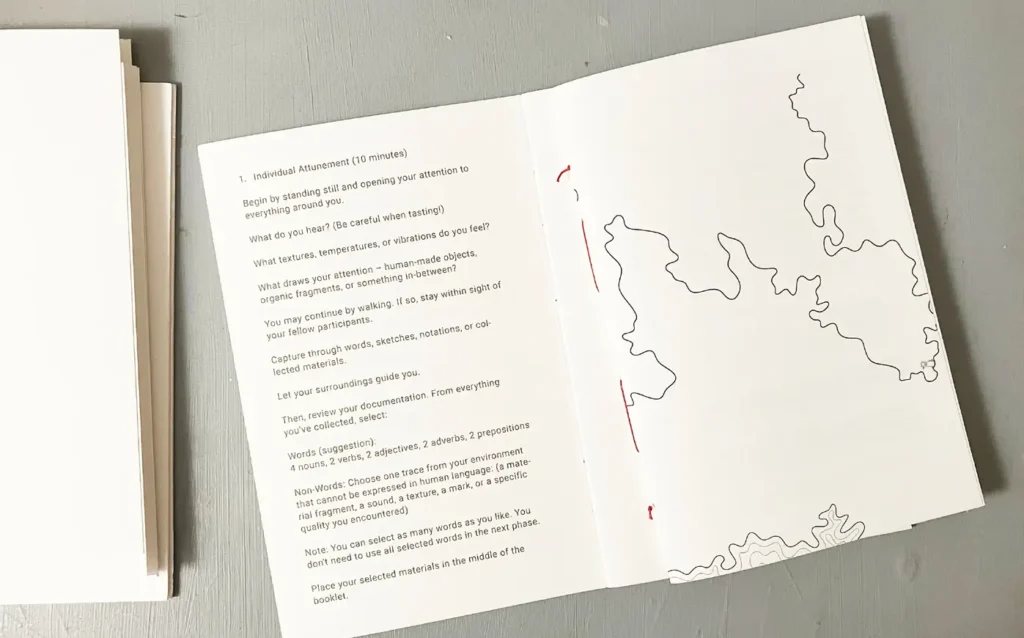
At the outset of the workshop, each participant received a hand-crafted booklet made from recycled print samples of a previous project. We combined different paper types and textures – varying in density, grain, and shades of white – so that each booklet presented a distinct spatial condition. These variations shaped how participants wrote, drew, and attached found materials, allowing the medium itself to intervene in the process of documentation. The booklets thus became unique terrains of exploration: ecological, tactile, and interpretive extensions of the site. Functioning as portable studio spaces, they invited participants to document their experience through writing, drawing, notation, or the collection of tangible and intangible materials – transforming the act of documentation into a form of spatial co-composition. Within these pages, the workshop site and its materials inscribed themselves through gestures of encounter, transposing the booklet into a living cartography of the event’s unfolding.
A booklet is itself a site: its paper surface, folds, and blank intervals generate topographies of encounter. Writing within it becomes spacing – a performative act of walking across the page, not to occupy but to invent space (Ballhausen & Peytchinska 2024, 34). As a case in point, Georges Perec’s spatial taxonomy in Espèces d’espaces (1974) begins with the book page. Perec further reminds us that writing materializes through the process of its own becoming (Perec 2000, 21). In Johanna Drucker’s view, the page is never static but “a scene of forces and vectors” in balance, where “the first words placed define the space” (Drucker 2013, 3–4). Each mark, then, is a gesture of orientation.
In this sense, the booklet acts as both a document and a terrain – where words, textures, and traces coexist as equal participants. The act of writing within it reconfigures authorship as a movement from point de vue [point of view] toward point de vie [point of life] (Aït-Touati et al. 2019, 51; Coccia 2018, 34): not a view from outside, but a practice lived amidst the environment it describes (Ballhausen & Peytchinska 2024, 34). The booklet thus performs a double gesture – it documents the site while simultaneously producing it.
The temporal activation of the workshop unfolded through a set of prompts, composed in the tradition of performance scores, which invited participants into a sequence of attunement, collaboration, and composition.
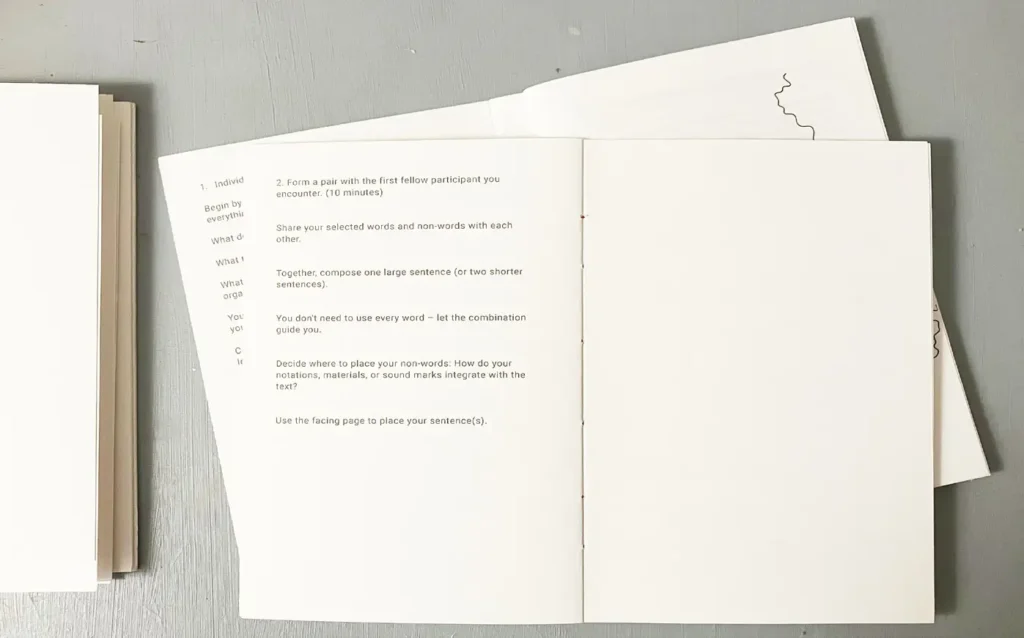
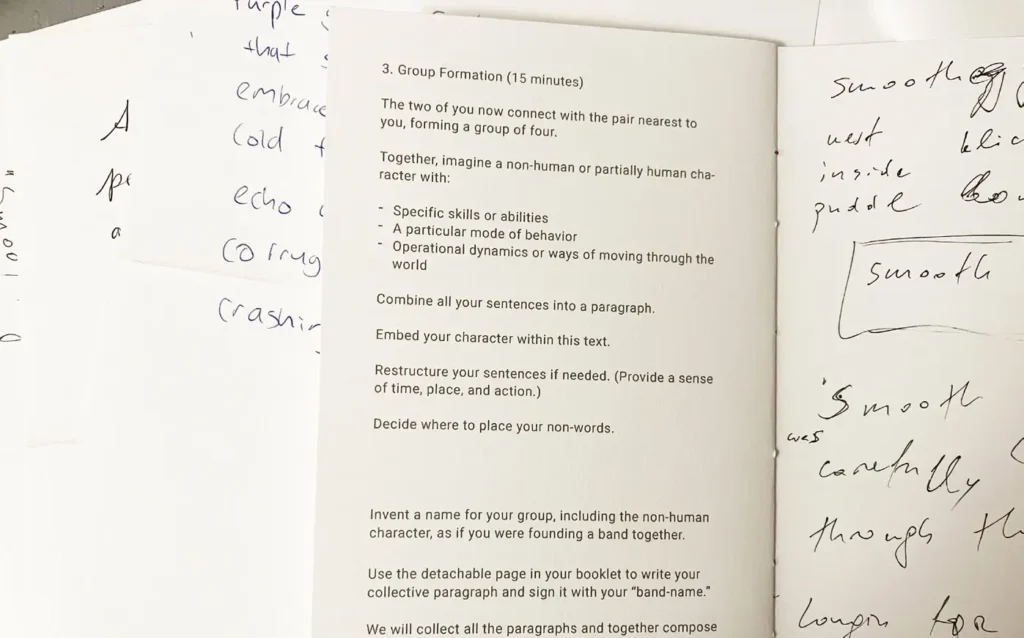
The format of a performance score proved particularly suited to structuring the workshop, providing a framework that guided participants through shared procedures while leaving space for individual interpretation and disciplinary translation. Emerging from the avant-garde music and Fluxus movements of the 1950s and 1960s, performance scores developed as experimental notations that replaced prescription with invitation. As Elena Biserna observes in Walking from Scores (2022), the influence of the score soon extended beyond music and performance art into dance, visual art, and architecture, where it became a medium for embodied spatial engagement. Performance scores facilitate a “merging of one’s body with one’s surroundings” (Biserna 2022, 22), enabling participants to inscribe movement into a site and to challenge predetermined spatial orders. This trajectory from avant-garde experimentation to contemporary practice underlines the score’s ongoing relevance as a method that democratizes authorship, invites improvisation, and privileges process over outcome – qualities evident in numerous contemporary artistic-research contexts, for example in the volume No Telos! (2019), edited by Emma Cocker and Danica Maier.
Within our workshop, the performance score acted as an epistemic device, structuring embodied knowledge production through participatory engagement and process-oriented exploration, yet at the same time leaving space for other-than-human participation. Designed to create conditions for emergence rather than control, the score balanced written prompts, material constraints, and participants’ interpretive gestures, reaching beyond our initial conceptual premises.
The workshop unfolded through four successive actions. In Individual Attunement, participants oriented themselves to the site through multisensory observation – listening, touching, collecting tangible and intangible fragments, and documenting traces in words and non-words. During Pair Formation, they exchanged these materials with a peer to compose hybrid sentences that combined linguistic and non-linguistic elements. Through Group Building and Writing a Collective Paragraph, pairs joined to form quartets, inventing non-human or hybrid characters and weaving their sentences into short collective texts. Finally, in Composing the Collective Story, all paragraphs were assembled and connected – intentionally or by chance – into a polyphonic composition that intertwined the voices of participants, materials, and surroundings.
Remarks and following questions
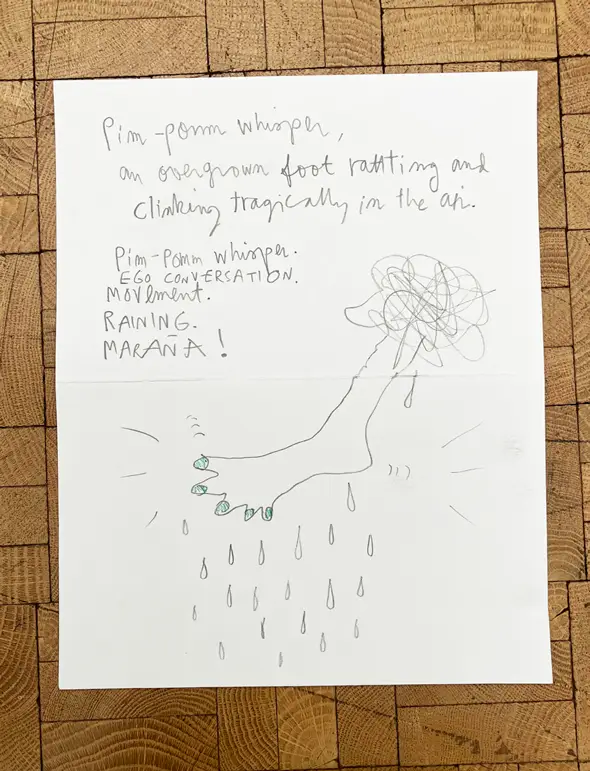
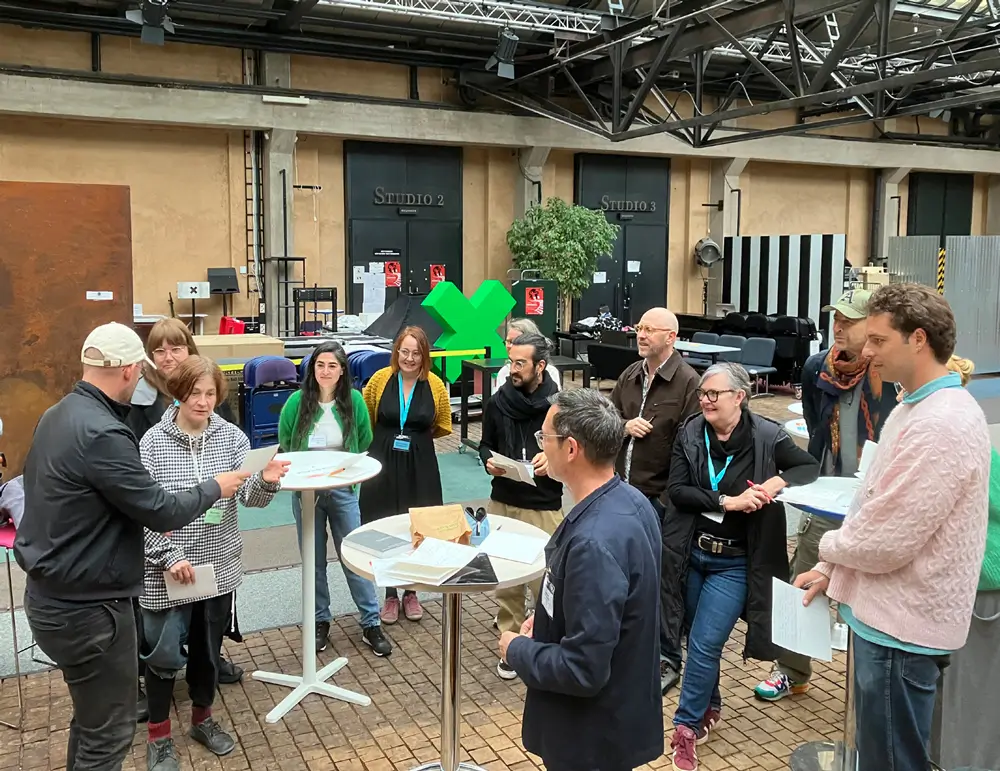
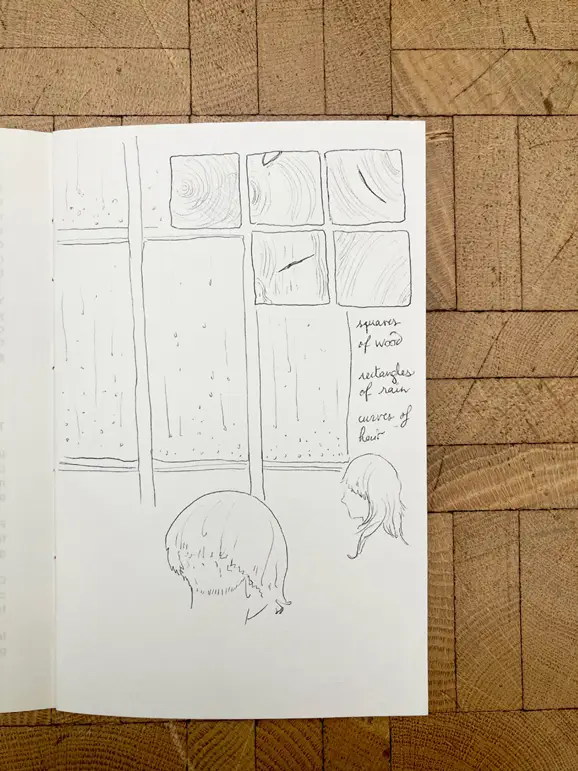
We would like to express our gratitude to all workshop participants. Their active engagement not only shaped the event itself but also extended the scope of our ongoing research. Through their reflections, comments, and suggestions, new possibilities emerged for thinking about the operative potential of language in its many forms – verbal, visual, spatial, and sonic[3]. Each contribution unfolded as a small experiment in how language might exceed its human boundaries and participate in the making of shared worlds. We are grateful to the participants for their permission to include photographic documentation from the workshop in these proceedings.
From these encounters arise questions that continue to move with the work: How does collective authorship transform our relation to creative control? What forms of meaning appear when we relinquish ownership to process and environment? In what ways do our surroundings participate in the act of storytelling? What happens to narrative temporality when the site – its rhythms, materials, and nonhuman agencies – intervenes in the unfolding of a story?
Notes
1 In the introduction to his edited volume Transpositions: Artistic Research and Creative Practice (2018), Michael Schwab distinguishes transposition from representation, emphasizing its potential for artistic research. Whereas the logic of representation remains singular across instances, “the logic of transposition is multiple” (Schwab 2018, 7), foregrounding the differential relations enacted between positions and the epistemic shifts that arise through such movement.
2 https://ercim-news.ercim.eu/en133/special/curatorial-companionship-a-new-framework-for-managing-high-quality-digital-cultural-content-and-data
3 We particularly thank Raisa Kilpeläinen for her insights into the agglutinative grammatical structure of the Finnish language and for discussing the limits of our prompt suggestions – a comment that may expand the procedural aspects of our future research.
References
Ağin, Başak. 2018. “Animated Film as an Eloquent Body: Seth Boyden’s ‘An Object at Rest’ as Mattertext.” Manisa Celal Bayar University Journal of Social Sciences 16(1–2, Environment and Literature Special Issue): 27–45.
Aït-Touati, Frédérique, Alexandra Arènes, and Axelle Grégoire. 2019. Terra Forma: Manuel de cartographies potentielles. Paris: Éditions B42.
Alaimo, Stacy. 2008. “Trans-corporeal Feminisms and the Ethical Space of Nature.” In Material Feminisms, edited by Stacy Alaimo and Susan Hekman, 237–64. Bloomington: Indiana University Press.
Alaimo, Stacy. 2010. Bodily Natures: Science, Environment, and the Material Self. Bloomington: Indiana University Press.
Ballhausen, Thomas, and Elena Peytchinska. 2024. “Herbarium of Words: Literary Style at the Scale of a Street.” Reposition Journal 2: 13–35.
Ballhausen, Thomas, Stefan Gindl, and Markus Tauber. 2023. “Curatorial Companionship: A New Framework for Managing High-Quality Digital Cultural Content and Data.” ERCIM News, 133(April). Special theme: Data Infrastructures and Management.
Biserna, Elena, ed. 2022. Walking from Scores: An Anthology of Text and Graphic Scores to Be Used While Walking. Dijon: Les presses du réel.
Buell, Lawrence. 2005. The Future of Environmental Criticism: Environmental Crisis and Literary Imagination. Malden, MA: Blackwell.
Coccia, Emanuele. 2018. Die Wurzeln der Welt: Eine Philosophie der Pflanzen. Munich: Carl Hanser.
Cocker, Emma, and Danica Maier, eds. 2019. No Telos! Suffolk: Beam Editions.
Drucker, Johanna. 2013. Diagrammatic Writing. Eindhoven: Onomatopee.
Harari, Josué V., and David F. Bell, eds. 1982. “Introduction: Journal à plusieurs voies.” In Hermes: Literature, Science, Philosophy, ix–xxxix. By Michel Serres. Baltimore and London: Johns Hopkins University Press.
Iovino, Serenella, and Serpil Oppermann. 2014. “Stories Come to Matter.” In Material Ecocriticism, edited by Serenella Iovino and Serpil Oppermann, 1–17. Bloomington: Indiana University Press.
Massey, Doreen. 2005. For Space. London: SAGE Publications.
Massey, Doreen. 2006. “Landscape as a Provocation: Reflections on Moving Mountains.” Journal of Material Culture 11(1–2): 33–48.
Massey, Doreen. 2022. “A Global Sense of Place.” In Doreen Massey: Selected Political Writings, edited by David Featherstone and Diarmaid Kelliher, 151–63. London: Lawrence Wishart. Originally published in 1991.
Neimanis, Astrida. 2017. Bodies of Water: Posthuman Feminist Phenomenology. London: Bloomsbury Academic.
Perec, Georges. 2000. Espèces d’espaces. Paris: Galilée.
Peytchinska, Elena. 2025. “Artificially Generated Friendships? On the Possibility of Co-creation in the Age of Generative AI.” Medienimpulse 63(2).
Peytchinska, Elena. Forthcoming 2026. “Botomorphism.” In Prospective Lexicon, edited by Lara Favaretto.
Schwab, Michael. 2018. “Introduction.” In Transpositions: Aesthetico-Epistemic Operators in Artistic Research, edited by Michael Schwab, 7–21. Leuven: Leuven University Press.
Serres, Michel. 1980. Hermès V: Le passage du nord-ouest. Paris: Les Éditions de Minuit.
Serres, Michel. 2008. The Five Senses: A Philosophy of Mingled Bodies (I). Translated by Margaret Sankey and Peter Cowley. London: Continuum. Originally published in 1983.
Voegelin, Salomé. 2021. “The Landscape as Sonic Possible World.” In Sonic Possible Worlds, 2nd ed. London: Bloomsbury Academic.
Watkin, Christopher. 2020. Michel Serres: Figures of Thought. Edinburgh: Edinburgh University Press.
Contributors
Elena Peytchinska
Elena Peytchinska is an independent researcher, visual and performance artist, performance designer, and musician. She holds a PhD from the Institute of Language Arts at the University of Applied Arts Vienna and is currently a lecturer at the Department of Stage and Film Design of the same university. Her research entangles language-based artistic research, performance space, and digital drawing with history of science and posthuman feminist epistemology – most recently through the emergent epistemic conditions of human-AI interactions.
Thomas Ballhausen
Thomas Ballhausen is a poet, philosopher, curator, and Head of the Interuniversity Organization Arts & Knowledges at the University Mozarteum Salzburg. He holds PhDs in philosophy (focusing on media history and archival theory) and language arts (exploring new forms of artistic epistemology and ontology through the format of literary and artistic cahiers). Thomas’s interest in media history, aesthetics, digitality, and literature as artistic research informs both his academic and literary works.