This contribution discusses and outlines productive possibilities that the approach “use what you have” and the concept “politics of the mundane” can offer for a student-centred and malleable, ecological and resource-conscious[1] artist pedagogy in the context of teaching performance and live art practice at art universities at the introductory level. Drawing on projects and workshops that I have realised with Bachelor-level students from diverse artistic backgrounds at the MUK – Music and Arts University of the City of Vienna (2023–) and at the Academy of Fine Arts Vienna (2021–2022), I aim to show ways in which the mundane dimension of daily life can serve as an accessible starting point for investigative artistic endeavours both for students with, and without, previous experience in performance-making and knowledge of discourses related to resource-consciousness in the arts.
Starting points and infrastructural avowal
While the field of artistic research on artist pedagogies[2] is still novel and evolving – spearheaded in international terms by the Society for Artistic Research Special Interest Group on Artist Pedagogy[3] – questions about ecological and resource-conscious strategies for creating art and performance are increasingly prevalent in the contemporary pedagogical discourses, among artists and designers, and in the field of theatre and performance studies (cf. e.g. Beer 2021; Beer et al. 2024; Alexandrowicz & Fancy 2021; Kershaw 2007; Krasny et al. 2022; Loveless 2019). In this contribution, my focus is on “hands-on” performance teaching practice, materials, and resources. This is due to my conviction that at art universities, it is not solely the statements and strategy papers regarding ecology and sustainability and the use of diverse resources that matter, but, above all, the resource-related decisions and nuanced (self-)critical reflection at the level of practice.
As an artist-researcher and pedagogue, I adhere to Shannon Jackson’s views on “infrastructural avowal”, “systemic relationality” and “interdependent systems of support” which might offer an alternative to the system-critical and anti-institutional ethoses in art-making and research that run the risk of complying with Neoliberalist policies (cf. Jackson 2011a, 21–24; Jackson 2011b, 10–12; Woolf 2015, 109–110). While acknowledging the limitations and problems of institutionalized artist education (see Allen 2011; Bauer 2009; Chicago 2014; Fleming 2021; Hjort Guttu 2020; Loveless 2019; Madoff 2009; Thorne 2017), I believe that art universities can facilitate the development of progressive, resource-conscious and ecological artist pedagogies. Following Jackson’s line of thought, I consider art universities as parts of the “interdependent systems of support that sustain human beings [in this context, art students and artist-pedagogues in particular], even though we often feel constrained by them” (Jackson 2011b, 11) – also regarding ecological issues and in promoting what Linda Steg and Charles Vlek refer to as “pro-environmental behaviour” (Steg & Vlek 2009, 209)[4].
Politics of the mundane
By the term “mundane” I refer to our unremarkable, unspectacular habits, routines and patterns of daily activities that often go unnoticed; drawing on Goudouna, Kalliopoulou, Laine and Rachev, I view the “mundane” as a related yet separate notion from the rather well-examined concept “everyday”, characterizing its dull, routine, and unquestioned aspects (cf. Goudouna et al. 2023, 1). The mundane, habitual dimension – what we encounter in our daily life – crucially informs the parameters of our world-views and our ethical and social standpoints; thus, mundane experiences have (proto-)political currency in that they structure our experience(s) and shape our perceptions and experiences of reality, including artistic practice and pedagogical strategies. This dynamic can be illustrated by Jacques Rancière’s concept “distribution of the sensible”[5] that, put briefly, refers to “perceptual forms of knowledge that parse what is and is not sensible, what counts as making (i.e., fabricating) sense and what is available to be sensed.” (Panagia 2009, 6) To Rancière, the distribution of the sensible “is […] the play of relations between the visible, the sayable, the thinkable and the doable at the heart of which gazes operate, things are named, discourses produced, actions undertaken.” (Rancière 2011, 242) Indeed, as I have suggested elsewhere, our experiences, feelings, emotions and reflections “are bound to sensory, bodily and cultural everyday [and mundane] practices and to our formal and informal education and experiences of (not) having or playing a specific part in the prevailing distribution of the sensible, and in the social dramaturgy of a certain social body or of a society.” (Lahtinen 2020, 38) This also goes for artist education and our views of ecological and resource-conscious performance practice.
“Use what you have” in performance workshops
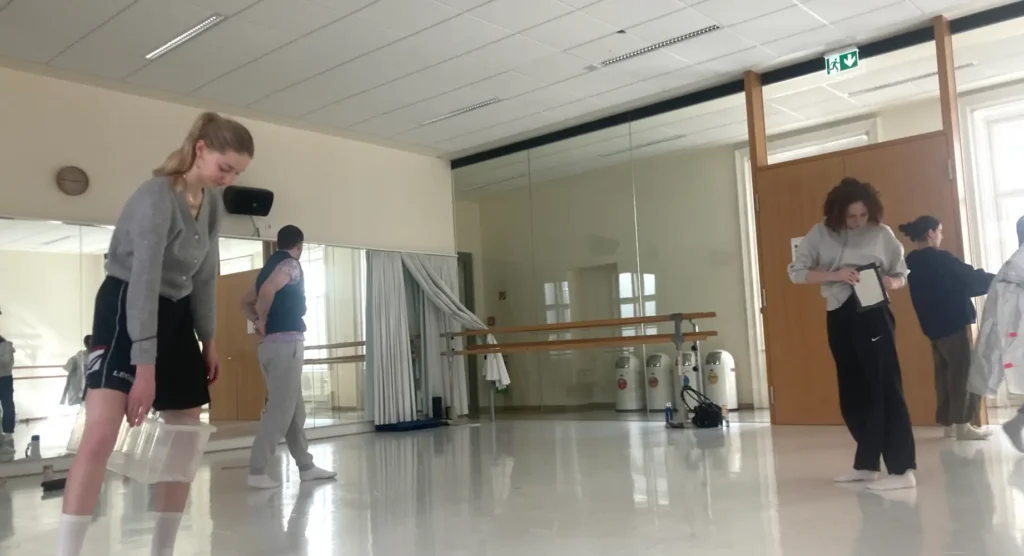
In teaching situations, the “use what you have” approach refers to the task of identifying and working with specific resources – including but not limited to material, spatial, knowledge-related, institutional, biographical, and technology-related resources and artefacts – that each student has “at hand” in their daily life, in terms of artistic experimentation. In my introductory performance workshops for Dance and Dance Pedagogy students at the MUK, the students collect, make inventories, and play with mundane materials and objects by way of improvisatory tasks at the class and homework assignments.[6] For instance, in the very first meeting, I usually ask the students to play with objects such as plastic boxes and small mirrors I have brought in the class; I encourage them to explore non-conventional ways of using those objects, against their dedicated functions (see Fig. 1). In that way, the students gain first-hand experience in exploring body-object-movement-space-relationships, functions of household objects, and related body techniques.[7] Thus, the “use what you have” approach promotes an investigative mindset on a grassroots level, independent of the students’ previous experience and knowledge regarding performance practice and artistic research methodologies.
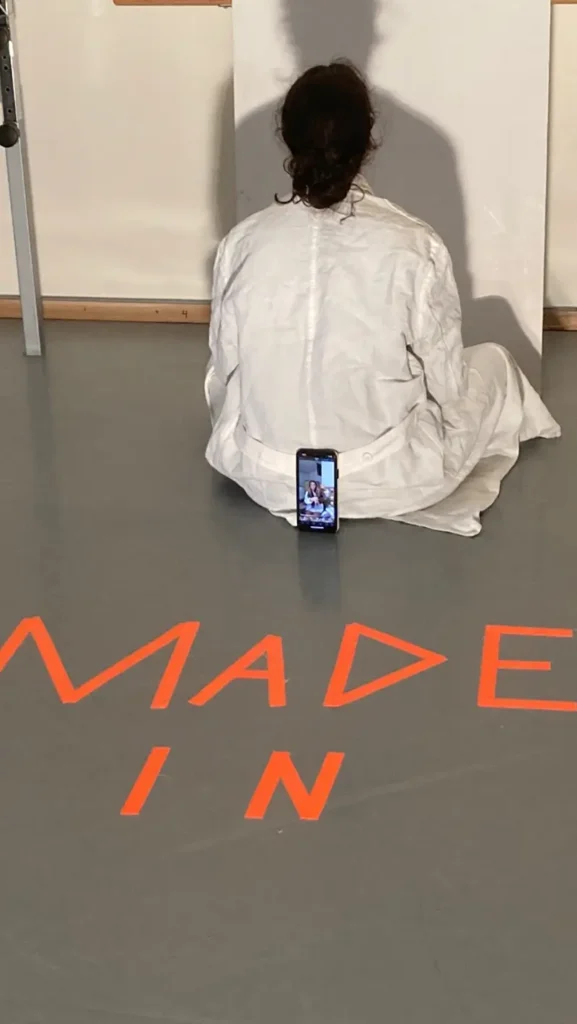
The focus on the mundane encourages the students to reflect on questions related to consumption and to one’s identity and biography in the artistic context. For instance, a 3rd year dance major student in my latest workshop devised a research-based performance sketch based on her daily habit of scrolling the Instagram feed on her smartphone; in her sketch, she analyzed and presented product presentation clips made by a social media influencer, thereby addressing ecological, social, and financial problems and inequalities regarding “fast fashion” and the manufacturing of clothes (see Fig. 2).
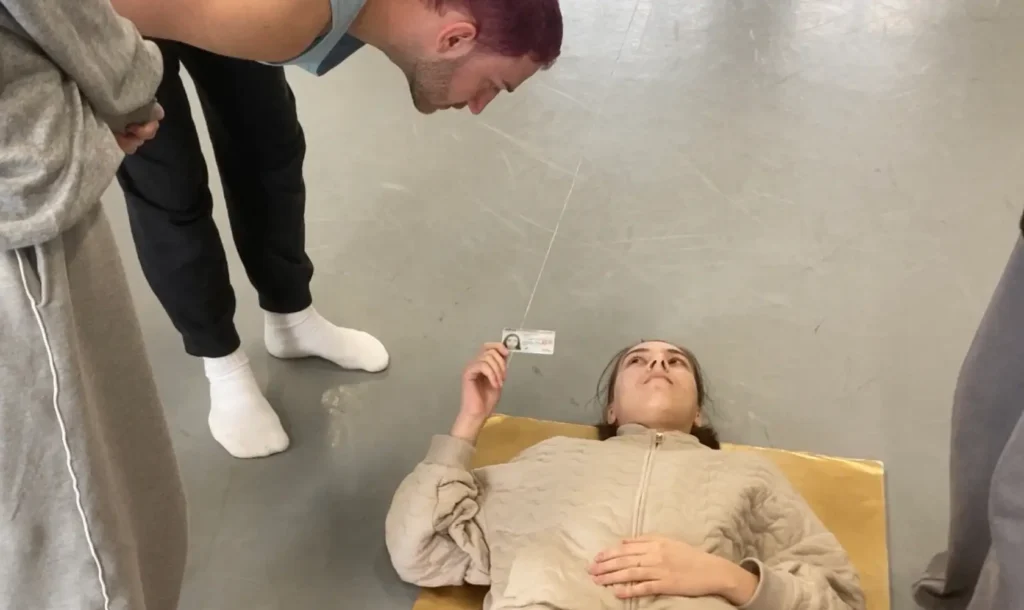
In the same workshop, another student devised a participatory performance sketch based on her Ukrainian background, her identity card – a piece of plastic that has a major impact on one’s rights in a society and that, in a sense, embodies the logic and dynamic of inclusion and exclusion – and the importance of Ukrainian music in her current everyday life in Vienna. (See Fig. 3.)
In the introductory workshops, our focus is not on project-oriented outputs, “virtuosity”, or skills in conventional sense but, instead, on what I call the “just do it” mentality: on exploring different ways of engaging with mundane materials and objects without performance pressure, in a non-judgemental atmosphere. I always emphasise that, should a student feel uncomfortable towards a specific task for whatever reason, he*she does not have to participate in it, without the need for an explanation. At times, I also discuss my own past experiences as a performance artist with the students, and take part in selected solo tasks. Further, I hope to embody the “use what you have” approach as an artist-pedagogue in that I bring my collection of diverse objects and materials gathered over the period of 13 years of teaching in the Academia and “leftovers” of my past artistic projects to our classes; the students can use these materials freely for improvisation tasks.
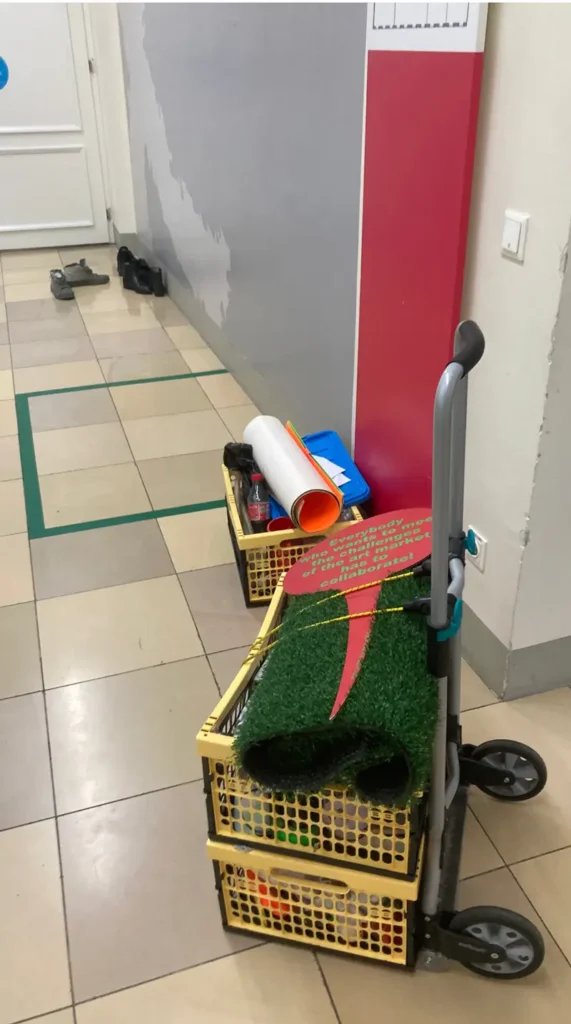
For the workshop classes, I transport my somewhat “unruly” collection of materials from my office to the studio space with a wheel cart; in the Rancièrean sense, this can be viewed as a form of visual and spatial “disruption” (see Lahtinen 2020, 57–59; Rancière 2008, 11) into the clean and orderly spaces at the Department for Dance at the MUK – thereby highlighting the materiality and diversity of the resources needed for teaching performance and live art (see Fig. 4).
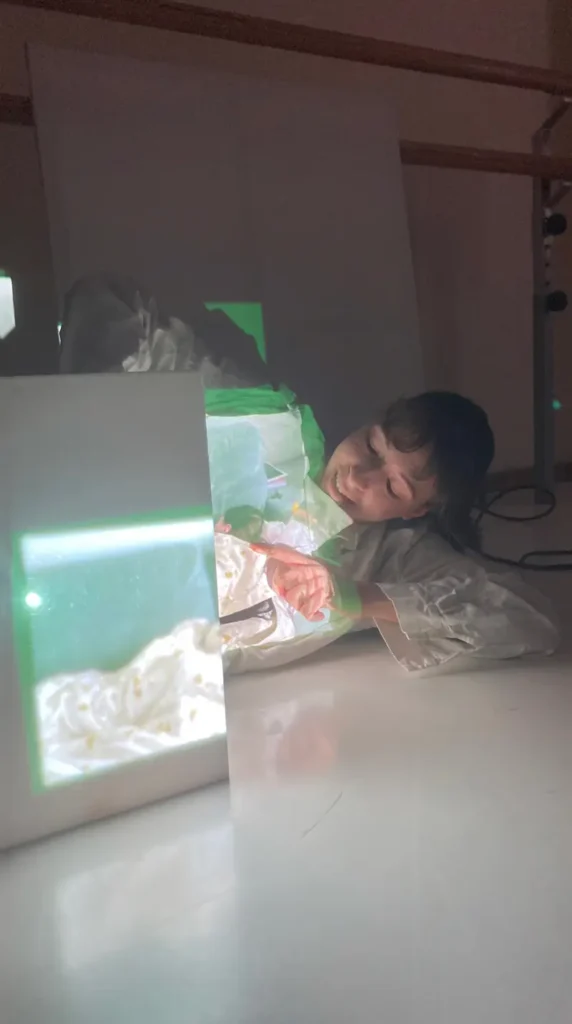
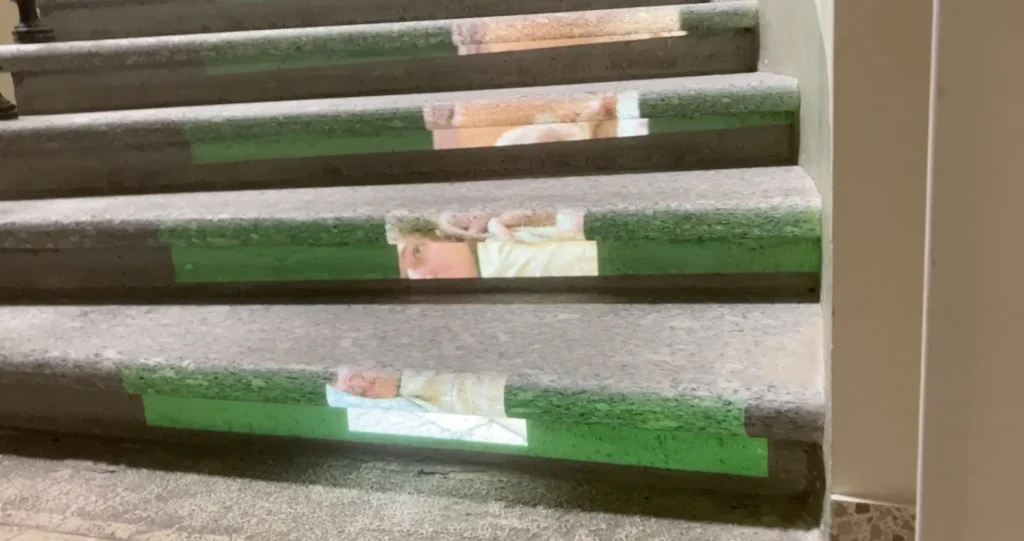
In the workshops, we pay special attention to personal technological devices. Above all, smartphones constitute an accessible mundane resource for artistic practice: they make it possible for the students to experiment – in the “just do it” mentality – with photography, video recording, and audio recording without any extra financial investment or specialist skills. Also, I often use beamers and laptops provided by the university; these devices can be considered as instances of institutional and infrastructural support, a fact that many students have not come to think of before I bring it up at the class. Further, with smartphones and beamers, we explore alternative mundane spaces for teaching performance, and the functions of institutional spaces – such as staircases, toilets, and corridors – more generally, thereby reflecting on unconventional spatial resources for teaching and learning that an art university may, and does, provide (see Fig. 5 and Fig. 6).
“Use what you have” in a black box setting and art history as a resource
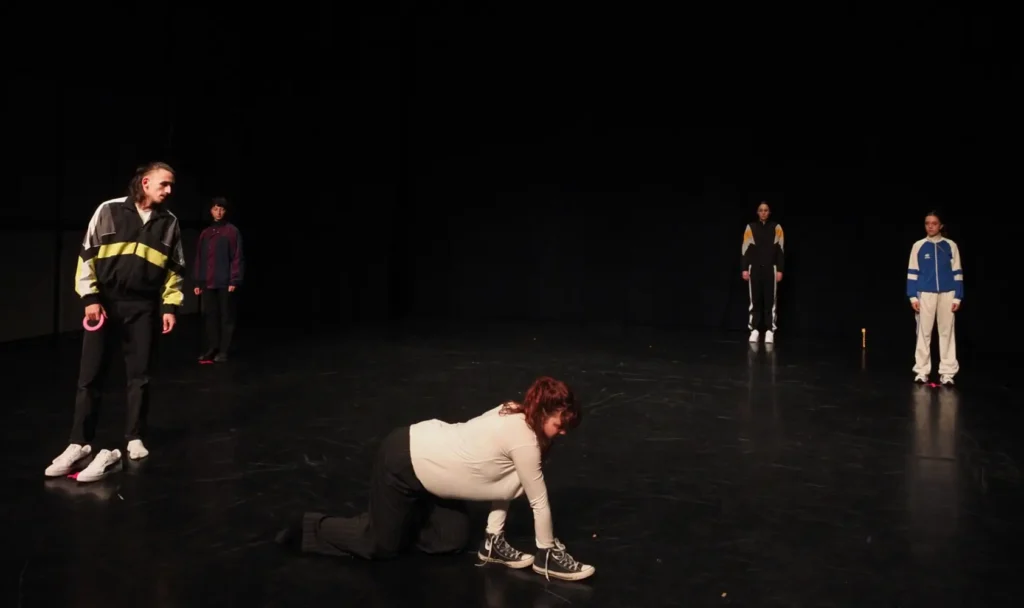
While I primarily employ the “use what you have” approach for task-based experimentation, it can also be used in project-oriented pedagogical contexts, and for devising performances for conventional black box theatre settings. The scenes for the 30-minute-performance ODD MEASURES (MUK.theater Vienna, February 2024) – that performatively investigated questions of logic, normativity, presence, and value related to acts of measuring (see Fig. 7) – were created based on the “use what you have” approach, within a workshop course for six 3rd year Dance students.[8]
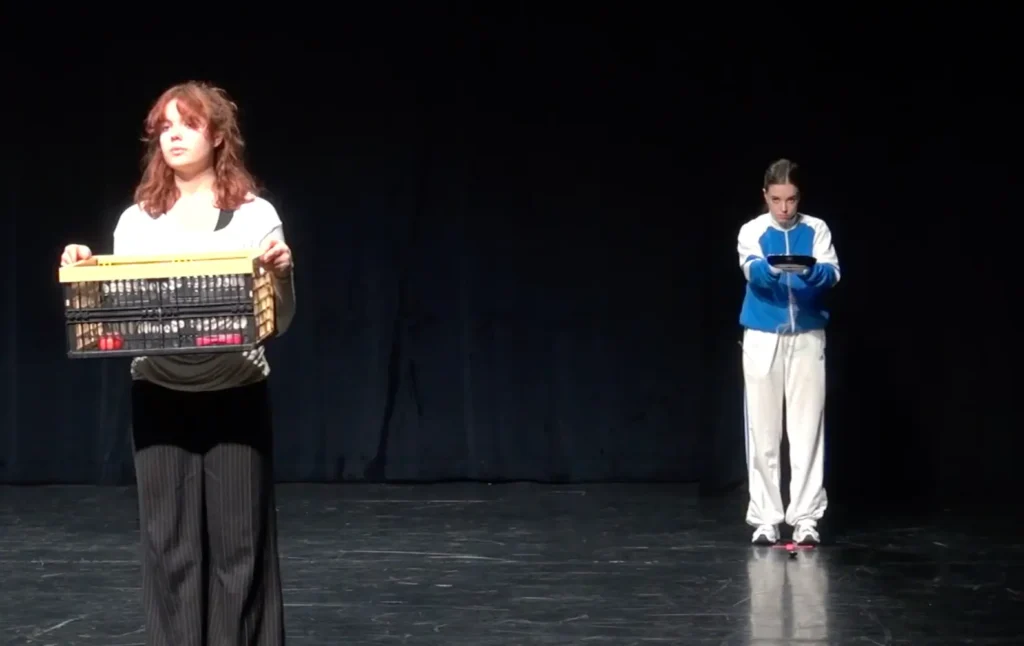
In the devising process of ODD MEASURES, we discussed and analyzed selected key historical performance-based works that address daily life and its political relevance, and that employ mundane artefacts and devices. The final version of our performance featured a scene inspired by Martha Rosler’s seminal feminist video work Semiotics of the Kitchen (1975)[9]; the scene was based on a homework task in which the students had to choose a sequence of Rosler’s work and create a short performance sketch based on it (see Fig. 8). In this way, ODD MEASURES highlighted the fact that previous artistic projects and – more generally – knowledge of art history, artistic traditions, and critical art historiography, can indeed be viewed as valuable resources for performance practice and teaching; in line with the “use what you have” approach, most art students do, or should, gain access to this knowledge in the course of their studies – at classes, in specialist libraries, and via various online resources; thus, they can draw on it both in artistic terms, and in order to situate and contextualize their own evolving practice.
“Use what you have” in an ecological and installative laboratory setting
The “use what you have” approach can be employed in the context(s) of site-sensitive installation and artistic research laboratory as well. Together with the students at my introductory performance and transmedia courses at the Institute for Education in the Arts of the Academy of Fine Arts Vienna, I planned and realized a participative and process-based installation and artistic laboratory FROM NOWHERE TO NOW-HERE – on resources and care in art practice at Schauspielhaus Wien, a major theatre in Vienna, in 2021–2022. Our project was part of the five-month-long curatorial experiment SCHAUSPIELHAUS HOTEL in which the theatre premises were temporarily converted into a hotel with bookable rooms, and spaces for over 50 different artists and groups for experimenting and sharing their explorations with visitors.[10] We had the opportunity to inhabit one of the rooms for a period of two months.[11]
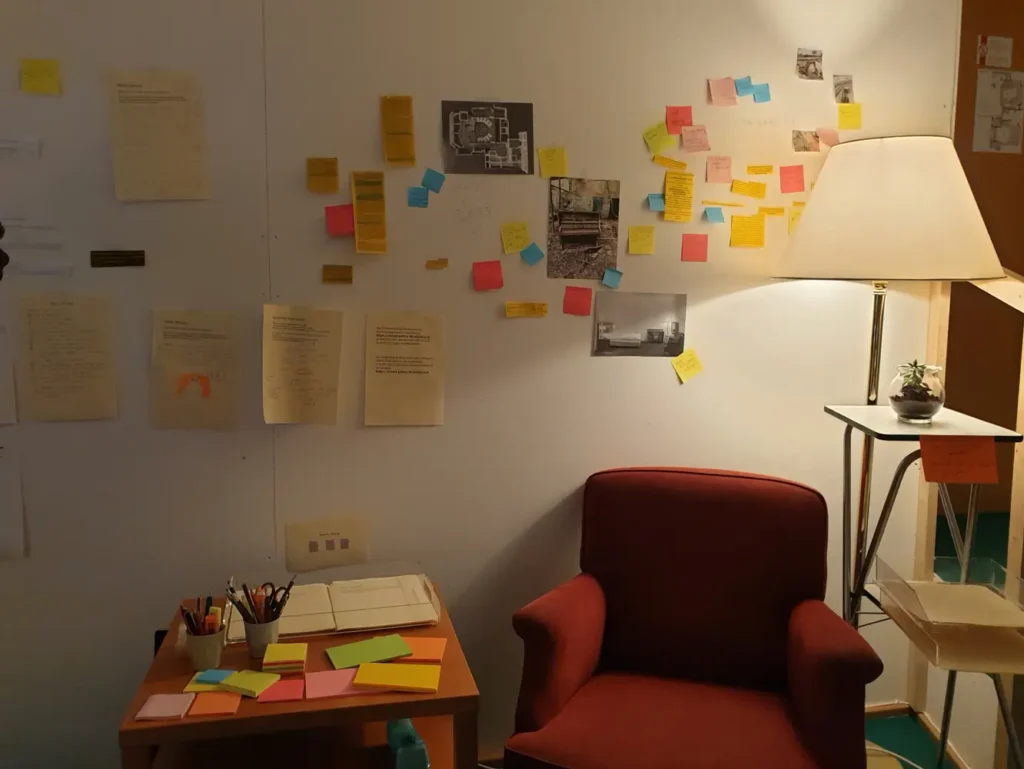
We started the devising process with two interrelated key questions: first, what kind of resources, support, and spaces do art students and emerging artists in Vienna need? And, second, which contexts, materials, cultural histories, power relations, and politics of visibility inform and underlie artist education, and the students’ own perspectives on art practice? In line with the “use what you have” approach, our starting points were the daily lives and personal experiences of the participating students and their peers, whom we interviewed via video. The visitors could add their own reflections and opinions to our installation via sticky notes and by writing directly on the walls. As the weeks passed, the room began to resemble a three-dimensional “mind map”, or the beginnings of a transmedia archive (see Fig. 9).
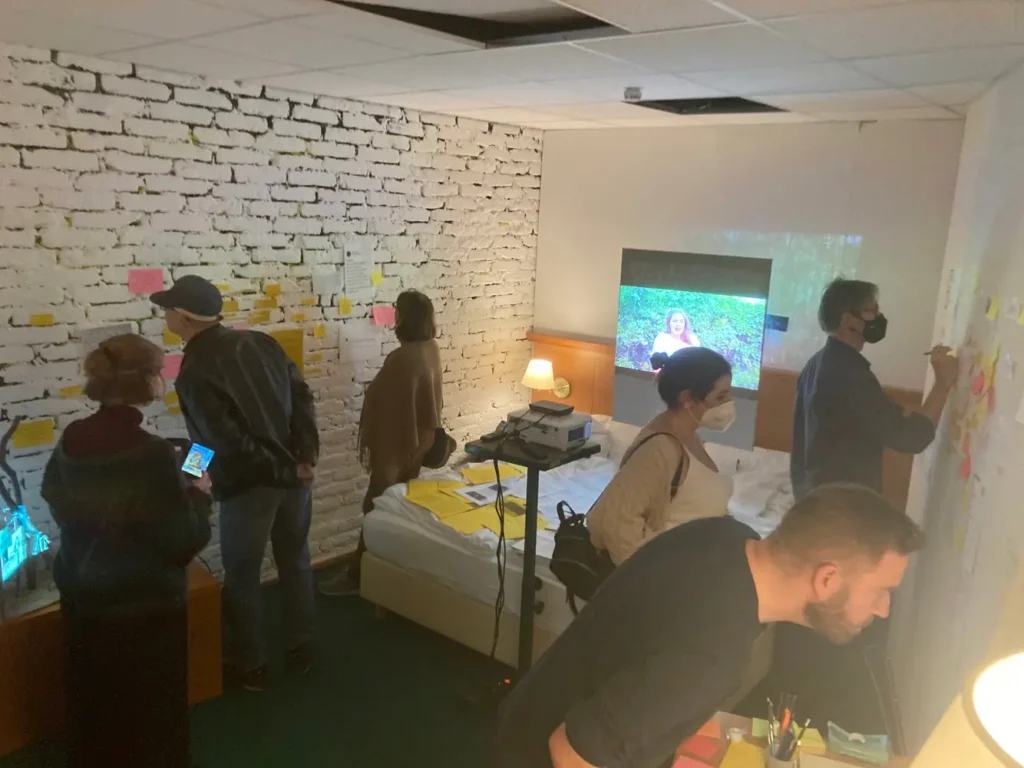
Further, in this project, the ecological aspect of the “use what you have” approach came strongly to the fore: almost all materials, such as office supplies, research books and printed articles, furniture, and technical equipment we employed, were collectively gathered from the Academy of Fine Arts Vienna and Schauspielhaus Wien. (see Fig. 10).[12] Also, we incorporated artistic sketches and tryouts made by the students in other classes at the Academy of Fine Arts Vienna – such as a small-scale architecture model – in the installation.
Conclusion
In this contribution, I have shown that the mundane dimension of daily life can serve as an accessible starting point for investigative artistic endeavours in institutional art university settings, both for students with – and without – previous experience in performance practice and knowledge of discourses related to resource-consciousness and ecology. Further, I have suggested that the “use what you have” approach can encourage the students to pay attention to, reflect on, and use resources – both institutional, private, and domestic – they have access to, in a resource-conscious, anti-consumerist manner. I have also introduced the term “politics of the mundane” as a way to grasp the significance of mundane experiences and habits for future-oriented and resource-conscious artist pedagogies. I would like to finish with two interrelated questions addressed to all of us artist-pedagogues active in the field of artist education: What do we really need for our artistic and teaching practice? What kinds of mindsets regarding ecology and resource-consciousness do we convey to our students through our mundane actions and decisions?
Notes
1 By the term “resource-conscious” in this context, I primarily refer to artistic and pedagogical practices that pay special attention to the responsible use of material, institutional and infrastructural resources, thereby promoting environmental awareness and, in broad terms, “pro-environmental behaviour” (Steg & Vlek 2009, 309).
2 By the term “artist pedagogy”, I refer to professional artist education mainly offered by Higher Education Institutions (HEI), whereas the broader term “art pedagogy” commonly refers to art education offered at the primary and secondary levels, and by diverse cultural and art institutions for persons not necessarily striving for an artistic career.
3 See SAR Artist Pedagogy Research Group.
4 Steg and Vlek describe “pro-environmental behaviour” as “behaviour that harms the environment as little as possible, or even benefits the environment” (Steg & Vlek 2009, 309).
5 Rancière’s original French term “la partage du sensible” can also be translated as “partition of the sensible” as Davide Panagia does. In this text, I use the more common form “distribution of the sensible”. See Rockhill 2004, 85.
6 These workshops typically consist of three 90-minute-meetings, for groups of 3–10 students.
7 As I have suggested elsewhere, we learn and adopt behavioural patterns – i.e. collective body techniques – through observing and mimicking other people’s behaviour both automatically and intentionally; body techniques “‘embody’ social and cultural norms, values and hierarchies in that they produce and manifest accustomed ways of using one’s body ‘properly’; of reacting to other bodies ‘properly’; and of having a ‘proper’ relation to one’s own body in various social situations” (Lahtinen 2020, 41). For a more detailed account of body techniques, see Lahtinen 2020, 39–42. See also Crossley 2004; Lahtinen 2015.
8 This Bachelor-level course comprised 14 90-minute-classes held in the MUK dance studios, final rehearsals at the MUK.theater, and three performances as part of the annual EMBODIMENT evening of choreography.
9 For a detailed description of Rosler’s Semiotics of the Kitchen, see e.g. Museo Reina Sofia.
10 For more information about the SCHAUSPIELHAUS HOTEL experiment (in German), see Schauspielhaus Wien.
11 Our project premiered in the side programme of the second part of the conference “Überschreiten und übereignen” (18.–20.11.2021, Vienna), jointly organized by the HTM Academy of Music and Theatre Felix Mendelssohn-Bartholdy Leipzig, Schauspielhaus Wien, and the Art and Education Programme of the Academy of Fine Arts Vienna. The conference was curated by Barbara Büscher, Elke Krasny and Lucie Ortmann. Due to a state-wide Corona lockdown in Austria, our project was on show for a significantly longer period than what we had originally planned.
12 For a more detailed analysis of the ecological and anti-consumerist aspects of the project (in German), see Krasny et al. 2022, 22–26.
References
Allen, Felicity, ed. 2011. Education. The MIT Press.
Alexandrowicz, Conrad, and David Fancy, eds. 2021. Theatre Pedagogy in the Era of Climate Crisis. Routledge.
Bargetz, Brigitte. 2009. “The Politics of the Everyday: A Feminist Revision of the Public/Private Frame.” In Reconciling the Irreconcilable, edited by Irina Papkova. IWM Junior Visiting Fellows’ Conference Proceedings 24. www.iwm.at/publications/5-junior-visiting-fellows-conferences/vol-xxiv/the-politics-of-the-everyday (accessed 25.10.2025).
Bauer, Ute Meta. 2009. “Under Pressure.” In Art School. Propositions for the 21st Century, edited by Steven Henry Madoff, 219–227. The MIT Press.
Beer, Tanja. 2021. Ecoscenography. An Introduction to Ecological Design for Performance. Palgrave Macmillan.
Beer, Tanja, Tessa Rixon, Ian Garrett, and Angela Goh. 2024. “Embedding ecoscenography into performance design pedagogy: three practice-based approaches.” Theatre, Dance and Performance Training 15(3): 472–494. doi.org/10.1080/19443927.2024.2345609.
Brekhus, Wayne. 1998. “A Sociology of the Unmarked: Redirecting Our Focus.” Sociological Theory 16(1): 34–51.
Chicago, Judy. 2014. Institutional Time: A Critique of Studio Art Education. The Monacelli Press.
Crossley, Nick. 2004. “The Circuit Trainer’s Habitus: Reflexive Body Techniques and the Sociality of the Workout.” Body & Society 10(1): 37–69.
Fleming, Peter. 2021. Dark Academy. How Universities Die. Pluto Press.
Goudouna, Sozita, Eleni Kolliopoulou, Eero Laine, and Rumen Rachev. 2023. “Editorial: On mundane performance.” Performance Research 28(4): 1–4.
Hjort Guttu, Ane. 2020. “The End of Art Education as We Know It.” Kunstkritikk – Nordic Art Review 22(May). kunstkritikk.com/the-end-of-art-education-as-we-know-it (accessed 25.10.2025).
Kershaw, Baz. 2007. Theatre Ecology. Environments and Performance Events. Cambridge University Press.
Jackson, Shannon. 2011a. Social Works: Performing Art, Supporting Publics. Routledge.
Jackson, Shannon. 2011b. “Working Publics.” Performance Research 16(2): 8–13.
Krasny, Elke, Sophie Lingg, Joonas Lahtinen, and Johannes Köck. 2022. Wie Kunst für Zukunft unterrichten? Feministische Sorgeethik als Perspektive der Vermittlung in Zeiten planetarischer Katastrophe und digitaler Toxizität. [How to teach art for the future? Feminist ethics of care as an educational perspective in the era of planetary catastrophes and digital toxicity.] Fabrico Verlag and EduArtMusic – Academy of Fine Arts Vienna, University of Applied Arts Vienna and University of Music and Performing Arts Vienna. www.fabrico-verlag.de/per-eduart (accessed 25.10.2025).
Lahtinen, Joonas. 2015. “How to Address Politics of the Body in Participatory Performance? On the Possibilities of Sensory Fields and Collective Body Techniques As Analytical Tools”. Nordic Theatre Studies 27(2): 36–46. doi.org/10.7146/nts.v27i2.24249.
Lahtinen, Joonas. 2020. Making Sense of Perception and Power in Participatory Performance. Horizons of Change and Politics of the Sensible in Lois Weaver’s “What Tammy Needs to Know”, Tellervo Kalleinen and Oliver Kochta-Kalleinen’s “Complaints Choir”, and Claudia Bosse’s “dominant powers. was also tun?”. Doctoral Dissertation in Theatre Research. Faculty of Arts, University of Helsinki. urn.fi/URN:ISBN:978-951-51-6419-3.
Loveless, Natalie. 2019. How to Make Art at the End of the World. A Manifesto for Research-Creation. Duke University Press.
Madoff, Steven Henry, ed. 2009. Art School. Propositions for the 21st Century. The MIT Press.
Museo Reina Sofia. “Semiotics of the Kitchen”. www.museoreinasofia.es/en/collections/artwork/semiotics-kitchen (accessed 25.10.2025).
Panagia, Davide. 2009. The Political Life of Sensation. Duke University Press.
Rancière, Jacques. 2008. “Aesthetic Separation, Aesthetic Community: Scenes from the Aesthetic Regime of Art.” ART & RESEARCH: A Journal of Ideas, Contexts and Methods 2:1 (Summer 2008), PDF version. http://www.artandresearch.org.uk/v2n1/ranciere.html (accessed 25.06.2019).
Rancière, Jacques. 2011. “Against an Ebbing Tide: An Interview with Jacques Rancière.” In Reading Rancière, edited by Paul Bowman and Richard Stamp, 238–251. Continuum.
Read, Alan. 1993. Theatre and Everyday Life. An Ethics of Performance. Routledge.
Rockhill, Gabriel. 2004. “Appendix I. Glossary of Technical Terms.” In Jacques Rancière, The Politics of Aesthetics, 80–93. Continuum.
SAR Artist Pedagogy Research Group. 2025. societyforartisticresearch.org/project/sig/pedagogy (accessed 25.10.2025).
Schauspielhaus Wien. 2021. “Schauspielhaus Hotel.” archiv.schauspielhaus.at/schauspielhaus_hotel (accessed 25.10.2025).
Steg, Linda, and Charles Vlek. 2009. “Encouraging pro-environmental behaviour: An integrative review and research agenda.” Journal of Environmental Psychology 29(2009): 309–317.
Thorne, Sam, ed. 2017. School. A Recent History of Self-Organized Art Education. Sternberg Press.
Woolf, Brandon. 2015. “Putting Policy Into Performance Studies?” Performance Research 20(4): 104–111.
Contributor
Joonas Lahtinen
Joonas Lahtinen is Professor of Artistic Research and Performance Art at the MUK – Music and Arts University of the City of Vienna. He studied Performance at Queen Mary University of London and Theatre research at the University of Helsinki, where he completed his dissertation “Making Sense of Perception and Power in Participatory Performance” in 2021. Lahtinen’s artistic and research projects have been presented internationally in renowned institutions and festivals. He convenes the subgroup Spaces of Artist Education within the Artist Pedagogy Research Group of the SAR.