The current study examines the application of Indigenous terminology in discussions of performance, focusing on the themes of ancestral knowledge and heritage. The performance Sea Sámi, See by the North Sámi artists Johan Sara Jr and Katarina Skår Lisa unfolds through the Northern Sámi term Maadtoe.
Introduction
Different Indigenous communities have unique terminologies for referring to their heritage and ancestral knowledge. In the Māori community, the term Whakapapa is applied, while in the Northern Sámi community, the term Maadtoe articulates the interconnectedness with land and ancestry, as well as relational responsibilities within Indigenous knowledge (Te Hira et al. 2022). Each Sámi language has a variation of the term, but Maadtoe is specifically applied within the Northern Sámi community (Te Hira et al. 2022), which is important, as the case discussed in this paper and the artists represented are from the Northern Sapmi area. Ancestral knowledge and connection to the land manifest in the Sámi duodji and creativity connected to it (Guttorm 2012, 2015). This means that Sámi creative individuals use their creative practices to claim their identity and connect to their traditions.
Arts-based research
The current research applies an arts-based research method (Chilton & Leavy 2014) due to the curatorial and management tasks implemented by the manager-curator-researcher, who has institutional affiliation with Nordlandsmuseet and helped organise the earlier performance presentation as a part of the Sapmi Triennala project in Karasjok. The researcher was involved in planning, fundraising, event communication, making posters, and moderating the artist talk after the performance (see Image 1). The Sea Sámi, See performance was produced by Johan Sara Jr and Katarina Skår Lisa, and the exhibition was produced by Johan Sara Jr. The artistic data involved video and photodocumentation by the manager-curator-researcher upon agreement with the performing Sámi artists Johan Sara Jr. and Katarina Skår Lisa.
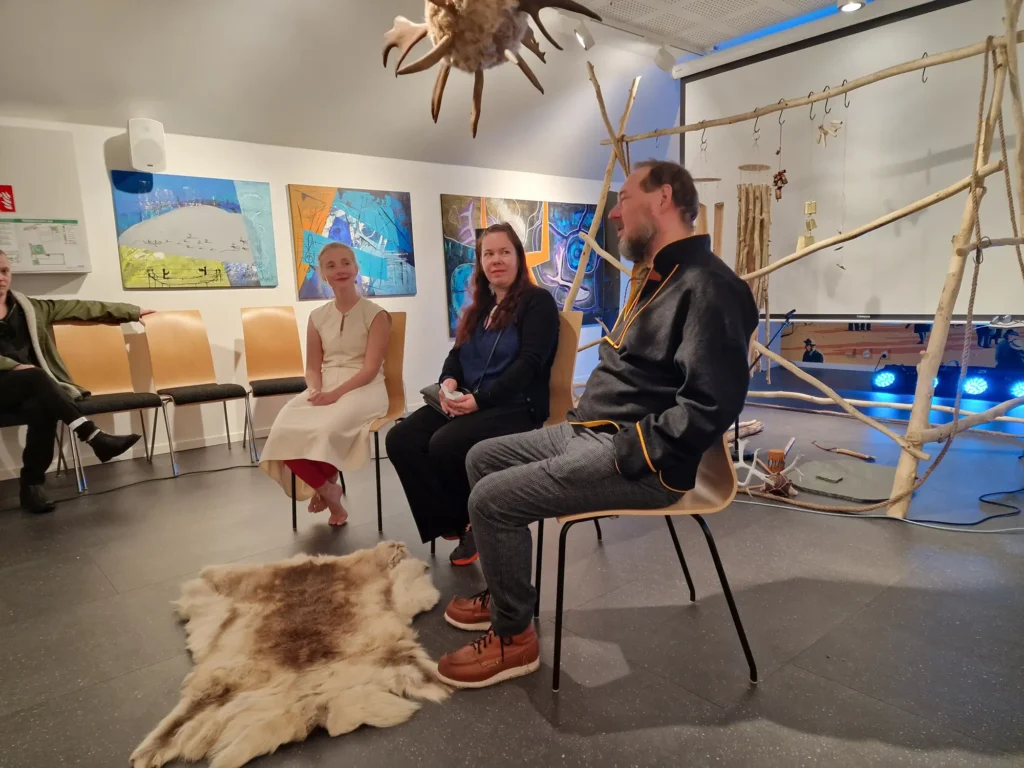
The question addressed was, “How is the concept of Maadtoe seen in the Sea Sámi, See performance by Johan Sara Jr and Katarina Skår Lisa at Bodø City Museum?”
The venue for the performance: Bodø City Museum
Nordlandsmuseet, and specifically, Bodø City Museum in the South Department of Nordlandsmuseet Museum, focuses on the dissemination of Sámi culture and heritage, due to the location of Bodø on traditional Sámi lands. Thus, the museum’s program is built around events relevant to the Sámi culture, for example, the yearly Sámi language and culture weeks and Sámi National Day, on which special events and exhibitions take place. The yearly exhibition program accommodates special themes of Sámi culture from art and ethnography perspectives.
Performance: Sea Sámi, See
The exhibition Sea Sámi, See by Johan Sara Jr, containing a musical instrument and paintings took the form of a pop-up exhibition at Bodø City Museum’s conference room during Sámi Language Week. The culmination of the project was a performance that took place on the last day of the exhibition, in collaboration with Sámi choreographer Katarina Skår Lisa.
Johan Sara Jr offered the following quote about the performance and exhibition: “Sea Sámi, See is based on the life and mindset of the Coastal Sámi people. It was natural, as I was born and raised by the sea in Alta and on Stjernøya, where our reindeer grazed during summer.”
The performance contains sequences where sound and choreography connect. The first part of the performance contains only the sounds created by Johan Sara Jr by touching different objects from the coastline assembled in one musical instrument. The choreographer joins in, wearing the duodji work by Anna-Stina Svakko, first connecting the movements to the reindeer skin placed on the floor after extending the body to the white-coloured reindeer skull (Image 2). The sequences continue as the objects are introduced through the movement in the area outlined by the four duodji items interconnected with a lasso, the object traditionally used in reindeer herding.
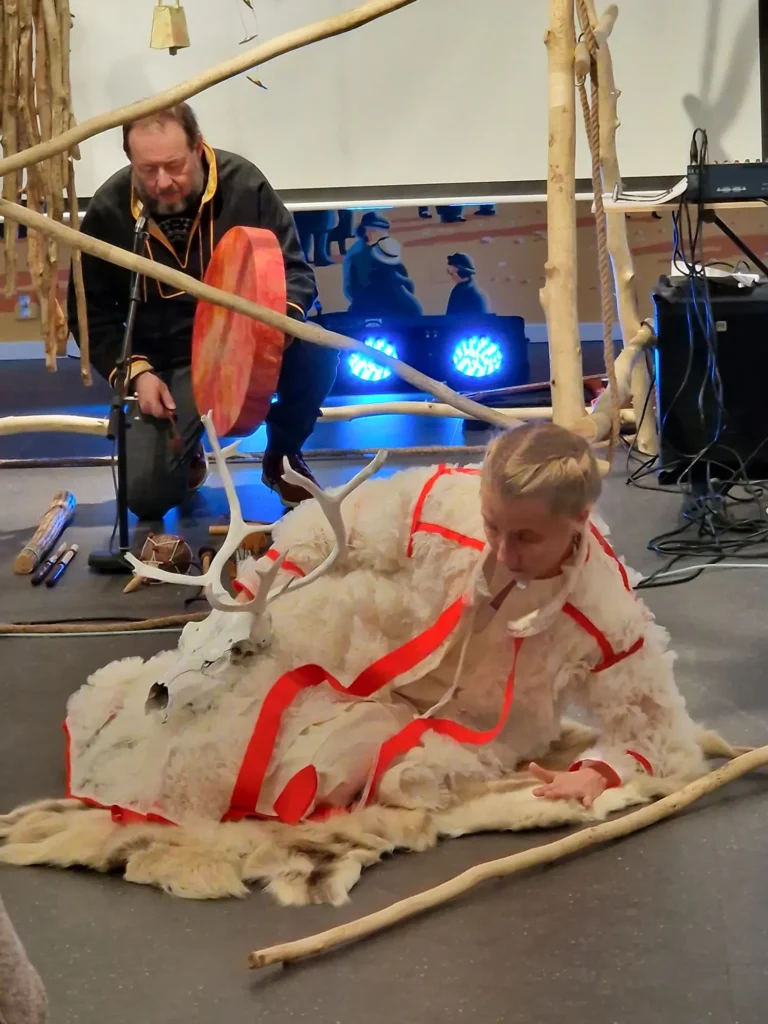
In the introduction to the project, Johan Sara Jr says, “Everything relates to the sea, the coast, fishing, reindeer herding, and integrated farming. Knowing that my ancestors lived here in Alta for hundreds of years generates identity, pride, and a drive to carry on traditions, culture, and hopes for the future.”
Maadtoe in Sea Sámi, See
The performance consists of two elements: frontstage, which is visible to the audience, and backstage, which encompasses the processes involved in implementing the performance (Schechner 1977). Both artists have an ancestral connection to the Sea Sámi area, which is in the Northern Sámi area, today Finnmark County in Norway. The project Sea Sámi, See is a longitudinal journey, where Maadtoe manifested in on-site work by the artists while creating a performance and videoperformance. The coastal area of Porsangerfjorden was chosen as the location for the videoperformance.
The embodiment of connection with nature, the fjørd, and the harsh weather conditions are reflected in Katarina’s, as the choreographer’s costume in the videoperformance. This costume was partly created from wool, protects the body, and appears against the background of the sea and rocks in the video shown during the videoperformance. Through Maadtoe, as connecting to nature in a mutually respectful way, the performance, performer, costume, and nature become one narrative, and the action of dancing in this location is claiming the identity and manifesting the Sea Sámi culture.
Similarly, for Johan, gathering materials by the coastline, whether it is sound recordings or hard duodji materials (which later become the musical instruments in the performance), is a form of connectedness to the landscape of his ancestors. Notably, the first performative gesture in the performance is applying the rock, recognisable from the videoperformance, to create the sound. The performance in the museum’s venue starts by echoing nature. The listeners and viewers are taken outdoors by the sound, objects, and movements created by the sea as a reflection of the artists’ ancestral narrative of the ways of life in the Sea Sámi culture. The artists use natural materials for their performance. Similarly, their ancestors used the sea and coastline as a respectful source for duodji and creativity.
Conclusion
The Sea Sámi, Sea performance, developed as a longitudinal project and shown at Bodø City Museum, addresses the concept of Maadtoe as a reconnection of artists Johan Sara Jr and Katarina Skår Lisa to their ancestral lands and heritage. The videoperformance created by the coastline focuses on connecting the body, sounds, and land. By activating both the coastal environment and the museum space as stages, the artists move fluidly between personal heritage and collective cultural expression. Their actions transform natural materials, sounds, and movement into carriers of Sea Sámi identity.
Acknowledgement
The performance and artist talk were a part of the educational program supported by Nordlands Fylkeskommune and Bildende Kunstneres Hjelpefond (BKH). Marija Griniuk received funding from the Research Council of Lithuania (LMTLT), agreement No S-PD-24-49, for this research.
References
Guttorm, G. 2012. “Duodji: A new step for art education.” International Journal of Art & Design Education 31(2): 180–190.
Guttorm, G. 2015. “Contemporary Duodji – A personal experience in understanding traditions.” Relate North: Art, Heritage and Identity, 60–77.
Chilton, G., and P. Leavy. 2014. “Arts-based research practice: Merging social research and the creative arts.” In The Oxford handbook of qualitative research, 403–422.
Schechner, R. 1977. Essays on performance theory, 1970–1976. Drama. Book Specialists.
Te Hira, Jasmine, Zoe Black, and Carola Grahn. 2022. “Embodied knowledge: Exploring the influence of Whakapapa and Maadtoe jah Maahtoe.” Vessel Magazine 3. vessel-magazine.no/issues/3/embodiedknowledge/editorial-third-issue.
Contributor
Marija Griniuk
Marija Griniuk holds a DA (Doctor of Arts) from The University of Lapland in Finland and currently is a postdoctoral researcher at Vilnius Academy of Arts in Lithuania. She holds a position of department leader at Nordlandsmuseet in Norway and has a background in visual arts, performance art, and performance pedagogy. orcid.org/0000-0002-5648-5575.