This article examines heterarchical creation as a unique strategy in performance-making, focusing on the decentralization and redistribution of power among all participants. Drawing on Crumley’s concept of heterarchy and Radosavljević’s notion of the heterarchical director, it frames performance-making as an adaptive, self-sustaining ecosystem. Through a case study of my own practice as part of ongoing artistic research, I propose a directorial strategy rooted in heterarchical structure and discuss its impact on collective creation, authorship, creativity, and ecological awareness. This strategy represents an approach that reimagines theatre-making as an interdependent, responsive system attuned to ecological and social challenges.
Introduction
To begin with, I would like to acknowledge that the focus of my ongoing artistic research is not initially rooted in ecological thinking, approaches, or any subject directly related to ecology. However, the ecosystemic approach which appeared as a side effect of my practice gradually revealed itself to be an integral part of it.
The starting point of my PhD journey was an exploration of directorial strategies that decentralize power structures within the process of performance-making. Coming to this inquiry as a theatre director – shaped by both directorial theatre and collective theatre-making practices – I found myself drawn to creative strategies that not only address the ethics of the working environment but also nurture the systemic polyphony of theatre-making. So, I began to design a set of models based on dispersing and/or shifting power in areas such as decision-making, responsibility, and creative input.
In questioning vertical hierarchies within performance-making, I discovered that many management models, such as sociocracy, holacracy, and heterarchy, adopt an ecocentric approach in which power is distributed dynamically. In these systems, power does not function as a tool of control or manipulation but rather as a force that impacts, affects and transforms relationship dynamics.
To design such a place where the multitude of talents could emerge and the leadership will be distributed is also one of the main ethos of eco-leadership. As Simon Western, who is known by coining the term, notes, this new model of leadership is rooted in the holistic approach and “[…] redistributes the power from the center to the edges, recognizing the impossibility of ‘going it alone’ when we are interdependent on each other and on planet Earth.” (Western 2010, 42.) Just as eco-leadership encourages shared responsibility and collaboration, so too does a growing trend in the arts emphasize collective creation and co-authorship. This suggests a potential shift toward coalitional thinking within theatre practice. However, translating these principles into practice presents significant challenges.
How can heterarchical structures serve as sustainable creative strategy in contemporary theatre-making? What are the implications of decentralizing directorial position for authorship, collaboration, and creativity in performance? And how might an ecological approach to performance-making reshape both directorial practices and performance aesthetics? By exploring these key questions, I aim to propose and discuss an original directorial strategy that not only supports the idea of an internal creative ecosystem in practical terms, but also fosters greater awareness of the external ecosystems we are inherently connected to.
Heterarchy as a framework
While reconsidering the conventional role of a director I came across to the notion of heterarchical director introduced by the scholar of contemporary theatre and performance practice Duška Radosavljević. According to her, the heterarchical director is interested in systemic rather than individual leadership and focuses on cultivating a self-sustaining process in the rehearsal room, emphasizing the outcomes that emerge from the process rather than trying to predict or control them (Radosavljević 2019, 264).
The term heterarchy originates from the field of anthropology and refers to a governing structure composed of multiple hierarchies or centers that function in relation to one another. As anthropologist Carole Crumley explains, heterarchy is characterized by the interaction of elements that are either unranked or have the potential to be ranked in various ways (Crumley 1995, 3). In such a relationship, power can be contrasted rather than ranked. According to Crumley, “the inclusion of the concept of heterarchy in the vocabulary of power relations reminds us that there are forms of order that are not exclusively hierarchical and that in complex systems, interacting elements do not necessarily have to be permanently ranked relative to each other. In fact, flexibility and adaptability are lost in order to maintain a fixed ranking” (Ibid. 3). Hence, the heterarchy model proposes a permanent mechanism of power change, which depends on a direct response to environmental changes.
Building on the theoretical framework of heterarchy, I attempted to design a model in which this structure could function as a practical tool to engage with the process of performance-making. To explore this approach, I conducted two separate experiments which I call The Deer Method I and The Deer Method II. The first took place during the spring of 2024, where I tested the initial version of the model. And a year later, I continued investigating the method by addressing its shortcomings and refining its strengths, based on the analysis and insights gathered from the first experiment.
Methodological approach
In the core of the model (both versions) is a division of the rehearsal process into autonomous spheres functioning by individual members of the creative team (Figure 1). These members included playwright, composer, scenographer, and myself as the director. Later – in the second experiment the playwright and scenographer were replaced by audiovisual artist and choreographer. In the first experiment each of us worked separately with a team of four professional actors. They were the only ones who worked continually in each rehearsal.
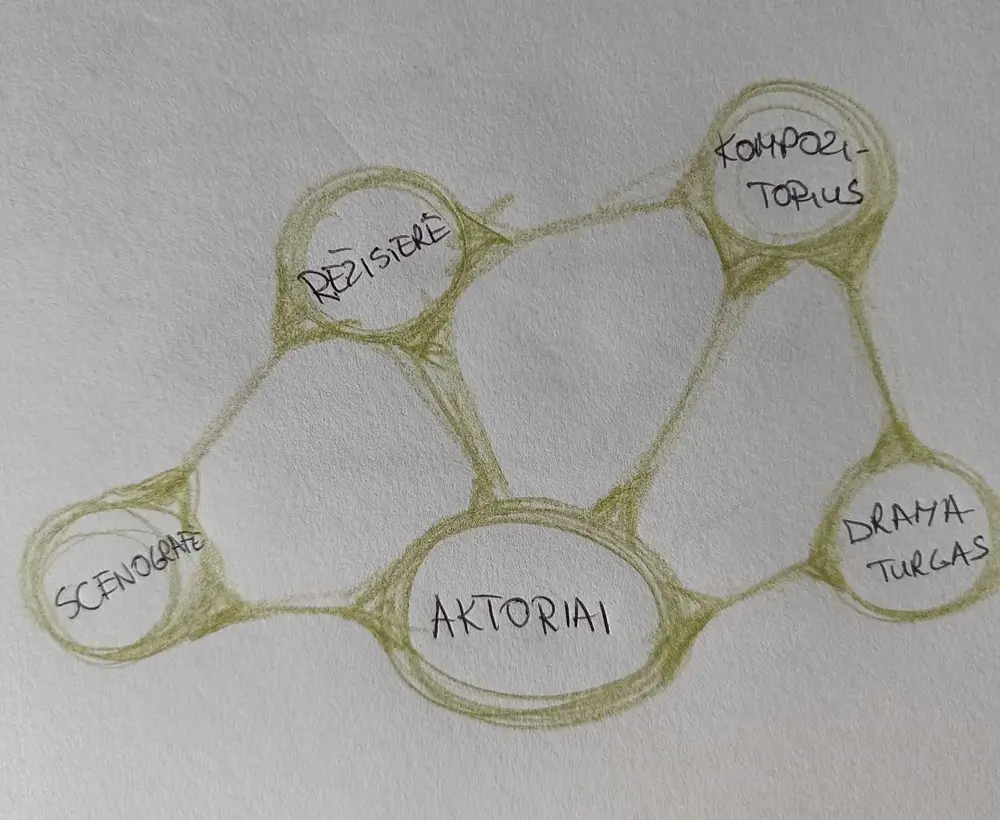
At the beginning of the creative process of The Deer Method I – we started from a blank page: we had no predetermined theme or visual concept. Only the instructions how we would work in this particular structure. The entire process was structured into 12 rehearsals, divided into three distinct stages with four rehearsals for each.
- The goal for STAGE I was to collaboratively discover a central topic or idea.
- In STAGE II we focused on developing the established theme or concept.
- And the final STAGE III aimed to shape the material into a 15–20 minutes performance draft, emphasizing aesthetic and structural coherence.
The guiding principle of this process was to build upon each other’s contributions: each team member was required to accept and respond to what had been created in the previous rehearsal, while also offering their personal input through their artistic practice.
A key challenge of this model was that none of the creators were permitted to attend one another’s rehearsals. The main reason for that was to explicitly ensure the creative and organizational autonomy for each leading member. Thus, we could only learn about the evolving process through written reflections that we submitted after our individual sessions. In these reflections, we documented our discoveries and outlined ideas or directions to pass on. When preparing for our own sessions, we had to follow the trajectory proposed by the previous team member and interpret it through our own perspective.
In the second, revised version of this model, I introduced a significant change: all members of the creative team were allowed to attend every rehearsal. Moreover, each participant had to engage in the process according to the expectations set by the leader of that particular session (Figure 2). This modification proved to be a major turning point. It heightened the sense of individual as well as collective responsibilities and deepened our engagement with the process – both of which had been identified as weak points during the first experiment. It pushed us further by challenging and reshaping our approach towards the artistic decisions and assumptions of our roles defined by disciplines.
The adjustments for the second try were made by supplementing the same core idea of heterarchy – dividing the whole structure of performance making into multiple centers – defined by the artists representing different disciplines in the creative process. Now we were only five members – audiovisual artist (Miglė Križinauskaitė), choreographer (Vaiva Paukštė), composer (Manuel Velazquez), one actor (Arnoldas Augustaitis) and me as a director. This time I regarded the actor not as a medium between all of the other creative authors, but as an autonomous creator itself who had to take leadership of his rehearsal. The second version was tested in a more condensed way – we had four days of creative residency in which we conducted seven rehearsals. Five rehearsals were led by assigned leaders (the order was picked randomly). And the final two rehearsals were collective sessions focused on gathering the material. Artistically, we chose to continue developing the thematic concept established in the first experiment – the casting of Anthropocene.
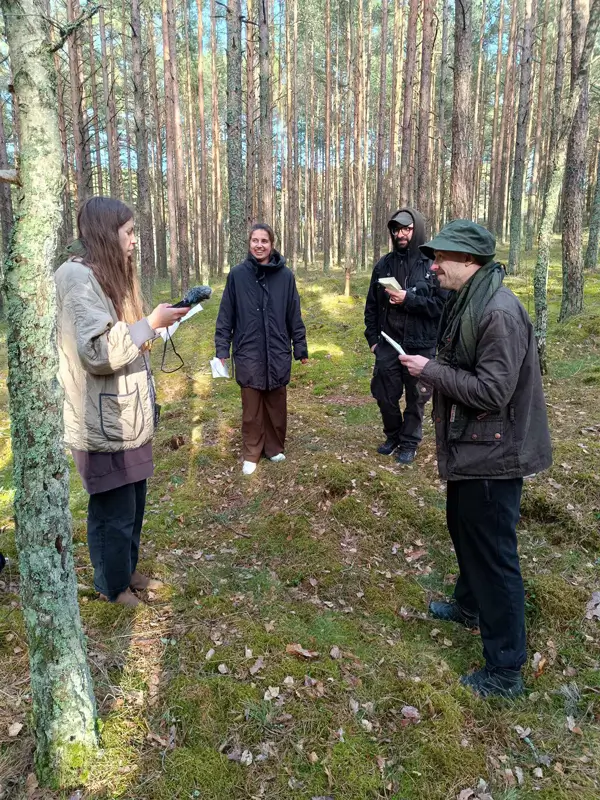
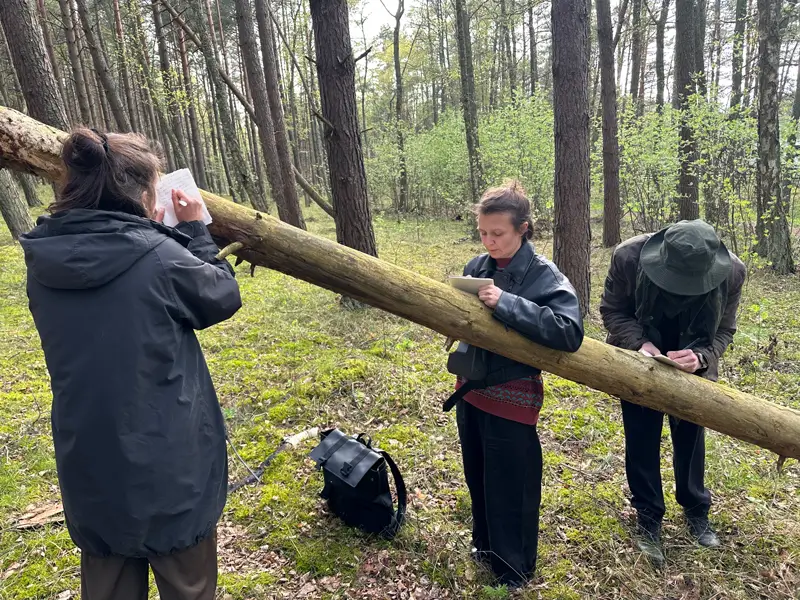
As session leaders, we were each fully responsible for organizing the time, determining the artistic approach, and deciding how to involve in the process the rest of the group. This could take the form of collective tasks or individual assignments that addressed each participant’s role within the process. The more condensed process of the experiment allowed us to better capture the changes occurring in the shift of leadership as well as emphasized the required qualities of such a process – ability to adapt quickly, to be flexible and more aware about the surroundings. During one day we had to switch from the rehearsal process focused on the soundscape – recording the sound of the forests and us in it, to visual thinking – observing the surroundings and our interaction with it through the lens of the camera. From engaging with the topic through the physical-movement based tasks, to writing monologues or giving the performative lectures to each other.
Alongside the existing roles of leading and following, each participant during rehearsals was also assigned an individual tasks. Which included: documenting the rehearsal process; taking written notes on the process; formulating questions for the session leader and/or other participants in relation to the ongoing work; and preparing a general reflection on that particular rehearsal. For each session, tasks were assigned randomly, ensuring a dynamic distribution of responsibilities. These individual tasks later served as a framework for our feedback sessions as well as inspired our next step towards the process – each participant would share their experience and insights based on the specific task they had carried out (Figure 3). I noticed that this helped to navigate through the complexity of multitude perspectives, shared responsibilities and strengthen our active engagement in the whole process. This also aligned with an idea of ecosystemic approach – where biodiversity is needed in order for the system to function healthy and productively. As Simone Western notes: “[…] each individual, each part, contributes to the health of the whole system; and to achieve this they must retain their diversity and autonomy.” (Western 2010, 48.) In the experiment, this was achieved not only through what I call the leadershift strategy (the rotation of leadership supported individuality within the collective), but also through the map of functions (randomly assigned individual tasks created a structured space for multiple perspectives on the creative process).
Deer method – Conceptual (aesthetical) approach
The second experiment of Deer Method took place primarily in the forest. This shift of rehearsal space significantly influenced our approach to performance-making, framing it through a more ecological lens. It made us acutely aware of the direct relationship between our aesthetic choices and the surrounding environment. Thus, most of the tasks were developed in interrelational response to the forest itself. The sound of it and our encounters and physical contact with the existing landscape and interchangeable influence for each other. The forest in our rehearsals was approached as a sixth member of our team (Figure 4). Rehearsing in the forest was a decision informed by the outcomes our first experiment, during which we developed the concept of Anthropocene Casting. Where four actors participated in a casting led by deer, auditioning to become one of them – and thereby ensuring their continued existence on this planet. Conceptually, we agreed to develop a performance centered on the relationship between nature and humankind, aiming to shift away from the dominant pessimistic narrative of the Anthropocene. We asked: What if, instead of preparing for the end, we began to imagine new scenarios for survival? What might they look like?
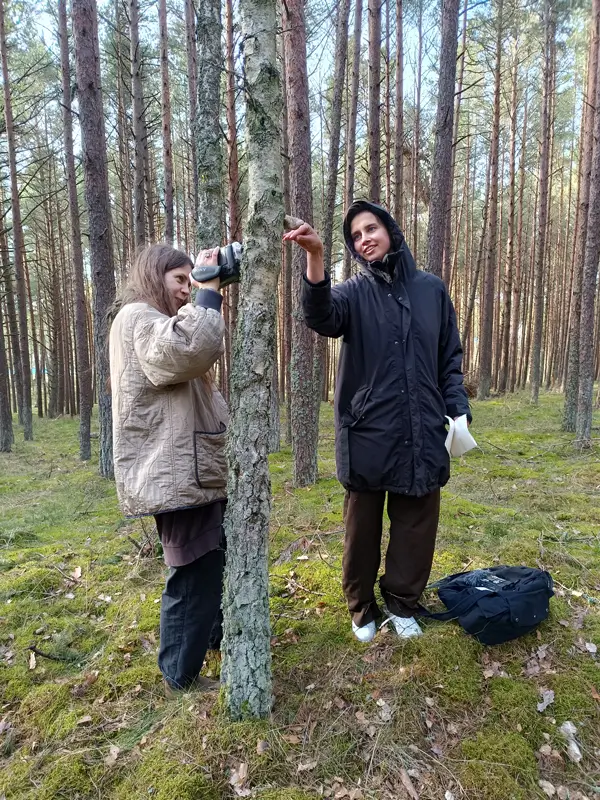
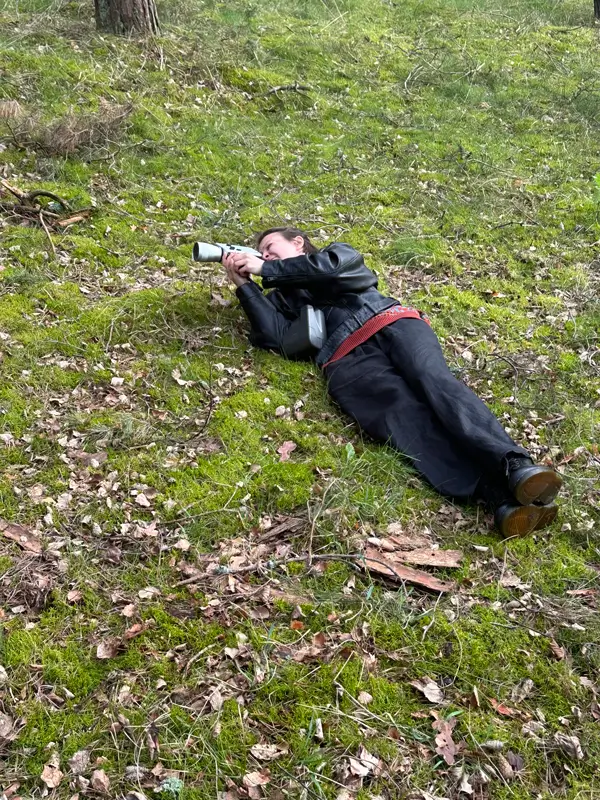
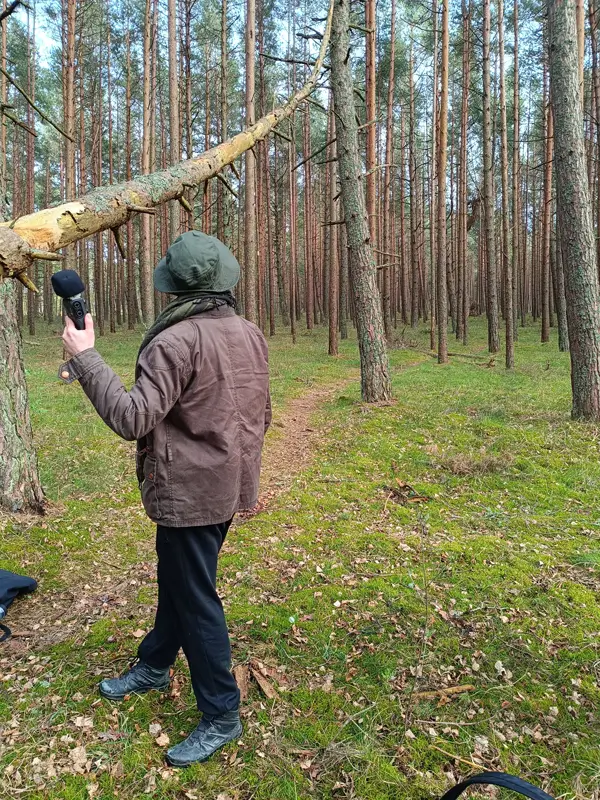
This conceptual form made us search for different modes and values for us to engage with the surroundings. How would it affect our interdependence with ecosystem if from the self-assigned leaders, we would become the followers? In this creative process, we unknowingly performed across several meta-layers: engaging with the concept of power as something to be questioned and reconsidered within the structure of performance-making, while also proposing an aesthetical framework that challenges dominant power relations in a broader ecological context – one that envisions a less hierarchical coexistence between humankind and nature.
I would like to think that the heterarchical structure – which led us from the very beginning to approach the creative process through a radical shift of power dynamics and emphasised the importance of multiple perspectives – was the reason for our conceptual choices towards the artistic projection of performance. For example, in the rehearsal held in Vilnius, I have followed the deer image founded in the very first rehearsal and asked each actor to go outside – into the city center – the urban space and to embark on an individual deer search journey. I asked them to document their journey either through video or audio recordings. When they returned, each had developed a distinct visual and conceptual interpretation of the deer. Some searched for a real animal, others approached the deer as a philosophical concept, and some looked for its presence within human beings. This particular task was a turning point from which we began, through other forms – text, sound, and visual media – to explore the concept of a deer.
Thus, during the second experiment held in the forest, we were trying to engage with a wide spectrum of a deer – as an animal, a spiritual journey and a metaphor. This stream of ideas lead us to focus more on an ecological aspect – how should we involve nature as an aesthetical as well as practical framework in our creative process? What does it mean for us to act together with nature rather than simply advocating for it?
Findings
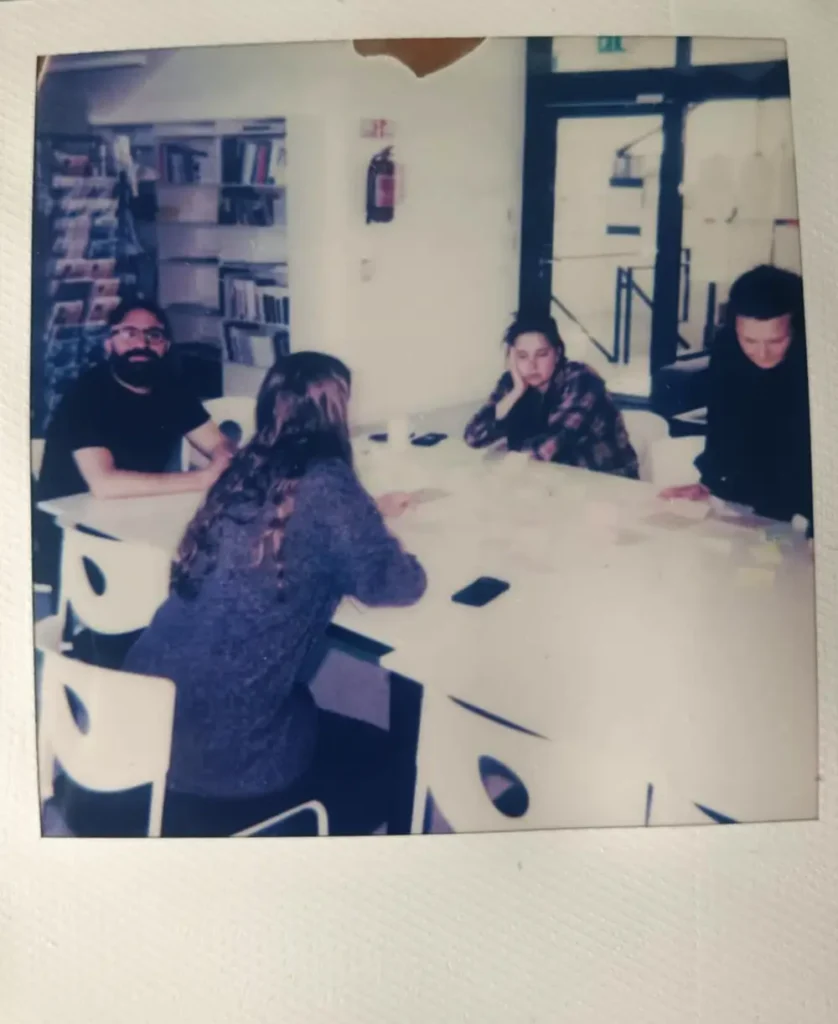
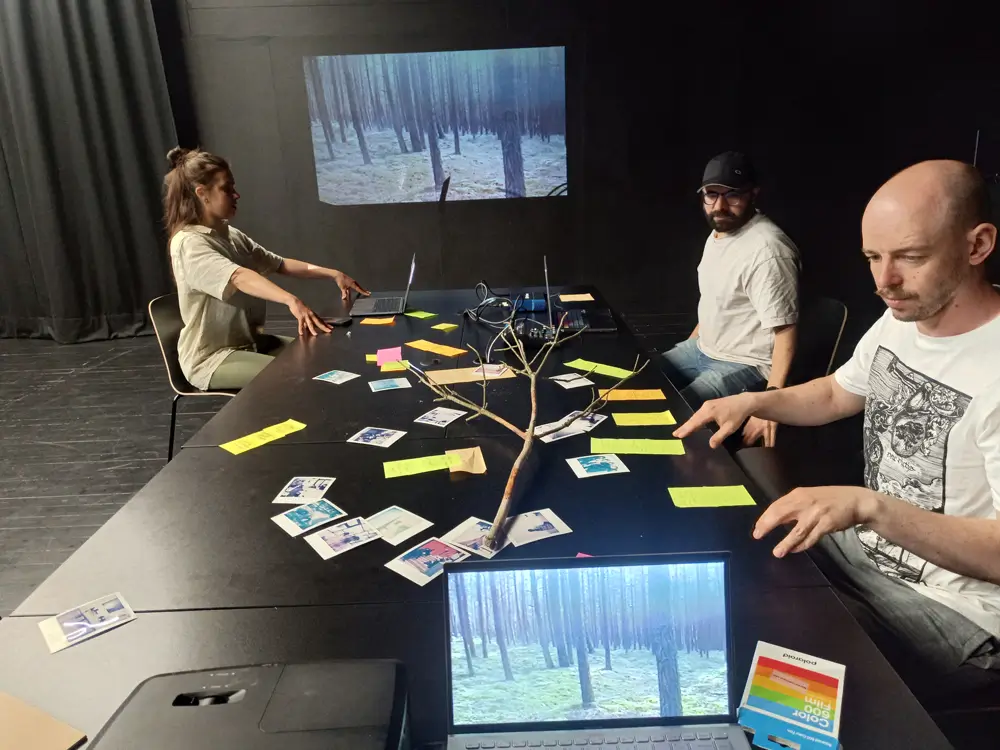
We ended the first experiment by presenting a draft for possible performance in a more conventional setting: actors on the stage, the creative team – behind it. In contrast, the second part of experiment in terms of artistic outcome ended by everyone sitting around the table – sharing one space and becoming one performative body (Figure 5). In a fluid interchange between performative-fictional and reflective-real modes, we shared the outcomes of our creative investigations. We extracted and shared the images and experiences that had resonated with us most deeply. In this way, we arrived at something akin to a performative lecture – a hybrid form that merged artistic research (a reflection on the creative structure we had tested) with artistic practice (a performative sharing of what had been generated within that structure).
I believe that the transformation of the performing body across the first and second parts of the experiment was directly influenced by the modes of interaction we engaged in during the process. In the first experiment, we “met” as a creative team only through the presence of the actors – they served as medium for both conceptual and aesthetic proposals. This decision was inspired by the ethics as well as aesthetics of collaborative creation practice. However, this model still kept us within the boundaries of our conventional roles, tied to predefined expectations of what each of us was supposed to contribute. Also, considering the ethical dimensions, it felt that the actors, even though they had a crucial part in the process as mediators, did not have as much responsibility in terms of decision making and process shaping as the rest of the team members.
In contrast, during the second phase, we were not only physically present at each other’s rehearsals but also actively participated in them. As a result, our roles began to expand, reaching into a more liminal space where expectations were less fixed. This shift in how we related to the process – and to one another – began to generate a new sense of equality within the group, forming new working ethics.
The rotation of leadership made us to remain highly adaptive and open, constantly shifting between the roles we represented and those of a follower or active participant. We were able to zoom in on micro-aspects of the task and later to observe the whole process in a broader context. Additionally, the individual functions – helped clarify responsibilities and deepened both individual and collective involvement.
This experience strongly resonates with the theory of eco-leadership, which expands the idea of leadership beyond individual traits or styles, emphasizing instead networks, relationships, and systems thinking. While the term doesn’t necessarily refer to ecological issues directly, it draws on the concept of ecosystems and emphasizes holistic thinking – something that inherently includes, rather than ignores, the environment. As Simon Western notes, in contrast to traditional leadership narratives that emphasize the “great man” theory, eco-leadership finds its roots in marginalized, grassroots movements that drive innovation and meaningful change. (Western 2010, 42.) This type of leadership challenges traditional top-down, hierarchical models by advocating for heterarchy – a fluid and distributed structure of influence. The heterarchical structure, tried in both experiments highlighted the significance of collaboration as a co-existential act, where what becomes important is not so much the team members’ individual pursuit of authorship (ego), but the interdependence and the ability to act together with the others (eco).
Analyzing the processes of The Deer Method I and II through the lens of eco-leadership theory helped me to answer the question of how, as a collective, we arrived at an ecologically concerned artistic concept – the symbiosis of urban life – human being and nature – deer. As one of the principal guides of an eco-leadership, according to Simon Western, is the acknowledgment of the environment – or an external landscape in his term, which shapes and affects the inner worlds (Ibid. 44). Following this thread, I would argue that our practical experience – particularly the structure of our work, which emphasized interchangeable dynamics shaped our conceptual thinking. The lived experience of synergy among us as creators and human beings awakened our awareness of interconnectedness on a broader scale. In turn, this opened us up to exploring more diverse relationships and interrelations with the environment.
Conclusions
To conclude, in the discussed case study, the heterarchical approach generated a threefold effect that supports the principles of an ecological approach to theatre-making. By rotating leadership and sharing responsibility, the process mirrored the dynamics of an ecosystem, where adaptability, responsiveness, and co-authorship could emerge in a more structured way. The applied strategy not only challenged conventional artistic roles but also created a framework in which the work could grow through genuine collective symbiosis. Moreover, The Deer Method itself invited performers into dialogue with the environment, using embodied encounters – such as the search for deer in outdoor spaces – as material for performance-making. This methodological choice dissolved boundaries between performer, environment, and material, positioning ecology as something lived and practiced, not merely referenced. Aesthetically, the process generated the concept of The Casting of the Anthropocene, a performance that questioned human–nature power dynamics and shifted the very notion of the performing body: everyone shared one space, dissolving divisions between stage and backstage.
The experiment of The Deer Method suggests that sustainable performance-making does not begin with ecology as a theme, but rather with an ecological approach as a method. Heterarchy not only reflects the structural functioning of ecosystems but also nurtures the core values of coalition: building and sustaining networks while supporting individual perspectives. It creates a space where the ethics of collaboration remain vivid and are continually revised in relation to the participants of the process. Embedding heterarchy as a directorial strategy within the creative process of performance-making may be one way to support ecological thinking in the context of practical artistic engagement. This, in turn, influences the aesthetic and conceptual approaches to the outcomes of the creative process, fostering a heightened ecological awareness.
References
Crumley, L. Carole. 1995. “Heterarchy and the Analysis of Complex Societies.” Archaeological Papers of the American Anthropological Association 6(1): 1–5.
Radosavljević, Duška. 2019. “The Heterarchical Director: A Model of Authorship for the Twenty-First Century.” In Director’s Theatre, edited by David Bradby, David Williams, and Peter M. Boenisch, 247–269. London: Red Globe Press.
Western, Simon. 2010. “Eco-Leadership: Towards the Development of a New Paradigm.” In Leadership for Environmental Sustainability, edited by Benjamin W. Redekop, 36–55. London and New York: Routledge.
Contributor
Monika Klimaitė-Daunienė
Monika Klimaitė-Daunienė: I am a Lithuanian theatre director and researcher. I received BA degree in Theatre Directing at Klaipeda University and MA degree in Performance Practices and Research at Royal Central School of Speech and Drama, University of London in UK. At the moment I am a PhD student in artistic research at Lithuanian Academy of Music and Theatre. My artistic research focuses on the decentralization of power structures in the process of performance making and investigates the changing role of director and the requirements of directorship in the environment of collective creation.