This paper is a reworking of the presentation at CARPA9, in which I shared findings from my ethnographic research on Jola masquerades. In the presentation, I used images to familiarise viewers with the aesthetic and context of these masquerades. I brought examples from the practice to illustrate the ecological web that connects different aspects of a performance ecology and how these aspects are changing or engaging with the aesthetic of Jola masquerade practice. This paper would not have been possible without the collaboration of kumpo performance groups and my interpreter, Lamin Jarju, in The Gambia. They shared their time and knowledge with me between 2018 and 2023. As a non-Jola, I hope to present the masquerades and the Jola belief system with integrity towards the community and its ancestry.
Introduction
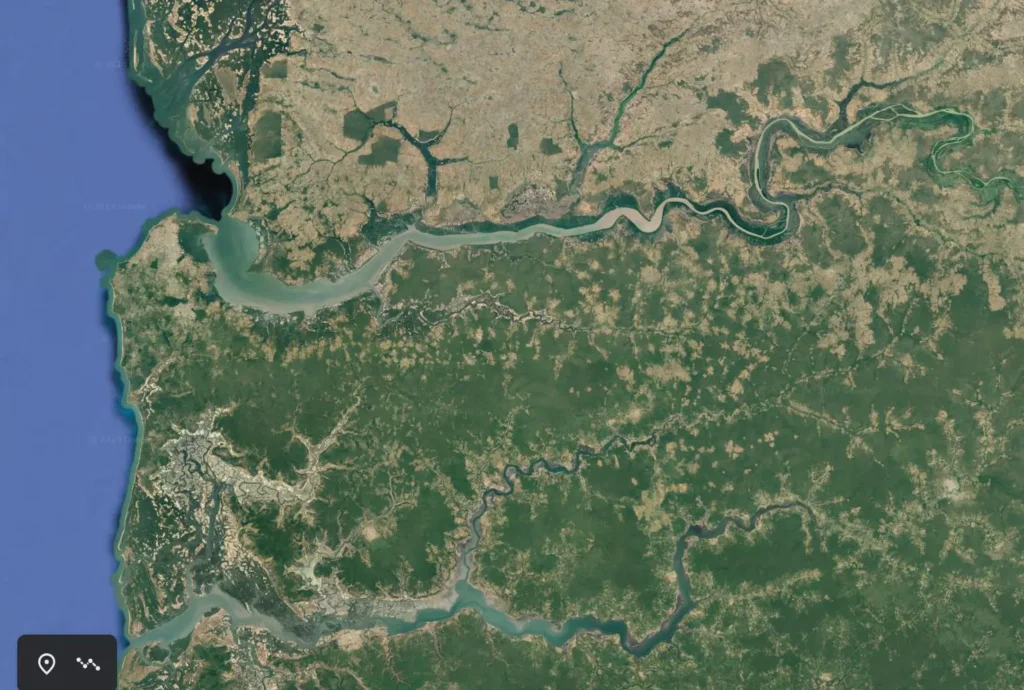
The kumpo masquerade, also known in Jola as fusanyellaf, is a tradition of the Jola people, who reside on the West coast of Africa. For this research, I followed kumpo performance groups in Senegambia. Specifically, the area between the River Gambia and the Casamance River, as shown in the image below. The area in between traverses two countries, The Gambia and Senegal, whose borders are not visible in that image. I do so intentionally to situate my research in the land and in the ways performers identified and read the land. In Jola epistemology, land is viewed as a source of sustenance for the family, including the sustenance of a spiritual life (Niang 2019, 31). The geographical borders of The Gambia, my home from 2018 to 2023, are evidence of opportunistic land-grabbing that occurred throughout its colonial history. However, the indigenous Jola people across West Africa are historically, ethnically, and culturally intertwined. The river and their position towards it constitute part of their cultural identity. These rivers and their banks provide Jola communities today with the particular ecosystem they have become culturally intertwined with, alongside other human and more-than-human, including spiritual more-than-human communities. Thus, in Jola epistemology, land is not merely material territory. It is a source of sustenance, corporeal and spiritual, material and ancestral, without a clear distinction between these realms. I contextualise the kumpo masquerade within this indigenous epistemology. In this chapter, I summarise the main components by exploring the masquerade’s aesthetic, its relationship with the sacred forest and its place within Jola ecotheology. Traditional masquerade performances exemplify a sustainable practice, working using natural resources and locally produced, or reusable materials, leaving no traces of performance when it ends. Because of this, and its embedded ecospiritual values, I analyse kumpo as ecoperformance. In the second part of this chapter, I draw three examples from my ethnographic observations to illustrate how the practice is changing in these relations as it adapts to the ecological crisis.
Kumpo and the Jola sacred forest
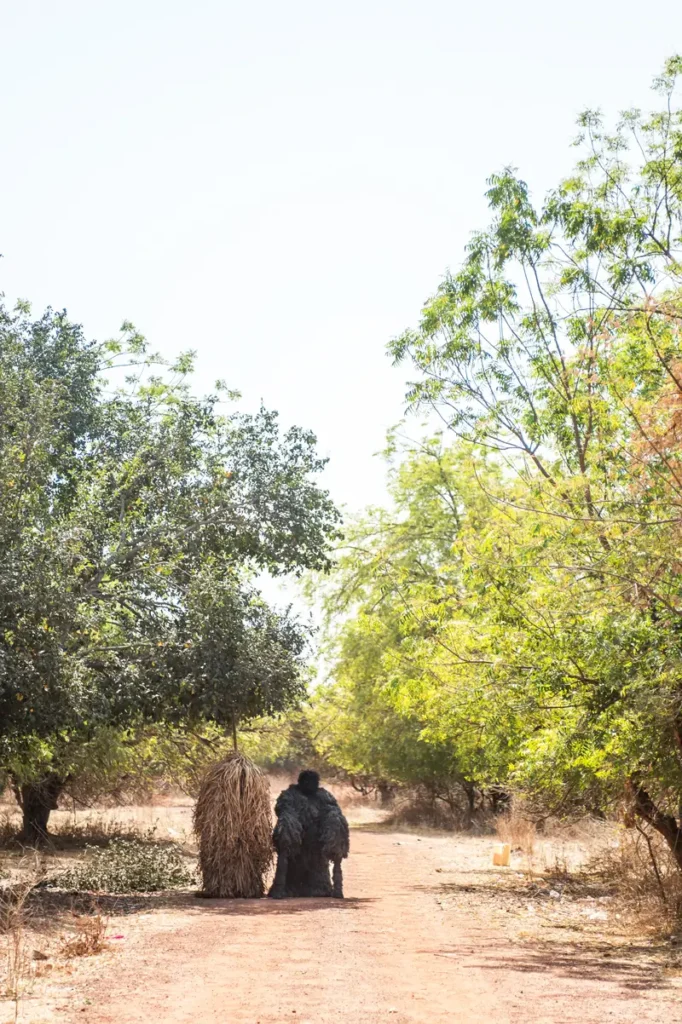
Kumpo performance refers to a group of masquerades that perform during a kumpo programme. Kumpo is also the common name for the main masquerade of a kumpo programme. Other masquerades can be seen accompanying the kumpo, such as the agomela and samay, as seen in Figure 2. These two masquerades are photographed as they emerged from the sacred forest on a hot January afternoon in Janjangbureh, The Gambia. During fieldwork, kumpo performers defined these masquerades as spirit animals of the sacred forest, attributing the forest as the home of these masquerades. This definition reinforces the connection between the sacred forest and the masquerades.
Sacred forests are specific sites in the forest marked for their spiritual powers to protect, heal and provide spiritual strength (Gamble 1976). The book Historic Sites of the Gambia explains how the life-giving power associated with the life-force found in trees and water imbues the site with spiritual strength (NCAC Gambia 1998). Its material environment supports the mysterious nature of these sites by providing privacy through deep, impenetrable vegetation that hallows the grove (Isaac 1964 in Park 1994, 250). Isolated, remote and hallowed attributes are integral to the ecological landscape of sacred forests, and their “nature” demarcates the sanctity of these sites. Thus, the sacred forest’s materiality imbues the site with its spiritual and cultural significance. Similarly, this overlap between the physical and metaphysical realms is also seen in the Jola worldview, which regards the sacred forest as a site of ancestral connection. As performers explain, the sacred forest is a place where they can connect with their forefathers and thus embodies both the cultural and spiritual spheres in the physical forest. Their ancestors stood in the same forest and knew the same trees. Additionally, indigenous Gambian oral history documented by Weil describes how spirits “live in bushes and trees” (Weil 1971, 283). The semantic dichotomies embedded in Weil’s choice of words here denote an inside/outside duality that does not accommodate Jola ontology, which does not designate the finality of spaces, boundaries, and functions in the same way. However, Weil’s writings continue to emphasise the forest’s significance in juxtaposing the spiritual, natural and cultural realms.
The connection between the performance practice and ecospirituality is manifest in kumpo’s connection with the sacred forest. Although the sacred forest is not a main feature during the performance duration, it remains central to the performers’ understanding of kumpo. They describe the masquerade as emerging from the sacred forest, and the forest is a central location for performance-making processes through preparatory practices and oral history. The rhun palm leaves, from which the masquerade is made, are sourced from the forest, as are other sticks and branches that privileged individuals carry and use during the performance, serving as a reminder of the connection to the sacred forest. The sacred forest is an integral part of the grassroots approach to performance preparation, where collective decision-making is traditionally practised in these areas. Together, these connections suggest that the masquerade functions as an extension of the sacred forest, communicating (in fact, dancing) with humans as an intermediary with the spiritual world – a spiritual more-than-human. (See Ukaegbu 2013.)
During the performance, songs continue to elaborate kumpo’s connection to the sacred forest and the latter’s spiritual power and identity. One of these songs is documented by Girard, who records:
Chant No. 34
| Mafousi! Sous sans crainte. | Mafousi! Have no fear. |
| Cette année, nous vos grands-parents, | This year, we your grandparents, |
| Vous conduirons dans la grande forêt | Will lead you into the great forest |
| Pour vous y circoncire. Vous y serez libre de danser, de dire n’importe quoi. | To circumcise you there. You will be free to dance, to say anything. |
| Voilà vos mères qui derrière vous. | Here are your mothers crying behind you. |
| Agitez plus fort cette cloche que vous avez en main. | Shake that bell in your hand harder. |
| (Girard 1969, 345, my translation.) |
Between performances, oral history continues to support the kumpo’s connection with the sacred forest through narratives passed down and repeated across generations. These narratives emphasise the masquerade’s spiritual power and identity as a spiritual animal from the sacred forest. Thus, I argue kumpo operates as an extension of the sacred forest, connecting the natural, social and spiritual world, serving as a divine intermediary.
Kumpo’s role as a divine intermediary is rooted in Jola indigenous ecotheology, which endows animals with this capacity. Previously, I mentioned that kumpo is the common name for the masquerade. Performers shared that, although it is commonly referred to as kumpo, which in Mandinka means “mystery” or “unknown,” the word “kumpo” does not originate with the indigenous community. Instead, performers refer to the masquerade as fusanyellaf, which in Jola means “porcupine”, a nocturnal animal found in West African forests. Its sharp quills have been documented in ethno-medical research on Jola traditional medicine, where “The Quills [are] burnt into ash and sprinkled onto sore” (Madge 1998, 301). The porcupine resembles the masquerade, especially during the masquerade’s virtuosic whirl, when its “quills” rise and move. Other masquerades can also be seen through this lens, as they embody animals or animalistic qualities and imbue them with the spiritual qualities associated with them in Jola ecotheology. Using this indigenous framework, the fusanyellaf has deep connections embedded in the indigenous ecosophy that connect it with the natural world. These connections are embodied and performed in the dramaturgy. From this perspective, it is alarming to recognise the repercussions arising from recent epistemological and dramaturgical fractures with the sacred forest, driven by deforestation, river salination, land commercialisation and migration. The connection to the sacred forest is challenged by the ecological crisis, altering the practice’s dramaturgy and affecting the ecosophy cultivated by kumpo performance.
Climate and crisis
“The Gambia is ranked among the top ten countries in the world with the highest share of population living within the lower elevation coastal zone” (Bah et al. 2018, 2). The climate crisis and the introduction of industrial exploitation are forcing displacement within Jola communities to escape devastating environmental collapse. Jola communities seek fertile land to grow their food because soil salination compels families to abandon their rice fields as they can no longer be used for crop production (Ibid 5.). The state of the river and the nearby rice fields, which enable Jola communities to grow rice, is a source of livelihood and also connected to the sustenance of a spiritual life within the Jola indigenous worldview. Faced with the threat of rising water levels, submerging land, coastal erosion, and the water’s changing composition, Jola people are displaced, leaving their rice paddies and ancestral land in search of greener pastures. A deterioration in the physical environment is understood to be deeply connected to a perceived crisis in spiritual connection. Cultural practices, such as dance, prayer, or song, can be performed in response to physical crises, such as drought and flooding. Natural occurrences, such as “the locust plagues and the recurrent droughts of the 1780s” (Baum 1999, 91), are also understood to be connected to metaphysical crisis and “generated new questions about the place of the individual in relation to family, community, and the spiritual world” (Ibid. 86). Because of these connections in Jola ecosophy, the climate crisis and localised environmental devastations are not isolated or understood as singular events. Thus, I refer to the Polycrisis, which highlights the ties between the climate crisis and other “slow violences” (Nixon 2011) across different domains. The examples I bring in this chapter relate to climate change, but also to a changing economic and ecosophical climate.
#1
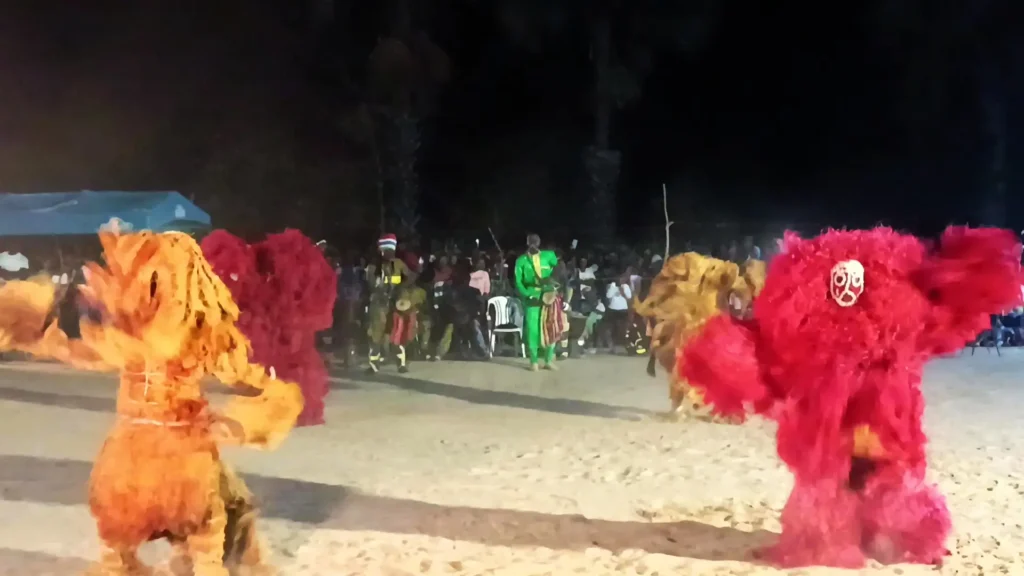
Climate displacement is posing several challenges for kumpo performers. The sacred forest, previously accessible from the village, is now, at times, too far to reach regularly or has become nonexistent because the performer has moved to an urban centre. Performers described that it is now more challenging to find the natural materials they need for the masquerade. Other masquerades besides the kumpo are increasingly made from synthetic fibres, often woven from and dyed rice or potato sacks (see Figure 3). Elders have raised concerns that this shift does not follow tradition and must, therefore, be avoided. As yet, there has been no advancement in replacing the natural materials of the kumpo with synthetic materials. However, the agomela, seen today accompanying the kumpo, has evolved from the traditional nyass masquerade made from plants. (Interview with Niasse, Niasse and Niasse 2021.)
Climate displacement and labour migration is causing difficulties in other areas of the practice, such as the masquerade’s informal transmission of knowledge and craft from father to son. Abandoning salty fields on indigenous Jola territory that can no longer sustain their families, young people move to more urban centres in search of better opportunities. A prominent cultural manager described:
From the Badibus to Koina [across The Gambia] the fields are getter saltier. So, if you are a rice farmer, maybe now you want to come to Serrekunda to be a watchman. […] Now usually maybe these were kumpo experts. Meaning, they know how to tie the kumpo, how to dance the kankurang, how to beat the drum for the kankurang and so on. I mean, the context in most cases, if you find yourself in an organization like Brusubi, staying with an uncle or, you know, with a nephew. The likelihood is that, a breakdown in transmission chain […] I mean, what it [climate migration] does basically is to deplete the villages of this knowledge, about masking traditions.
(Interview with Saidy 2023.)
Practices that depend on familial informal transmission, such as kumpo, are more difficult to pass on from one generation to the next because of decreased interest and exposure.
Performances may take place either in the village or in urban settings. When held in the latter, they are typically requested by hotels, companies or festival organisers. In these cases, the masquerades no longer emerge from the sacred forest but instead appear from private rooms or even swimming pool bathrooms (de Jong 1999, 64). As performances become more popular in urbanised areas, staged at commercial festivals in schools, car parks or hotels, the connection with the sacred forest is severed. This shift is significant, as the data collected indicates that the sacred forest, kumpo, and ancestry are deeply interwoven and together imbue sacredness and significance within the practice through indigenous ecosophy. Unravelling the connection of the masquerade from its forest origins unties the practice’s ecosophical values, weakening the link between the natural and the spiritual realms and no longer performing the sacred forest as a source of mystical power. Consequently, distance from the sacred forest disrupts the Jola community’s relationship with the natural world, particularly within faith communities that “regulate their interactions with the natural world, as a religious duty” (Golo et al. 2023, 5). Kumpo manifests Jola ecosophy, and driven by environmental pressures, changes in kumpo dramaturgy are evidence of the adaptations Jola communities are making in their interactions with the natural and spiritual world.
#2
The second example rests on the premise that the climate crisis cannot be separated from the Capitalocene. In my field site, the Capitalocene does not reflect a peak of capitalist or industrial practices, but rather the early stages of prioritising financial profit and economic growth. These emerging economic goals contrast with the egalitarian, subsistence-farming lifestyle Jola communities have maintained until recently. The performers I interviewed belong to the generation shifting away from rain-dependent rice farming on inherited land toward opportunities for income, employment, tourism and broader economic participation through performance practices. I observed an economic shift toward valuing productivity, where even cultural practices are reframed as forms of economic capital. This transformation is evident in the rise of private cultural troupes. While kumpo groups usually belong to each village, private cultural troupes select and train their own members.
Traditionally, kumpo is performed by the community for the same community, as travel is difficult without public transport and accessible roads. Today, the ability to travel from place to place, including access to remote areas, is accelerating the development of festivals. Festivals featuring kumpo are wildly popular and raise funds to support the host village by building roads, water tanks and taps, paying for communal electricity, or developing the local school and clinic. They raise funds through charging tickets ranging from 50 to 1000 Gambian Dalasis (1000 Gambian Dalasis was about 12 British Pounds in June 2023). I argue that these tickets introduce a new dynamic, shifting a circular community-participant-masquerade relationship into a paid-paying binary.
These festivals often seek to hire or involve private performance groups to cater to their specific audiences. Private performance troupes do not practice village-wide collective custodianship like village kumpo groups, nor do they seek to cultivate traditional Jola cosmology. Private troupes seek to entertain a diverse audience, whether Jola, Mandinka, Gambian, or other foreign. In essence, the troupe performers are for those who don’t belong to the village community and who are unaware of the performance’s expectations. Many festivals today accommodate the safety, comfort, and security of a new kind of spectator: the passive onlooker, unaware of local knowledge. A new stratum of spectatorship is emerging, comprising spectators who actively participate in the performance, while others watch from the sidelines. These accommodations change the conditions in which the performance takes place. These adjustments resulted in performances with a more rigid beginning and end, simpler spatial dynamics, restricted participation, and general tidying up of the surroundings, including the provision of chairs, police security, and tickets. De Jong observed similar trends that “Tourists and officials are allowed to attend the mask performance without being subjected to his authority” (de Jong 1999, 68). Festivals attract more foreigners each year and are enforcing more Euro-American ideals and values of performance. For example, the masquerade is prohibited from using physical threat. In 2022, the Janjangbureh Kankurang Festival invited the local prison police to help control the audience, especially local children, who trespassed the ropes separating the paid sections of the audience. When sanitised performance conditions are challenged by traditional practice, festival organisers reprimand the masquerade, challenging the traditional non-anthropocentric hierarchy it previously enjoyed. Traditionally, kumpo demanded fear and reverence as spiritual messengers punishing social or cultural transgressions.
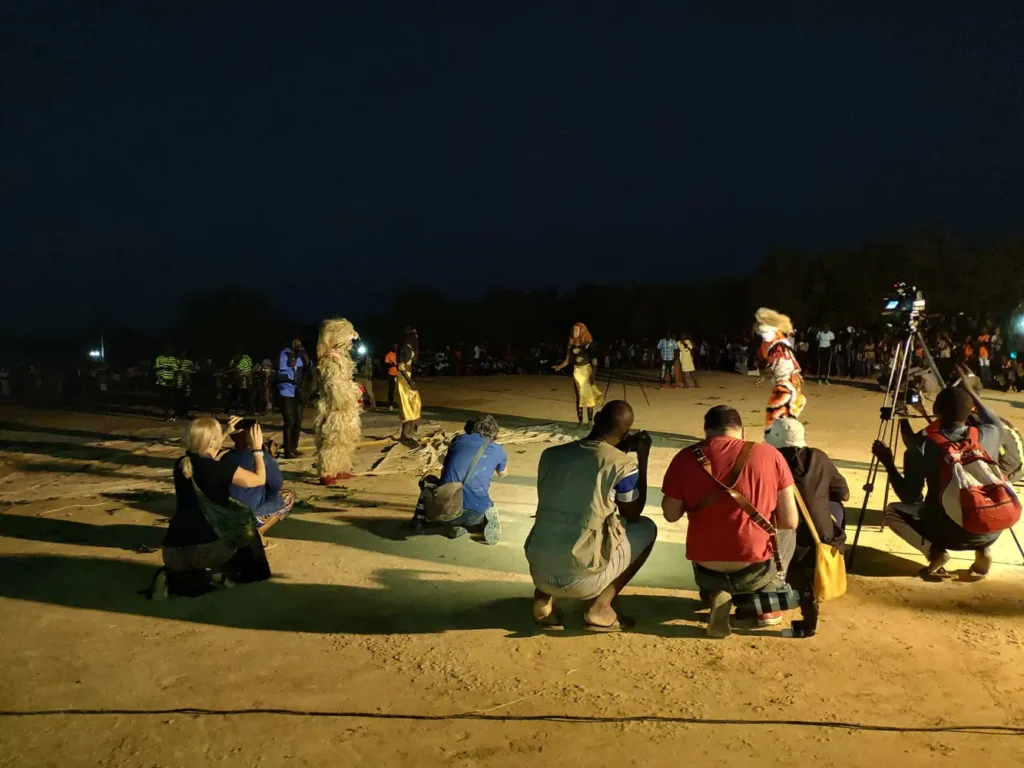
Today, the masquerade performs to new audiences, including the digital world, as a new form of spectatorship (Figure 4). Practitioners have commented that the kumpo masquerade is more virtuosic and popular, performing for the media, camera and mobile phones: The camera lens framing the cultural practice as a currency for consumption. I argue that sanitising the performance’s conditions compromises the practice’s nature, especially its ability to cultivate ecological beings.
#3
I argue that the changes and adaptations I have described so far lurk as slow violences on the indigenous ecosophy that, through cultural practices, previously cultivated a value system that brought together the spiritual, natural, and cultural realms, which are now being segregated and reflected in the aesthetic responses. The increase in commercialisation and mobility has accelerated the rise of private troupes and new audiences, distancing the practice from its original home – the sacred forest and the Jola community. Additional distance from the sacred forest and a weakening village community (due to climate change and labour migration) may shift the performance home to a placelessness that cannot fully reinforce the exact extent of socio-ecospiritual connections. Heim’s warning of impending forms of conflict following displacement resounds here, shifting “home” from a place of cosmological integration and dwelling to one of anonymity and placelessness. This schism in epistemology and the obvious uprooting, “driven by the technology and economics of globalization seem to catalyze an increasing sense of homelessness” (Grim et al. 2018, 18). I argue that this distancing is fostering a practice of homelessness, placelessness – a generalised masquerade practice – losing access to its sacred spaces, ancestral land, and the collective imaginary of its custodians.
Conclusion
My observations in the aesthetics and dramaturgy of kumpo masquerade highlight that, with increasing pressure from the climate crisis and the shifting economic and ecosophical climate, the practice is becoming more placeless. The relationship between the practice, its practitioners, and onlookers is changing the masquerade’s identity, moving it from being treated as the powerful, more-than-human to being a subject of anthropocentric and capitalocentric expectations. Having studied a practice that cultivates human and more-than-human relationships, and having watched it adapt to value consumption and capitalist gains, I am inspired to ask: Is the practice part of the currency of productivity? How can ecoperformance, or any performance, seek to prioritise cultivating values and relationships rather than capitalist practices of consumption?
References
Akubor, Emmanuel Osewe. 2016. “African Concepts of Masquerades and their Role in Societal Control and Stability: Some notes on the Esan people of Southern Nigeria.” Asian and African Studies 25: 32–50.
Anyebe, Ted. 2015. “Masquerade Performance Tradition of Idoma: Issues of limitation and methodological approaches in research.” Global Journal of Human-Social Science: A, Arts & Humanities – Psychology 15: 1–10.
Arons, Wendy and Theresa J. May. 2012. Readings in Performance and Ecology. Basingstoke: Palgrave Macmillan.
Bah, A., B. M’koumfida, and S. Yaffa. 2018. “The Impacts of Saline-Water Intrusion on the Lives and Livelihoods of Gambian Rice-Growing Farmers.” Research & Reviews: Journal of Ecology and Environmental Sciences 6.
Banahene Adjei, Paul, and George Sefa Dei, eds. 2014. Emerging Perspectives on “African Development”: Speaking differently. New York: Peter Lang.
Baum, Robert. 1999. Shrines of the Slave Trade: Diola religion and society in precolonial Senegambia. New York: Oxford University Press.
Bojang, Jonkong. 2000. “Village perspectives of community forestry in The Gambia: The Jarrol-Bondali-Kansala JABOKA Community Forestry Association.” Proceedings of the International Workshop on Community Forestry in Africa. Food and Agriculture Organization of the United Nations, ed. Banjul, The Gambia.
de Jong, Ferdinand. 1999. “Trajectories of a Mask Performance: The case of the Senegalese kumpo (Itinéraires des Spectacles de Masques: À propos des masques kumpo sénégalais).” Cahiers d’Études Africaines 39: 49–71.
Denzin, N. K., Y. S. Lincoln, and L. T. Smith, eds. 2008. Handbook of Critical and Indigenous Methodologies. Los Angeles: SAGE Publications.
Gamble, David. 1976. Accounts of supernatural beings: spirits, witches, werewolves, Ninkinanko, etc. from the Mandinka newspaper, Kibaro. San Francisco: UCLA Library Special Collection.
Girard, Jean. 1969. Genèse du Pouvoir Charismatique en Basse Casamance (Sénégal). Dakar: Institut Fondamental d’Afrique Noir.
Golo, Ben-Willie Kwaku, Hasskei Mohammed Majeed, and Nancy Oppongwaa Myles. 2023. “Akan Religious Ontology and Environmental Sustainability in Ghana.” Worldviews: Global Religions, Culture, and Ecology 27: 86–114.
Grim, John, Willis Jenkins, and Mary Evelyn Tucker, eds. 2018. Routledge Handbook of Religion and Ecology. London: Routledge.
Heim, Wallace. 2016. “Theatre, Conflict and Nature.” Green Letters 20: 290–303.
Kanu, Anthony Ikechukwu, ed. 2021. African Ecological Spirituality: Perspectives in anthroposophy and environmentalism – A hybrid of approaches. Maryland: The Association for the Promotion of African Studies.
Kanu, Anthony Ikechukwu. 2022. African Eco-Philosophy: Cosmology, consciousness and the environment. Bloomington: AuthorHouse
Madge, Clare. 1998. “Therapeutic landscapes of the Jola, The Gambia, West Africa.” Health & Place 4: 293–311.
Mark, Peter. 1992. The Wild Bull and the Sacred Forest: Form, meaning and change in Senegambian initiation masks. New York: Cambridge University Press.
Mbiti, John. 1969. African Religions & Philosophy. London: Heinemann.
National Council for Arts and Culture (Gambia). 1998. Historic Sites of The Gambia. The Gambia: NCAC.
National Council for Arts and Culture (Gambia). 2016. Kankurang and Other Masking Traditions of The Gambia: An Exhibition. The Gambia: NCAC.
Niang, Aliou Cissé. 2009. Faith and Freedom in Galatia and Senegal: The Apostle Paul, Colonists, and sending Gods. Boston: Brill.
Niang, Aliou Cissé. 2019. A Poetics of Postcolonial Biblical Criticism: God, human-nature relationships and Negritude. Oregon: Cascade Books.
Nixon, Rob. 2011. Slow Violence and the Environmentalism of the Poor. Cambridge: Harvard University Press.
Park, Chris. 1994. Sacred Worlds: An introduction to geography and religion. London: Routledge.
Ukaegbu, Victor. 2013. “Re-Contextualising Space Use in Indigenous African Communal Performance.” In Performative Inter-Actions in African Theatre 3: Making space, rethinking theatre and drama in Africa, edited by Kene Igweonu and Osita Okagbue. Cambridge: Cambridge Scholars Publishing.
Various kumpo groups. 2019–2023. Interviews, Performance Observations and Personal Communication in The Gambia. Janjangbureh, Berrending, Bignona, Kartong, Banjul, The Gambia.
Weil, Peter. 1971. “The Masked Figure and Social Control: The Mandinka Case.” Africa: Journal of the International African Institute 42: 279–93.
Contributor
Aldith Gauci
Aldith Gauci is a performance researcher interested in performance ethnography, decolonising methodologies and ecoperformance. Her research interests are framed by her pursuit of alternative knowledges in response to the Capitalocene and the Polycrisis. She looks towards somatic practices and alternative economic models to inspire ecological responses in performance and performance studies. Her PhD (University of Exeter) looks at Jola Masquerades as Ecoperformance and she holds an MA in World Theatre from Aberystwyth University.