During the CARPA 2025 conference held in Helsinki, we presented a sound performance that took place in a courtyard at the Sörnäinen campus of Uniarts Helsinki. The event involves the design and construction of alternative-energy electroacoustic instruments, as well as the development of performance techniques and embodied gestural vocabularies for group improvisation in outdoor settings. Placing ecological awareness at the core of the performative act, our artistic dispositive aim to foster an immediate and situated engagement within the milieu of the performance and to allow scrutinising from an experiential perspective the emerging relationality with both human and non-human agencies.
Keywords: performance milieu, corporeal empathy in listening, sustainable electroacoustic practices, microphenomenology, sensuous ecology
Performing in urban outdoor settings
For the CARPA 2025 conference held in Helsinki, we proposed to collectively experience the milieu generated by a performance using custom-designed instruments. We were three performers. The audience comprised about fifteen persons.
Performers and audience members circulated freely and interacted with each other as well as with the qualities of the built space (architecture, materials, colours, shadows, acoustics, ventilation sounds); the qualities of the urban space (distant sounds, air quality, ambiance or atmosphere); the manifestation of more-than-human life phenomena and energy (vegetation, rain, wind, sun, birds, radio waves).
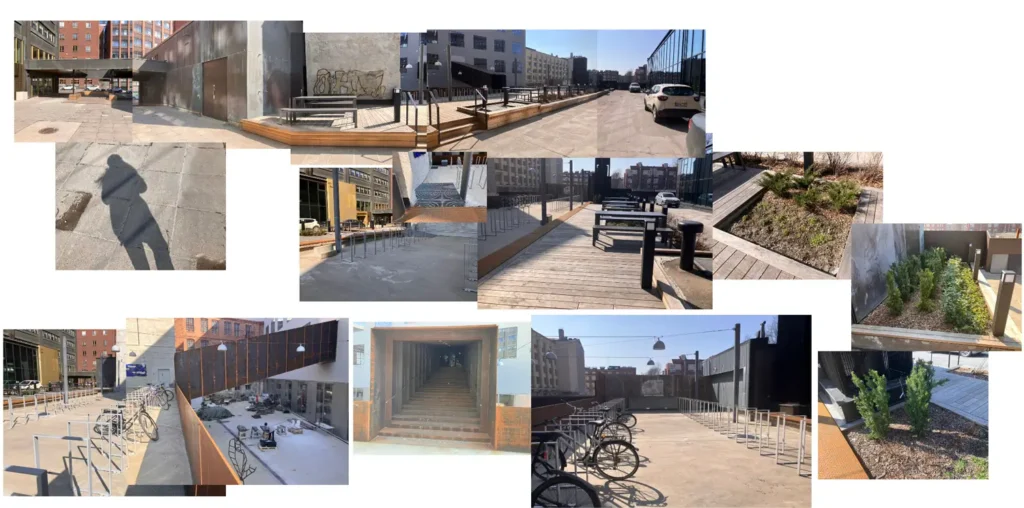
Short description of the performance
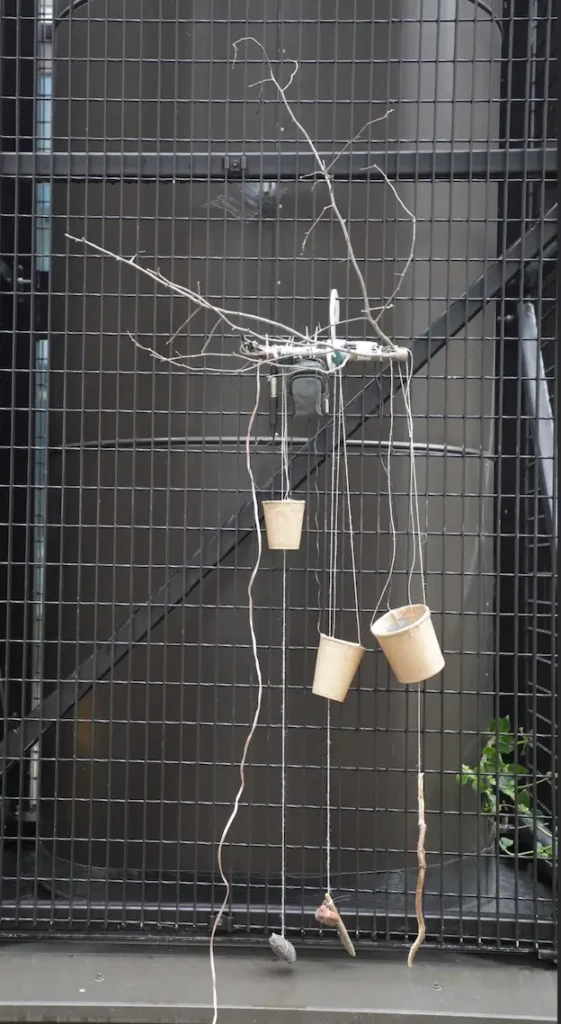
The day of the performance, the weather was not kind; it was cloudy and rainy. We had been present on site for two hours to test our instruments under these weather conditions, which was crucial for our instruments’ functioning. We installed some instruments in the planted flowerbeds, as well as a speaker connected to a Cup Harp.
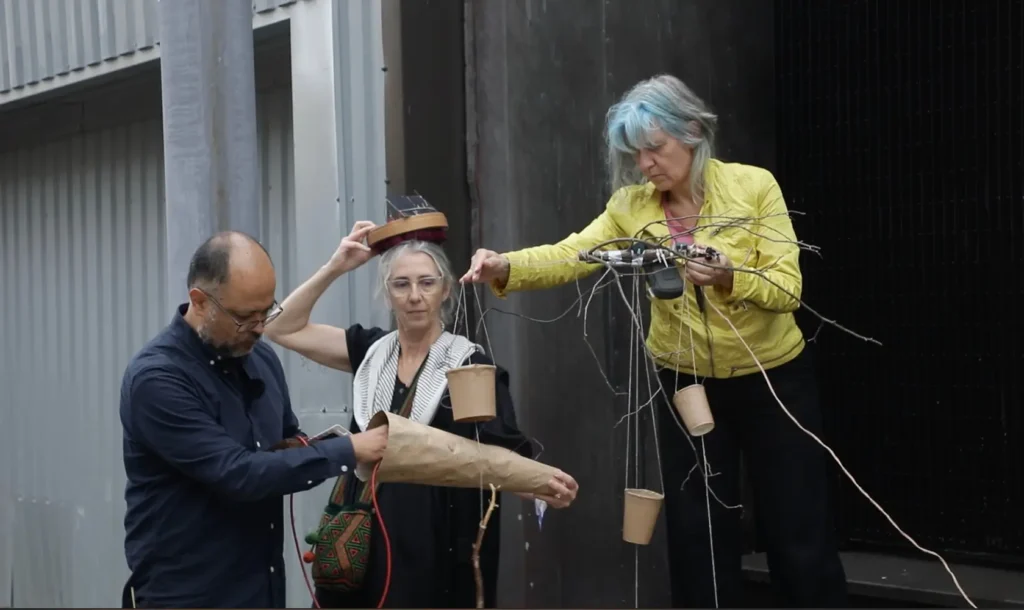
When the performance started, two of us stayed in the courtyard, while a third performer playing the Solar Trumpet fetched the audience from inside the building, leading the audience along the street and around the corner of the University building. In a couple of minutes, the group reached the courtyard where the two other performers were waiting with the Cup Harp and the Solar Box. After a short introduction and welcoming words, the performance unfolded over 30 minutes, with performers and audience members moving without delimitation of a stage, listening and sounding together with the environment. Each of the performers had a couple of custom-designed electroacoustic instruments harnessing solar energy to supply small amplification of audio signals produced through a simple analogue electronic circuitry interacting with light, humidity, touch, and gestures.
Instrument design and prototyping
The development of the following instruments has followed an iterative process in which practice, attentive listening, discussion, evaluation, and electronic tinkering continually inform one another. Each prototype has emerged through situated experimentation, responding to material constraints and insights gained in performance practice.
Design, materiality, and performance of the instruments
– Solar Trumpet
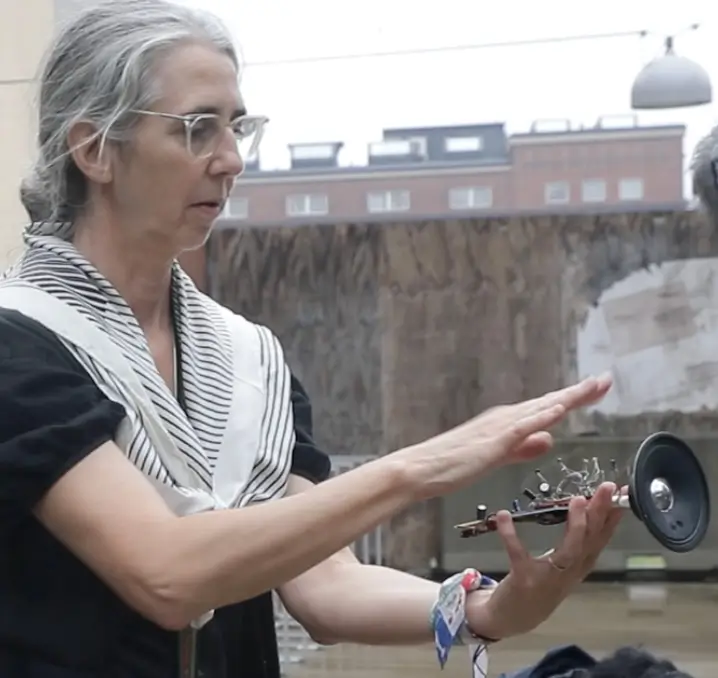
The Solar Trumpet is an electroacoustic instrument powered and modulated directly by sunlight. In direct sun the instrument produces a clear, brassy tone and it has the shape of a trumpet. A small loudspeaker suggests the bell, mounted on a handmade body of wooden chopsticks that support two solar panels and a set of interconnected oscillator circuits. Light dependent resistors function as valves: by shading them with the fingers, the flow of light is altered, producing changes in pitch, rhythm, and timbre.
– Solar Head Tray
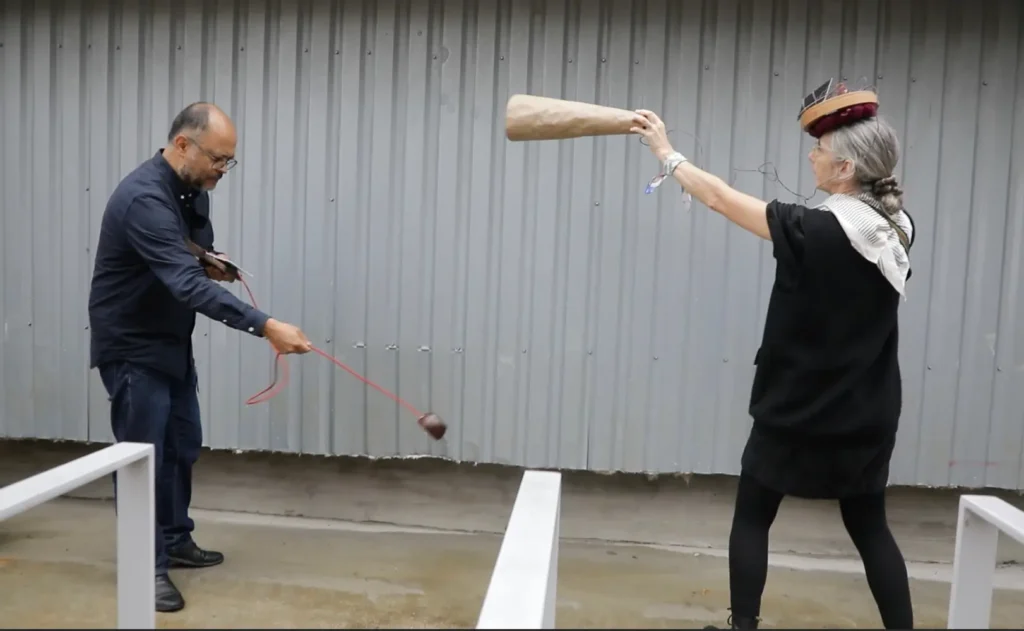
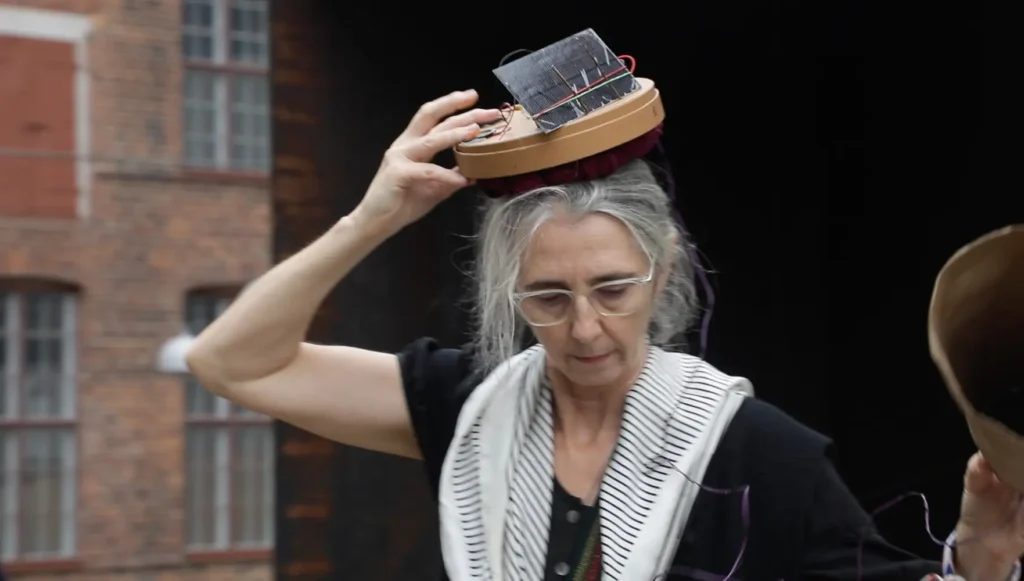
The SolarHead Tray is designed to be worn on the head, making the performer’s orientation toward the sun central to its sounding behaviour. The analogue circuit is mounted on a tray and offers several tactile points of interaction: one piezo element converts subtle pressure from a fingertip into electrical signals that alters the tone, while another piezo pair operates as an unstable switch, intermittently disrupting or cutting the signal. A small loudspeaker housed inside a “papier mâché” cone is held in the other hand, allowing the performer to spatialize and project the sound by moving the cone around the body. Performance therefore emerges from the coordinated movement of head and hands, with sunlight, gesture, and listening guiding each sonic event.
– Solar Radio Chess Board
The Solar Radio Chess Board contains a modified radio receiver whose antenna has been extended and exposed as a broken loudspeaker to enable performative interaction with surrounding electromagnetic fields. A small solar panel mounted on the board powers a minimal amplification circuit. By reorienting the panel toward or away from the sun, the performer modulates the available power and therefore the volume and character of the radio signal. Movements through space alter the reception of electromagnetic waves from nearby sources, causing fluctuations, crackles, interference patterns, and unstable tones. Playing the instrument becomes a matter of navigating invisible infrastructures of energy and communication, listening to the environment as it reveals itself through radio noise.
– Moisture Berimbau
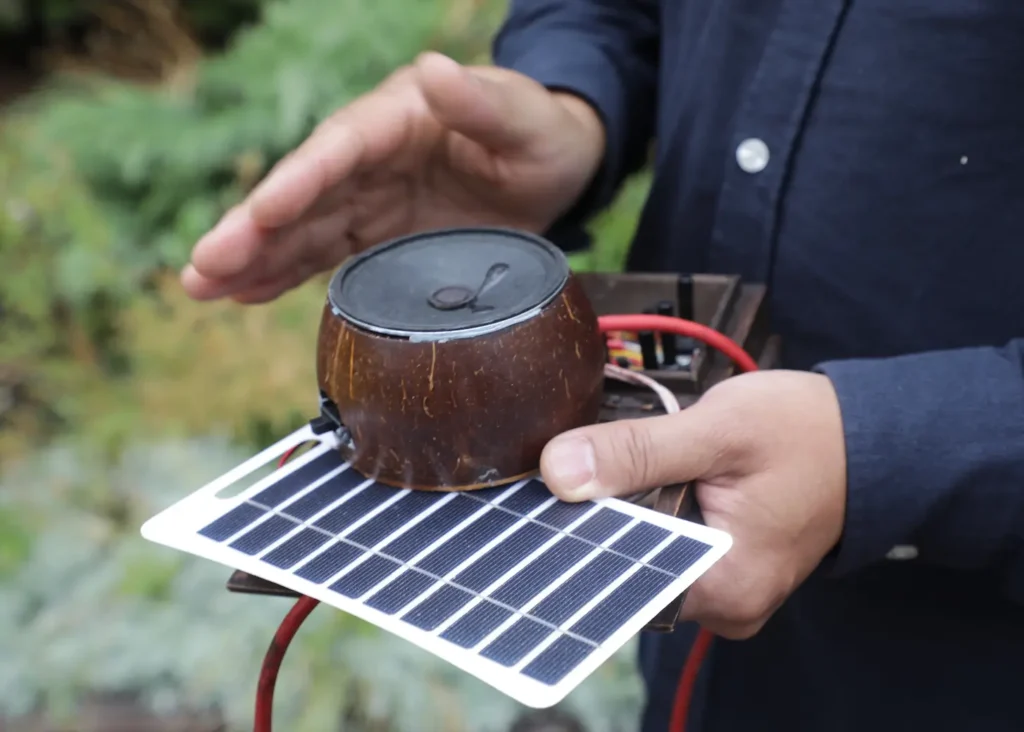
The Moisture Berimbau is an ongoing prototype inspired by the berimbau’s arched form and the use of a single tree branch as its supporting structure. A small loudspeaker housed in a hollowed coconut shell sits at the top, while a chain of miniature solar panels powers the oscillator and amplification circuits. A humidity sensor positioned at the base reacts to contact with soil, plants, or moisture from the performer’s fingers. The resulting sound fluctuates with environmental conditions, making the instrument especially sensitive to shifts in humidity and light.
– Pandora Solar Box
The Pandora Solar Box is a compact analogue synthesizer housed in a small wooden enclosure. Six light dependent resistors are arranged in a feedback configuration to modulate a set of CMOS oscillators powered entirely by a miniature solar panel. Performance occurs through controlling how much light reaches the photocells: the lid of the box can be opened, half closed, or shut to cast shifting shadows, and the instrument can be tilted or moved so the performer’s hand or body blocks the sun. As illumination fluctuates, the oscillators shift between stable tones and unstable bursts, a behaviour accentuated by the intentional starving of the circuit. The Pandora Solar Box exhibits variable sonic behaviour as it is exposed to changing light conditions.
– Feedback Coconut
The instrument operates using a feedback loop between a piezo contact microphone and a small loudspeaker installed inside a coconut shell. By pressing, sliding, or lightly tapping the piezo against the coconut shell or nearby surfaces, the performer alters the feedback path and shapes the resulting sound. Small variations in pressure, angle, and contact generate perceptible shifts in pitch, resonance, and timbre, making feedback control a matter of tactile sensitivity and attentive listening.
– Cup Harp
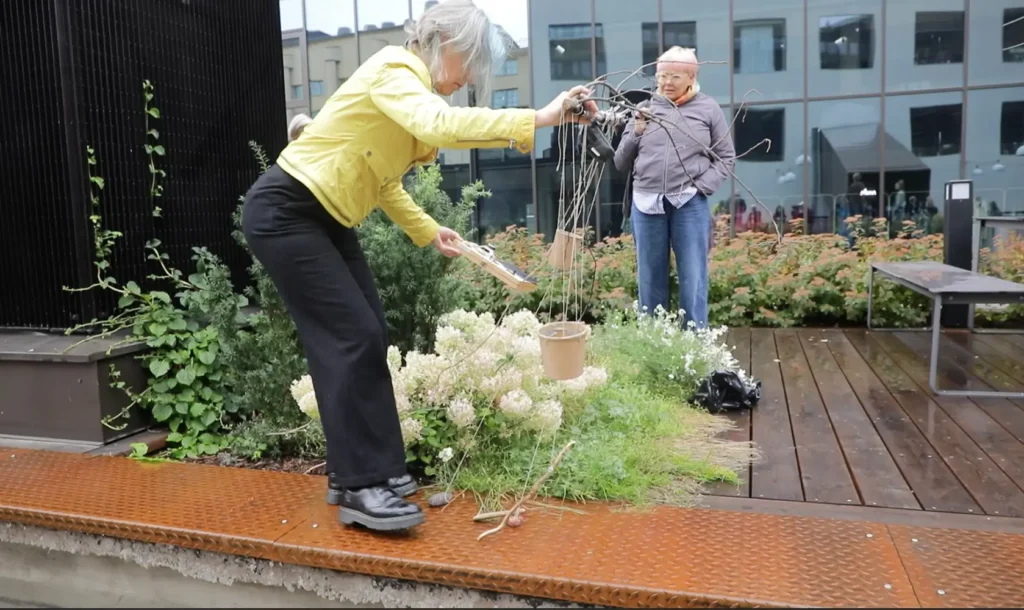
The Cup Harp is assembled from natural elements found along the shoreline, such as stones and driftwood, which are suspended from a tree branch using small ropes. A set of cups functions as resonators, amplifying the sounds produced when the elements rub against the ground or collide with one another. The vertical strings that hold the objects in tension give the instrument its harp-like character. The instrument is presently amplified with a small commercial speaker, pending the development of a solar powered version consistent with the rest of the instrument family. The friction transmitted by contact-mic gives rise to micro-variations and requires at this stage of the instrument’s development an amplifier that is too energy-intensive to operate with the low wattage solar panels. We look for solutions to reduce the use of batteries.
– Solar Crickets
The Solar Crickets are three small electronic modules assembled from hobbyist components and designed to resemble insects. Each module uses a compact eight-pin microcontroller to generate a single-pitch pulse-width modulated signal that is played directly through a piezo buzzer. The microcontroller runs a simple program that alternates between silence and brief, insect-like pulsations of equal pitch and duration, creating a basic routine of activation and pause. Powered by miniature solar panels, the modules operate autonomously and collectively, evoking the presence of a small technological fauna within the performance space.
Energy constraints and performative consequences
“Ecological art result from a dual awareness: that of a crisis in art and that of the ecological crisis. It also proceeds from a dual commitment that tends, on the one hand, to abandon a practice of art in order to define a new form of creation, and aims, on the other hand, to respect and defend the interrelations present in our environment […] the ecosystems in which the artists operate.”
(Weber 2020.)
The socio-ecological transition required to address the climate crisis has set part of the sound art and electroacoustic music community to question its societal role and the viability of its artistic practices. Within this context we drew up an artistic approach grounded in an essential restriction: to perform and create electroacoustic music without requiring to grid-supplied electricity. This approach led us to design specific instruments powered by low wattage solar panels. This self-imposed constraint challenges prevailing norms in our field, which are often predicated on energy-intensive technologies for sound amplification in particular, implying power relations structured on loudness.
Working with solar panels in Finland presents particular constraints for the development phase and the practice with these instruments: Cold and reduction of the daylight in winter-spring impacted our practice. Even in summertime we had to do with weather conditions. When it comes to performing with these instruments, the instability of these conditions causes the uncertainty of the performance. This added to the irregularity of the analogue circuits makes that all together the sounds of the instruments are particularly unpredictable. But with practice we develop a sense of their behaviours in various conditions.
Unpredictability and environmental influence
The instrument as interface
We here open the experience we got with each instrument during the summer period 2025 of our collaboration to describe the interaction between performer and instrument as an interface.
With the Solar Head Tray and Solar Trumpet between Earth and Sky
Playing the Solar Trumpet and later the Solar Head Tray opened on a whole dimension of attention relating to the presence of the sun. With these two instruments the relation with the sun implies an orientation of the body towards the sky. A feeling of being suspended-between earth and sky arises in this interaction. It feels like being rooted on the earth, still mobile, and in extension towards the sun, through the spine, through the atmosphere, traversed by the connecting line between Earth and Sun. Decoster-Taivalkoski reports: “Through this line passes energy, tying my body and the instrument as one. My sounding body-instrument moves and reveals the presence of this earth-sky axis, it reveals it for me the performer in an embodied way, it reveals it in the sonic sphere for listeners, and equally in the sphere of the visual through my movements”.
The Cup Harp, caressing the soil the earth
The instrument leads our attention on micro-events (the rubbing of a piece of wood on a stone) while simultaneously navigating, through our perceptions, within a larger environment (the passing of a tram, an airplane, interference from the setup of an open-air concert and level adjustments, the wind, a dog barking…). Producing slight sounds allows us to listen to the sonic milieu from which they emerge. Thus, it is less about producing sound than about inserting it into an existing continuum – about “accommodating” it (in the sense of visual accommodation). Furthermore, sound is used synesthetically: it calls upon touch, sight, the depth of space…
The Moisture Berimbau, sensing the microclimate of proximity
The Moisture Berimbau responds to both light and humidity. When held in the hands, small changes in moisture on the fingers and slight movements toward or away from the sun immediately affect the sound. The performer becomes aware of how their own body changes the local conditions around the instrument: the subtle evaporation of saliva on fingertips, the warmth of the hand, the changing exposure of its sensors to sunlight. The Moisture Berimbau can also be placed on the ground or near plants. In that situation, it continues to sound on its own, reacting to the dampness of the soil and the light that reaches it, following its own rhythm as the environment changes.
Listening practice
Acceptance of unpredictability as part of the artistic process
Maybe the topic of unpredictability ties in the question of de-escalation of loudness and dominance: giving-up part of the musician control over the instruments disturbs human centrality in showing what there is to listen to; finding ways of listening (here also as obeying) to non-human processes (sun-clouds-rain energies and movements). This phenomenon is experienced both by the performers and the audience.
The instruments rely on analogue circuits that do not behave in a fixed or fully predictable way. Although the electronics are logic and reproducible, each instrument reacts differently to light, humidity, temperature, changing air conditions, and the proximity of the performer’s hands, as well as nearby objects, other performers, and plants or trees. Variations in sunlight affect not only loudness but also the internal behaviour of the oscillators, altering tone and timbre. These fluctuations call for an active and responsive listening: the performer must continually cope with changes. Gestures arise from this ongoing negotiation, since the resulting sounds retain a degree of surprise that constantly reshapes the interaction.
Attentive listening as central to performance
The performance leads to attentive listening playing soft sounds moving around in the place, establishing no limits between audience and performers. Accepting the unpredictable aspects of our dispositif means that the musician is not controlling the instrument, but there is a sort of dialogue going on where musician and instrument are put at horizontal levels. And what is more, the understanding of connecting to a larger sphere of sounding agents arises. Human and more-than-human sonic presences are agents of the milieu of the performance and they are either sounding (birds, cars, ventilation, buildings reverberation, trams, steps, voices, clothes) or sounding through the instruments (sunlight, warmth, humidity, cloud).
To clarify the term milieu in this context, we refer to sociologist or phenomenologist approaches which distinguish “lieu” [place] from “milieu” where things co-exist in dynamic interaction. As De Certeau reminds referring to Merleau-Ponty’s phenomenology, “the essential structure of our experience of being is of being in relation to a milieu” (Certeau 1990).
We refer also to sound artist Elena Biserna:
“Considering milieus as fields of dynamic, temporary and processual relationships – as multiplicities constantly generated in relationship with our changing positions and behaviours – I am particularly interested in site-specific sound-making.”
(Biserna 2023.)
The very first part of the performance, the walk to the event place, is introduced by a short speech where the audience is invited to proceed in silence and connect with the sonic milieu. This moment frames the listening attitude promoted by our performance, attuning to the small sounds of our instruments interplaying with the rest of the sonic milieu. Even our own sounds (breaths, steps, clothes) are integrated in this musical texture.
Listening carefully to all details of sounds, overtones, grain, rhythms, harmonies and dynamics, continuities or disruptions, is an attention that electroacoustic musicians train. Also, soundwalk practice listening state opens awareness to all layers of sounds present at once and revealing presences in which ours as listeners or sound producers. The performance opens equally on listening to the relations of sounds in motion.
Such a highly sensitive state of attentive listening involves bodily attunement, imagination work, memories and affect. Drawing from the conversation with the audience, we suggest that this careful, respectful and holistic listening attitude gains the audience during the performance.
Paradox of producing sound to enhance listening
“For Merleau-Ponty (Phenomenology of perception, 1945), the body is a structure that itself structures the experience of the world: a system of systems devoted to the inspection of a world. It is most likely this very body, and first of all the question of its presence which makes the difference between art and science, if we consider their respective nature, methods and purposes” (Weber & Delsaux 2017). For the perception and neurophysiologists, our senses of perception function differentially. Our perception emerges from the gap between two pieces of information or two states of our body.
It is within the movement (of the body, of the group… even of thoughts) that our perception and our interpretation of experience are inscribed: for example the perception that it is indeed our foot (we suddenly remember it), is born from the vision of our foot on one step to the next step (Berthoz 1997).
Thus, a gap is necessary – the manifestation of an event – for us to perceive what surrounds us. It is because a sound emerges that our sonic environment suddenly comes alive. Failing that, we “forget” to listen and become deaf to our surroundings. We must practice listening, just as the audience is invited to do in a concert (which constitutes a real apprenticeship in listening) or be stimulated by an event to suddenly become keenly and attentively interested in our sonic environment.
There thus exists an active (“acting”) listening that could be described as paradoxical because it consists of disturbing what one wishes to hear in order to better perceive it. Similarly, there is an active (“acting”) and paradoxical presence that consists of feeling the environment one is in by “disturbing” it simply through one’s presence! Even in a concert, where the audience is accustomed to being silent and generally does not seek to interfere with the performers, the spectators, through the quality of their presence, modify the quality of the concert. Presence is never neutral.
For example, the Solar Crickets placed in the grass awake our attention to the rustling living world and that stones and branches dragged against the asphalt reveal the architectural and acoustic quality of the performance location. Listening and producing sounds generally develop an acuity of attention – to oneself and what one produces, but also to the other sonic (or silent: the audience) presences and to our interactions, that is to say, our coexistence.
Embodied performance and movement
Bodily movement and gestuality
“The performer seems to mobilise [their] body, to put it under tension to understand how [they are acted upon] by the environment, the context and public representation.”
(Weber 2018.)
Bodily movement and gestuality influenced by sound and environment
“Gestuality” is here understood as specifying a bodily language through the expressive qualities of movements. In general, we observed a particular slowness of displacement motions while tracing our paths in the courtyard. We suggest this slowing down is due to the attention to the sonic relations and the many subtle changes in the milieu which affects our bodily and sonic gestualities.
As an example, the sonic behaviour of the Solar Head Tray being sensitive to even very tiny modulation in the orientation of the head to the sun leads the head to finding freedom and fluidity of motion. The instrument’s sonic behaviour reveals the complexity of the head’s articulation and its capacities for micro and complex movements (rotations, translations, tilts). This enhanced mobility of the head once coordinated with the careful steps of the performer, may evoke the gestuality of a bird, like a chicken, a pigeon or a heron. Decoster-Taivalkoski says that performing with this instrument allows the emergence of a bodily empathy with the imagined bird species, where she feels a corporeal resonance.
The sonic presence of birds in the performance milieu is underlined through the performer’s gestuality and the sound of the Solar Head Tray. And vice et versa the action of the performer is impacted by the flying and sonic presence of birds.
Our instruments afford standing and walking, tracing many layers of paths and repositioning ourselves in the milieu aurally, topographically and in our interrelation. More intimately wavering occurs also in our identity as performer / audience member belonging to the performance milieu. This constant flow of traces, gestures and sounds emanating from all of us (human and non-human sonic agents) tie us in togetherness in the performative moment.
Corporeal empathy with the more-than-human
These instruments and the performance afford for approaching the human and more-than-human sonically, physically and emotionally through empathy in listening. For empathy to happen in the listening domain, we need the acceptance that we can share beyond the difference of listening points, listening organs, listening sensitivities.
Empathy in listening takes a corporeal dimension in this performance through a process of attuning to movements we hear in sounds, resonating to and moving with them. These vibrations act on us as impulse, thoughts, impression, bodily imaginary.
Repositioning and decentralization
Although the courtyard could have been easily shared in audience and stage zones, the intent was to avoid delimitation and allow porosity between positions and status. Each one is allowed to move freely, to explore various points of view or listening, follow someone, an instrument or any sonic presence, approach or take distance.
Despite the alternative listening modes explored in many sound art practices, audio reproduction in contemporary media and performance spaces is typically designed for an ideal listening position, or “sweet spot”. From stereo reproduction to surround formats, binaural listening, and complex spatial audio systems, loudspeakers are often optimized for a very narrow point of reception, where a coherent sonic image is delivered to a properly centred and immobile listener. Such configurations establish spatial hierarchies in which sound is projected toward a passive audience from a position of technical control (LaBelle 2010). In contrast, our performance with solar powered instruments produce sound that is inherently volatile in its projection and direction. Listening becomes distributed and malleable, depending on how each person moves in relation to others, to the instruments, and to the environmental conditions. Rather than reinforcing a centred listening paradigm, our practice diversifies the sonic experience and encourages a plurality of listening perspectives.
An impermanent milieu emerges to the forefront of the experience. Audience and performers may picture themselves more clearly as co-existing in harmony with all other presences, no will to dominate the sonic sphere, the whole sonic milieu has become meaningful in the musical act. Our performance aims at developing a practice of being in relationality. This stake is connected to Salomé Voegelin’s philosophy. She ties listening and the sonic thinking to knowledge:
“The sonic shows us the knowledge of human and more than human bodies from their invisible connecting, from how we sound together. It disrupts and rejects the distance of objectivity, relied upon in conventional knowledge frames. Instead, it insists on proximity and entanglements as the only condition to know the flesh and material body from.”
(Voegelin 2023.)
Link to video and audio excerpts of the performance: www.researchcatalogue.net/view/4035739/4035740
Collaboration wavering between places
Our collaboration process has been moving back and forth between France and Finland, taking the practice between the places we inhabit:
- From 2021 to 2024 in Helsinki with the design of a solar panel trumpet prototype by Alejandro Olarte, we expanded our explorative musical practice with performing gestures.
- In 2024, experiments with the trumpet were moved to France, initiating a collaboration with Pascale Weber. We invited each other to explore the place together through performance. Among the places are Eira Flower Parc, St-Mammès woods and riverbank, Töölö Bay Parc and shores, Mylly courtyard.
- In 2024 and 2025, we developed together an instrument family and gave two public performances in Helsinki.
Since the beginning of the process, the project is marked by the power of collaboration and the creative potential of geographical and cultural context shifting, that help us to invent our transition from anthropocentric to biocentric position.
Technology and de-escalation
Noise has historically been framed as an unwanted byproduct of industrialization, a sonic excess to be reduced or removed. In electroacoustic music this perception has been repeatedly challenged, with musicians featuring noise as material, expression, and critique (see Attali 1985; Russolo 1913; Schafer 1977; LaBelle 2006; Voegelin 2010). When relocated outdoors, noise acquires further ecological dimensions: it becomes inseparable of the sounds of the city, intertwined with traffic, hums, wind, human and non-human presences. Rather than treating these sounds as interference, our performance practice invites to integrate noise as a dynamic environmental agent that undeniably shapes the artistic outcomes. Energy variability, limited amplification, and sensitivity to atmospheric conditions enhance this integration: noise not as a controllable parameter inside insulated concert halls but as a partner in revealing the porosity between human and nonhuman agencies in sonic co-presences. Would then noise be contributing to the emergence of a performance milieu?
De-escalation, in this context, is more than a technical reduction of volume or a minimization of energy use; it is a reorientation of artistic and societal values in response to environmental (societal?) precarity. Performing and developing solar powered instruments, limited by the pace of clouds and the angle of the sun, enact a quiet refusal of a dominant industrial paradigm in which sonic power has often signified cultural legitimacy. In many modern and industrialized contexts, volume and amplification have functioned as markers of artistic authority and technological sophistication, from the monumental orchestras of the nineteenth century to the large-scale electroacoustic systems, public address infrastructures, and amplified popular music cultures of the twentieth and twenty first centuries. Against this lineage, in which over amplified sound frequently operates as a symbol of dominance with the militarized loudspeaker as one of its extreme manifestations, this practice turns toward what Stengers (2005) describes as an ecology of practices, where presence emerges through responsiveness rather than control. By scaling down, accepting vulnerability, and allowing the milieu to emerge, the performers seek a subtler and more relational way of engaging with each other, human and more than human. Such de-escalation resonates beyond artistic research. It gestures toward new modes of cohabitation in a fragile world, where reduced consumption, softened aggression, and redistributed agency become shared ethical and aesthetic pursuits. To perform quietly under the sun is not to renounce to technology, but to carefully recompose our place within the world: a hopeful act of remaining, transforming, and persisting alongside others, recognising that we are no longer the center from which music and sound emanate, and asking how we might relate through resonance rather than force.
Conclusion: Conversational audience encounters
In our dispositif, performers and audience members trace freely their own paths in the milieu and reposition themselves physically within it. Repositioning oneself within the performance milieu may open on possibilities for unconventional power structures, enter a sensorial understanding of horizontality between sonic presences, produce a feeling of perspiration between human and non-human living things. Within this line of perception-re-conception, our act of performing is perceived at times as creating sound for the environment rather than for the audience.
The proximity between the musicians and the audience favours an informal conversational exchange that takes place at the end of the event. Here is a selection of four quotations taken from the transcript conversation. Each of these quotations allows us to revisit points discussion in this papier:
“We were just somehow invited to be present.”
(Audience intervention n°1)
The performance primarily offers a sensory experience: becoming present to the location through a heightened and semi-guided perception (via acoustic interventions), as well as through a practice of listening to the environment in which the performance takes place.
“[…] at moments it was like you were dancing or […] wonderfully chicken-like, it was really beautiful, but maybe it was just because you were playing the instrument or were you dancing as well?”
(Audience intervention n°2)
Immersion in this environment is a synesthetic and holistic experience; the entire body of both the performers and the audience members is engaged – it wanders, strolls, touches the rough wall, observes the shadow on the wall, listens to a car in the street. The body moves harmoniously through space and the sonic continuum. Moreover, the instruments induce a particular gestural quality, and any movement that is applied and calibrated to a sound production falls under a form of dance.
“I felt like on many occasions you weren’t performing for us […] that you were actually making sound for the environment and the other species.”
(Audience intervention n°3)
Performance art is experiential and consists of collectively living a situation in a particular context. This collective aspect includes the more-than-human. Thus, the performance is not directed exclusively toward the audience but toward all presences within the performance environment.
“I had this feeling that what you had in your hands were kind of organisms with their own will. So that made me feel like you’re all the same ego somehow. This felt without control. If it would be an instrument, you would be more like controlling it.”
(Audience intervention n°4)
This acoustic proposition therefore does not consist of a demonstration of virtuosity, but rather an awakening to the commons and an opening toward otherness. The performance is part of a critical ecological perspective and questions both the place of the human in the urban performance environment and the place of electronics and technology in sound creation.
References
Attali, Jacques. 1985. Noise: The Political Economy of Music. Translated by Brian Massumi. Minneapolis: University of Minnesota Press. Originally published 1977.
Berthoz, Alain. 2000. The Brain’s Sense of Movement. Translated by Giselle Weiss. Cambridge, MA: Harvard University Press. Originally published as Le sens du mouvement (Paris: Odile Jacob, 1997).
Biserna, Elena. 2023. “Walking and Narrating Sound Borderscapes: An Experience in Hong Kong.” In Soundwalking through Time, Space and Technologies, edited by Jacek Smolicki, 215–228. New York: Routledge.
Certeau, Michel de. 1990. L’invention du quotidien. 1. Arts de faire. Paris: Gallimard.
LaBelle, Brandon. 2006. Background Noise: Perspectives on Sound Art. New York: Continuum.
LaBelle, Brandon. 2010. Acoustic Territories: Sound Culture and Everyday Life. New York: Continuum.
Russolo, Luigi. 1913. The Art of Noises. English translation, New York: Pendragon Press, 1986.
Schafer, R. Murray. 1977. The Soundscape: our sonic environment and the tuning of the world. Ontario: Arcana Editions.
Stengers, Isabelle. 2005. “The Cosmopolitical Proposal.” In Making Things Public: Atmospheres of Democracy, edited by Bruno Latour and Peter Weibel, 994–1003. Cambridge, MA: MIT Press.
Voegelin, Salomé. 2010. Listening to Noise and Silence: Towards a Philosophy of Sound Art. New York: Continuum.
Voegelin, Salomé. 2023. Uncurating Sound: Knowledge with Voice and Hands. New York: Bloomsbury Academic.
Weber, Pascale, and Jean Delsaux. 2017. “The Experiencing Body: For a Combination of Movements.” In Aesthetics and Neurosciences: Scientific and Artistic Perspectives, edited by Zoi Kapoula and Marine Vernet, 221–34. Cham: Springer.
Weber, Pascale. 2018. “The Body as Creation: Sensitive Adjustments between Presence and Representation.” TK-21 La Revue 84–85.
Weber, Pascale. 2020. “Modulation as an Ecological Principle: Performing on the Motif.” Plastik: Art et Écologie.
Contributors
Marianne Decoster-Taivalkoski
Marianne Decoster-Taivalkoski, lecturer and doctoral researcher. Electronic musician, interactive media and sound artist born in France, based in Helsinki since 1993, her artistic research activities deal with movement-sound relationships through creation of interactive sound installations, performances involving spatial audio techniques, and field recordings in motion. Within this practice her doctoral research investigates migration and identity building in flux, relationality and positioning in sonic worlds with a phenomenological attention to the lived experience of listening and performing outdoors. The performance presented at CARPA9 was initiated by her doctoral project People and sound constellations in flux, artistic research on migration-transposition-adaptation process through sonic arts creation (2022–2026).
Alejandro Olarte
Alejandro Olarte lecturer and head of department, Uniarts Helsinki, Sibelius Academy, Centre for Music and Technology (MuTe), alejandro.olarte(at)uniarts.fi, is an electroacoustic musician, researcher, and educator, serving as the Head of the Department of Music Technology at the University of the Arts, Helsinki. He holds a doctorate in live electronics and pedagogy, with degrees from the National Conservatory of Paris and a Master’s in Computer Music from the University of Paris. His work explores sound and its artistic applications through technology, examining its opportunities and challenges in everyday life. Dedicated to education, Olarte advocates for knowledge exchange as a driver of societal progress, supports artistic research through sound and musical practice, and has a strong interest in modern instrument design.
Pascale Weber
Pascale Weber, professor, Université Paris 1-Panthéon Sorbonne, École des Arts de la Sorbonne (EAS) – Centre St Charles, Pascale.Weber(at)univ-paris1.fr, PhD (2001), trained first in environmental design in Paris (École Supérieure de Design Industriel), then studiedArt and Art Sciences at the University Paris 1 Panthéon-Sorbonne (Centre St Charles), where she is professor responsible for the programme in Performance at ACTE research institute. Her general research theme is soma-aesthetics and geo-poetics: contemporary rituals. In addition to performance art, she practices Butoh dance, GIM (Guided Imagery and Music) and other Daydream journeys, vocal techniques derived from joik, throat singing or diphonic singing and, among somatic disciplines, the Feldenkrais method. She is the other member of the duo Hantu.