Introduction
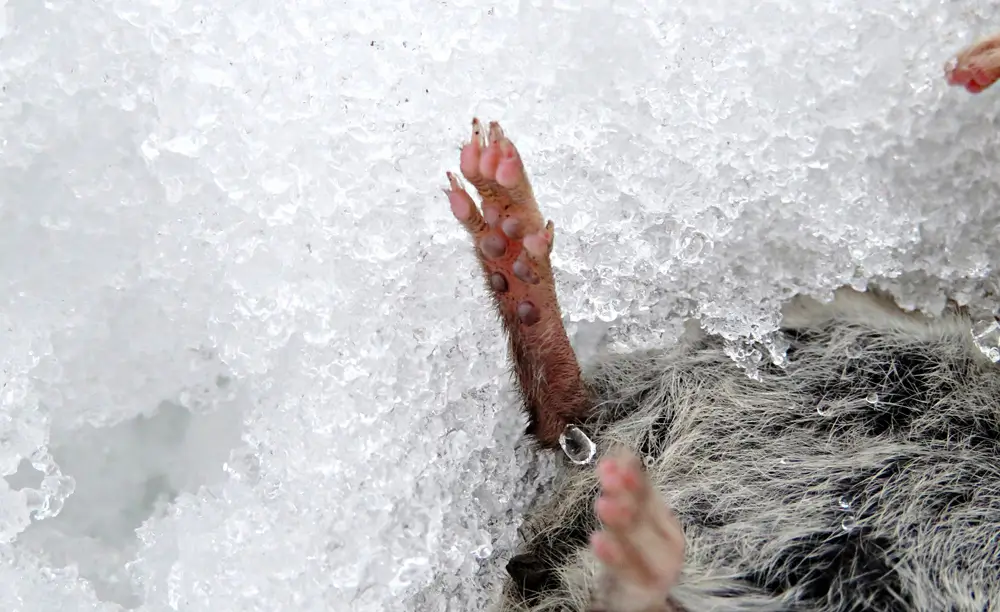
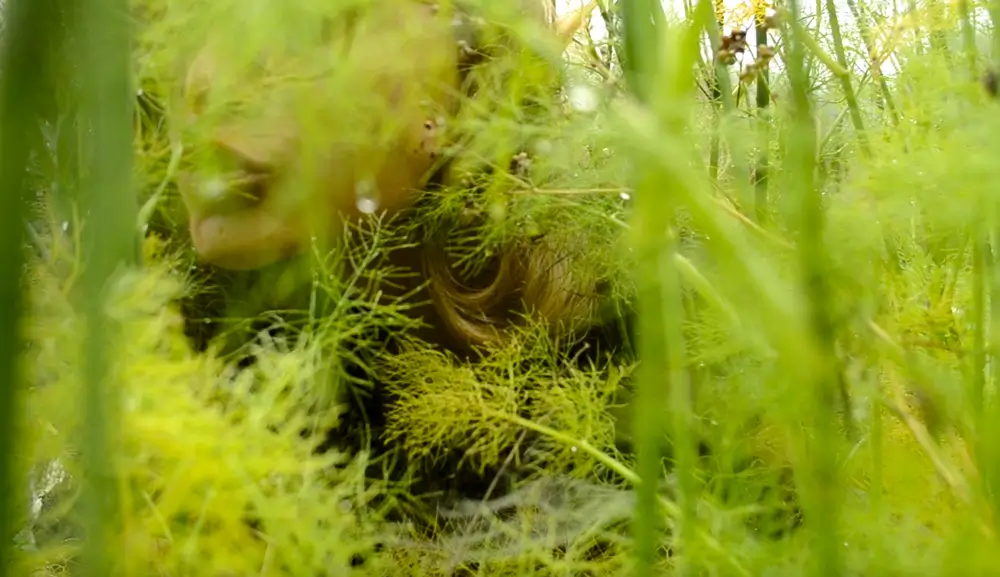
Tap Dancing With Moles deals with the garden as eating and touching situations, the observation of which started when the moles moved into the garden. What happens when moles and humans eat the same roots? For some reason, I wanted to tap dance in the garden. Later, I heard that moles actually are afraid of vibration. I saw the minimal bumps on the paws of a dead mole. Since then, I have admired them; do they dig long cavities in the clay with those tiny paws and microbe-sized nodes and claws? Sharing food with moles has revealed their abilities, their abilities to live within the soil, and the soil’s abilities. Later, I’m worrying when I haven’t met the moles for a while. The gestures of expulsion turned into gestures of invitation.
10.10.2020
Will the moles drown in that heavy rain?
21.4.2021
As I sat by the lodgepole pine, a mole came out of somewhere,
on top of the soil, rustling
from a pile of roof tiles towards the rhubarbs
Why did the mole walk on top of the soil?
Not within it. I guess it’s easier on top than on the inside.
Garden as a centre for multispecies knowledge production
When moving to the new place, I started to familiarize myself with the environment and its dwellers by gardening. My corporeal existence in the garden began to be based on kinesthetic empathy. When it rained, I wondered what it was like for a mole’s body. As I pulled the root vegetables out of the ground, I pondered what it would feel like to be a root and be surrounded by such compact soil for months and yet displace it with its own growth. How do seeds clear space for their growth in the ground? My corporeal relationship with the garden began to play a larger role. I was paying attention to what I was touching, and what effects it had on me, other living things, non-living things, and something in-between. And what or who, or which material, touched me. To garden is to be in touch with various materials and creatures.
Actually, I was interested in microbes and their functions in the garden. I was preparing a research plan for a dissertation in Sociology, and I thought it through while gardening. However, moles somehow stole the show. Gradually, it became clear that the moles were managing the area by eating the root vegetables “we” had grown. Also, they were mowing the soil all around. More came, and more, they swam from the nearby ditch and, of course, did not drown in the pouring rain, but swam deeper in the garden. Anyway, by observing moles, I got closer to the soil, where the microbes also live and do their stuff.
I started writing notes about the garden. They eventually became a bunch of poem-like texts, a collection called Myyrän (k)arvoitus (Mole’s Mystery/Mole’s Hair…not to be translated with my language skills). I also found myself shooting videos. It evolved into a video performance, Myyränkarkoitussteppi (Tap Dancing with Moles). A plan for a dissertation was also created, in which the moles gave way to the microbial relationships in the garden. In a way, I was tracking what can be understood by gardening – what kind of multispecies knowledge is accumulated in the process.
22.4.21
I threw a stone into a pond, followed by bubbles
How do moles breathe within soil?
Do they hold their breath while diving?How does a mole’s body experience vibration? (How about microbes?)
It is claimed that the moles are afraid of vibration
How does a mole’s body experience sounds? As massive as me?
I don’t think the moles are disturbed by the sounds of cars.
What do the sounds of cars sound like underground?
Can I record subterranean sounds?
Can I shoot underground?
Can I imagine an inner life of soil?
water
Some know how to move within the soil.
With the aid of an assistive spade, I may be moving within the soil, otherwise only on top of itHow does a dance foot thump sound underground?
Does it tickle? Why is it scary? Does it hurt?
The mole is a bit like a microbe
Neither of them shows a glimpse.
Yet their being is reflected in all around, almost.
Signs and traces
Their lives are reflected in others.
(whose lives are visible through me?) (whose existence?)
Do we need to appear to exist
Have they made a drum of me to echo their whispers?
Eating as a way of touching
What came apparent with moles and gardening in general is eating and its material character. Eating draws us all to the common resources of our ecosystems: eating is intertwined with soil (Bellacasa 2017, 23), which could be noticed in the garden directly, as multispecies eating happens within the soil. Eating has been characterized as the creation of practical material relationships with the world (Heitger et al. 2021, 37).
Touches are chained in the processes of eating. Touching is listening and understanding, communicating with the material world: knowing and nurturing, responsibility. After picking, I bathe the root vegetables thoroughly, chop, cook, and eat: I touch non-human bodies before they are microbially decomposed into my body, i.e., become me. Eating is intimate touching, touching is intimate knowing (Bellacasa 2017). Touch brings out an endless number of other beings, other species, and other times (Barad 2012, 206): that’s why I want to pay attention to what we touch daily, and why. More broadly, we touch our bodies all the time (Bellacasa 2017, 19).
23.5.2021
Contact Improvisation with Moles
We alternately touch different parts of the garden
Trying to mark them as our territory?
or just touching, we do some procedures to sometimes eat something
Maybe the mole won’t try to own soil, but I accidentally interpret it that way
(Hidden play; did you notice I touched this?)
In the garden, I follow material non-human bodies by touch. The project began by trying to track microbes in the garden. Attempts to find invisible microbes led to something else: microbes became a method to understand the tangible relationships of the garden and the body’s ability to communicate.
Touch makes our bodies more than one, as it is impossible to touch without being touched by ourselves (Kinnunen & Kolehmainen 2019). What we want to touch in the garden and what we don’t can tell us about our latent attitudes towards matter and actors. By touching, we are microbially connected; the touch is kind of a highway for microbes to move from place to place and to form collectives. Every touch also changes the microbiome (Fragiadakis et al. 2018). Thus, it does matter what we touch: in touch, invisible connections are formed between the non-human, the environment, and the human. Among other things, microbes in the body affect emotions and take care of our physical and mental health (Evrensel & Ceylan 2015). Is “my” microbiome a mix of all the agents in the garden that I touch? Are we a collective body, holobiont? The transformation of biological identity from individual to plural can change the perception of a human as a distinctly bounded being with the inside and the outside of the body, and change the perception of the body into a more porous, continuous interaction and co-formation with non-humans and human beings.
Tracking the touches to invisible actors like microbes, or quite fast actors like moles, has been enriching the way I understand relations in the garden. Stalking moles, but especially microbes, i.e., trying to observe them and looking for traces or signs of them, has resembled the profession of a spy, enjoyably. The practice of spying has made my body more alert to subtle cues in the garden. The observation of the moles’ routes led to viewing the garden through a cycle of water, as the moles arrived along the water route from a nearby ditch. The water cycle, on the other hand, awakened to understand the clayiness and compactness of the soil, and encouraged, for example, to grow long-rooted plants, such as broad beans, and to mulch the soil into a suitable habitat for microbes. So observation chained up and complex networks of relationships between plants, moles, water, soil fungi, bacteria, and worms, my body, etc., began to dawn. I pondered my own involvement in the ecosystem.
18.10.2021
first, I touch the seeds, to put them in the ground
Touching soil, plucking weeds, mulching the soil
then, when collecting, it’s about picking up the root itself: parsnip potato carrot, etc.
and then washing them in the muddy water in the garden
and then still finishing the rinsing indoorsand then chopping
rootstocks are broken down into bokashi compost
Compost material is pressed tighter with a palm
and bokashi flour is sprinkled on top
and then plucks from the hands the so-called everything away by rinsing the hands
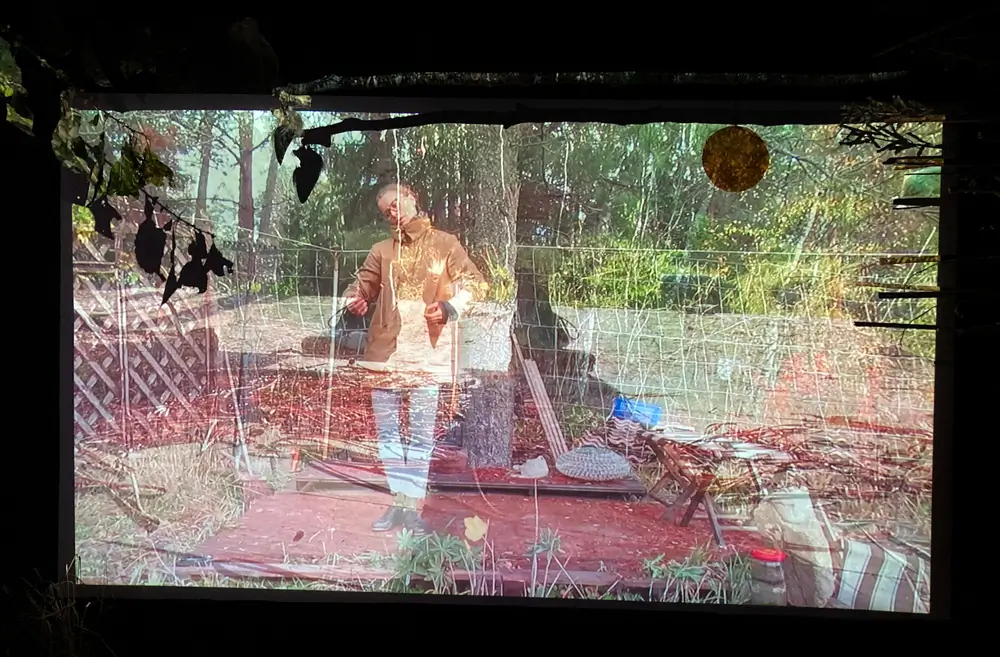
And when you do that whole choreography, it takes easily an hour searching for food and cooking
And, picking all the salad ingredients with the same formula, mangolds celery sages marigolds carrots and parsley, and welsh onions throughSo I have practically touched everything I’m going to eat.
and I have bathed them,
touched on many different occasions, passed alternately through all their bodies
Using water to wash the soil away because a microbe in the soil can cause chaos in the stomach.
or sand in the toothi.e., those microbes contribute to this choreography, this choreography of purification the matter for the body to eat, the chain reaction of touching?
and then still transport them all through the saliva, the lips, with the esophagus
through the mouth, tongue, the intestines.
The series of inner touches continues
and microbes and food fuss around in the intestines
then still push the poop out of the bowelthen finally still deals with the mass and puts it into post-composting
then still carrying it to various places in the garden for final nourishment
I wash away the environment from the roots
Or their relationship away.
Somehow it needs to be reduced.
before a human can eat it
I wash the conditions away.
not the dirt itself.
In this project, all understanding began with touch. Or to pursue it. I haven’t touched the mole much. I haven’t touched the microbes, I mean, I have, all the time. I have touched the earth and the plants, the soil, the roots, the dung, the water, the bushes, the trees, the stones, the tiles, the gauze, the plastic pots, the wind, the air, the roast, the snow, the heat, and the wind. Or have been touched by them.
I have touched things from the outside, through the skin of my body.
Then I touched many plants on the inside, eating.
Gardening revolves around eating. Eating is a continuous process of mixing. Non-human and human end up being not-so-human. And through eating, I began to think of the soil as a potential, a massive amount of potentiality materialised as soil.
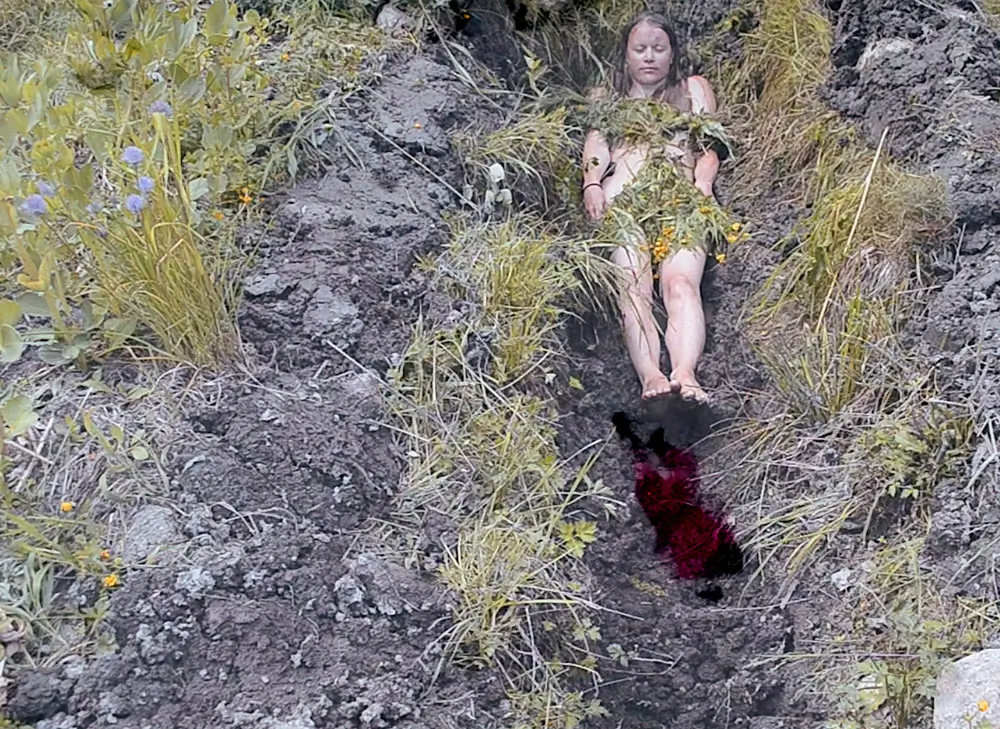
I was kind of jealous of the moles and other creatures living within the soil. I also wanted to be touched by soil, to feel it all around my body.
References
Barad, Karen 2012. “On Touching – The Inhuman That Therefore I Am”. Differences: A Journal of Feminist Cultural Studies 25(3): 206–223.
de la Bellacasa, Maria Puig. 2017. Matters of Care. Speculative Ethics in More Than Human Worlds. Minneapolis: University of Minnesota Press.
Dinan, T., R. M. Stilling, C. Stanton, and J. F. Cryan. 2015. “Collective unconscious: how gut microbes shape human behavior.” Journal of Psychiatric Research 63: 1–9.
Evrensel, A., and M. E. Ceylan. 2015. “The gut-brain axis: the missing link in depression”. Clinical Psychopharmacology and Neuroscience 13(1): 239–44. doi.org/10.9758/cpn.2015.13.3.239.
Fragiadakis, Gabriela K., Samuel A. Smits, Erica D. Sonnenburg, William Van Treuren, Gregor Reid, Rob Knight, Alphaxard Manjurano, John Changalucha, Maria Gloria Dominguez-Bello, Jeff Leach Justin L. Sonnenbu. 2018. ”Links between environment, diet, and the hunter-gatherer microbiome”. Gut Microbes 10(2): 216–227. doi.org/10.1080/19490976.2018.1494103.
Greer, Renee, Xiaoxi Dong, Andrey Morgun, and Natalia Schulzhenko. 2016. “Investigating a holobiont: Microbiota perturbations and transkingdom networks”. Gut Microbes 7(2): 126–135. doi.org/10.1080/19490976.2015.1128625.
Heitger, Anna, Sabine Biedermann, and Jörg Niewöhner. 2021. “More-Than-Human Eating: Reconfiguring Environment | Body | Mind Relations in the Anthropocene”. Berliner Blätter 84(Juni): 35–48.
Kinnunen, Taina, and Marjo Kolehmainen. 2019. “Touch and Affect: Analysing the archive of touch biographies”. Body & Society 25(1): 29–56.
Other sources
Oona Leinovirtanen 2022. Tap Dancing with Moles. Double-channel videoperformance, 24min.
Oona Leinovirtanen 2020–2022. Myyrän (k)arvoitus. A collection of poems (Finnish), unpublished.
Contributor
Oona Leinovirtanen
Oona Leinovirtanen is a multidisciplinary artist and PhD student in Sociology at the University of Turku. Leinovirtanens’ PhD deals with the relationships between soil, microbes, and humans in Permaculture gardening. She is part of The Center for Social Study of Microbes (CSSM, University of Helsinki), where she worked as an artist in 2023, creating a video performance about the microbial agency of the body, improvisation, and gut feelings. Art and science sometimes intertwine, sometimes compete. The garden works as a studio and colleague for her. Her dream is to move less in an upright position.